All species › Woodpeckers and allies › Woodpeckers › Golden-naped Woodpecker
Position in the tree Birds Aves › Birds with a flexible palate Neognathae › All other modern birds Neoaves › Landbirds Telluraves › Raptors, owls, kingfishers and woodpeckers Afroaves › Mousebirds, rollers and woodpeckers Coraciimorphae › Trogons and cavity nesters Cavitaves › Hornbills, kingfishers and woodpeckers Picocoraciae › Kingfishers, bee-eaters and woodpeckers Picodynastornithes
Golden-naped Woodpecker | Melanerpes chrysauchen
Goudnekspecht | Carpintero nuquidorado
The Golden-naped Woodpecker is a small, boldly patterned woodpecker with a restricted range in the Pacific lowlands and foothills of southern Costa Rica and western Panama. It lives in pairs or small family groups in the canopy of humid forest and several birds roost together in a tree cavity. It is closely related to the Black-cheeked Woodpecker of the Caribbean side.
Voice
A rattling, rolling churrr and a repeated krrrt, also given by groups. It drums in short bursts.
Recording: Johan Chaves — CC BY-NC-SA 4.0 · converted to mono · xeno-canto
Identification
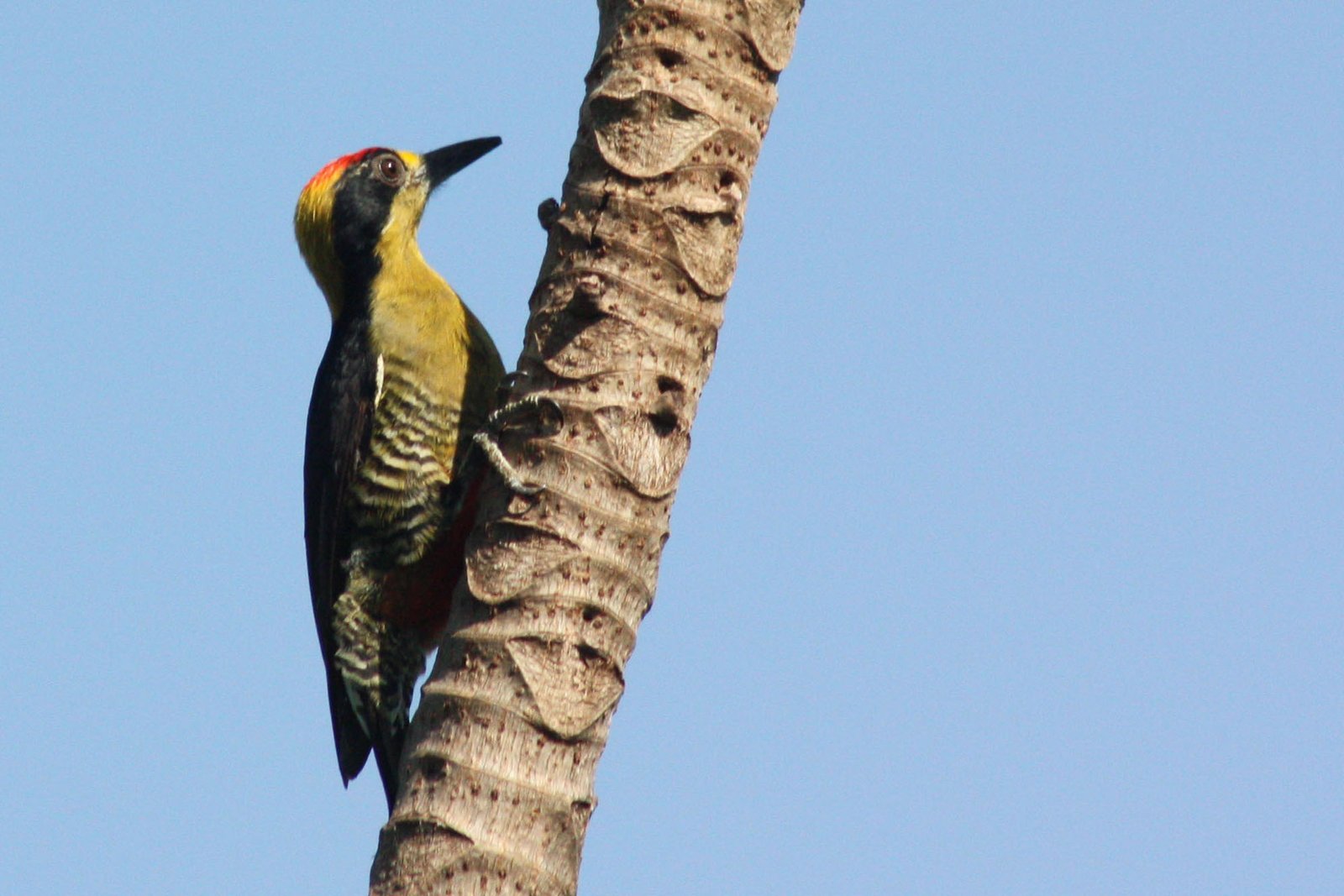
17–19 cm. A black mask runs from the eye to the nape; the forehead and nape are golden yellow. The male has a red crown between the yellow forehead and yellow nape, the female a black crown. The back is black with a broad white central stripe, the wings are black with fine white barring and the rump is white. The throat and breast are olive grey, the centre of the belly red and the flanks barred black and white.
Confusion species
Black-cheeked Woodpecker Melanerpes pucherani occurs only on the Caribbean side and has a black-and-white barred back without a white central stripe and a red nape. Red-crowned Woodpecker Melanerpes rubricapillus, common in open country in the same area, has a barred back, a pale head without a black mask and buffy underparts. Hoffmann's Woodpecker Melanerpes hoffmannii of north-western Costa Rica resembles Red-crowned Woodpecker, with a yellow nape.
Habitat
Humid lowland and foothill forest up to about 1500 m, tall secondary forest, forest edges and open ground with large dead trees next to forest. It searches the canopy for insects and also eats much fruit. It nests in dead trees, often high above the ground, and young from an earlier brood sometimes help raise the chicks.
Where the bird is most at home, classified by the vegetation units of Mexico and Central America.



Range and movements
Pacific slope of Costa Rica, from about Quepos and the Valle de El General south across the Osa Peninsula and along the Golfo Dulce to the Panama border. In Panama in western Chiriquí, where the species has declined sharply through deforestation and is now rare.
- Resident
- dark = core range, pale = thinly spread
How and when to look
Common on the Osa Peninsula, for example at Corcovado, and in the forests around the Golfo Dulce, such as at Piedras Blancas. Dead trees at the forest edge are often used as lookouts and nest trees and are the best places to wait.
Conservation status
Not threatened. Its range is small and deforestation has reduced it, above all in Panama, but it is common in the protected areas of southern Costa Rica.
Scientific name
Melanerpes chrysauchen | Salvin, 1870
Salvin described the species in 1870 and placed it straight away in the genus where it still stands. The genus Melanerpes was introduced in 1832 by Swainson. Melanerpes is Greek, from melas 'black' and herpēs 'creeper': 'black creeper'. chrysauchen is Greek, from khrusos 'gold' and aukhēn 'neck', after the golden-yellow nape. The specimen the first description was based on came from Bugaba (Chiriquí), Panama.