All species › Passerines › Kinglets › Golden-crowned Kinglet
Position in the tree Birds Aves › Birds with a flexible palate Neognathae › All other modern birds Neoaves › Landbirds Telluraves › Falcons, parrots and passerines Australaves › Falcons and passerines Eufalconimorphae › Parrots and passerines Psittacopasserae
Golden-crowned Kinglet | Regulus satrapa
Amerikaanse goudhaan | Reyezuelo de oro
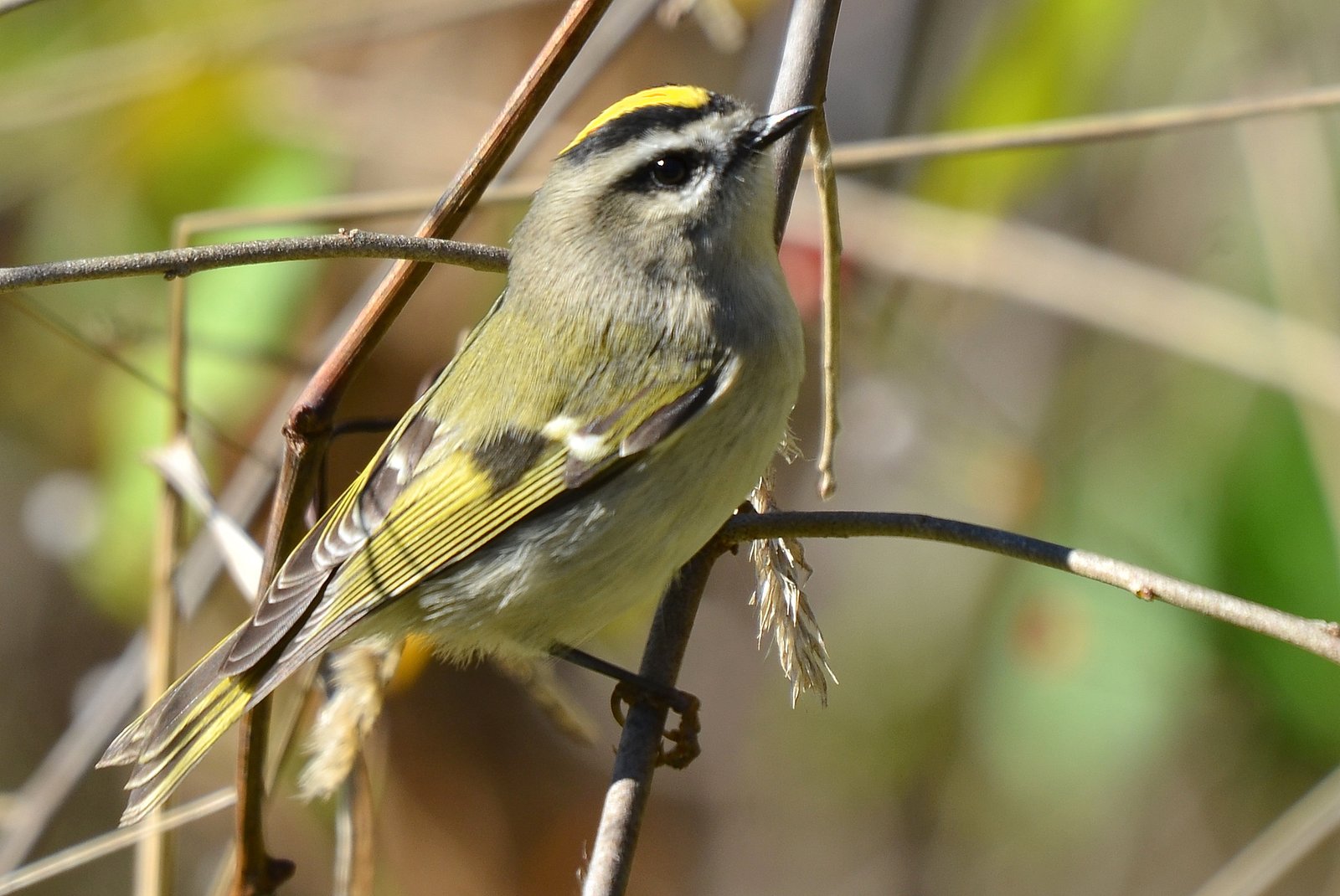
The Golden-crowned Kinglet is one of the smallest songbirds of the guide area, with a striped head and a yellow crown. A resident population lives in high-elevation conifer and pine-oak forest in Mexico and Guatemala, where it moves in small groups high in the trees.
Voice
Very high, thin calls, tsee-tsee-tsee, often in a short series and barely audible to many people. The song is a series of high notes ending in a fast, descending chatter.
Recording: Greg Irving — CC BY-NC-SA 4.0 · converted to mono · xeno-canto
Identification
9–10 cm. Crown yellow, with an orange centre in the male, bordered on each side by black. White supercilium and black eyestripe. Upperparts olive-green, underparts dingy white to greyish. Two white wing bars with a dark band behind; flight feathers edged yellow. Bill short and thin.
Confusion species
Ruby-crowned Kinglet Corthylio calendula lacks the striped head and has a broken white eye-ring. Crescent-chested Warbler Oreothlypis superciliosa also has a white supercilium but is larger, with a grey head, yellow throat and breast, and a chestnut breast band.
Habitat
High-elevation conifer forest with fir (Abies) and pine, also montane pine-oak forest, mostly above 2000 m. It gleans small insects and spiders high in conifer crowns, often in small groups together with chickadees and other songbirds.
Where the bird is most at home, classified by the vegetation units of Mexico and Central America.



Range and movements
In the guide area in the higher mountains of Mexico, from the Sierra Madre Occidental and the Trans-Mexican Volcanic Belt to Oaxaca and Chiapas, and in the highlands of Guatemala. Northern birds reach northern Mexico in small numbers in winter. Outside the guide area in Canada, Alaska and the United States.
- Resident
- Winter visitor (c. Oct–Mar)
- dark = core range, pale = thinly spread
How and when to look
The best chance is in high fir forest, for example on the high volcanoes of central Mexico. Listen for the very high calls in the treetops.
Conservation status
Not threatened. Widespread in North America; the population in Mexico and Guatemala is confined to high-elevation conifer forest and is therefore local.
Scientific name
Regulus satrapa | Lichtenstein, 1823
Lichtenstein described the species in 1823 and placed it straight away in the genus where it still stands. The genus Regulus was introduced in 1800 by Cuvier, GLCFD. Regulus is Latin for 'little king', a diminutive of rex 'king', after the golden crown stripe. satrapa is from Greek satrapēs 'satrap, Persian provincial governor', after the orange-yellow crown worn like a ruler's headdress. The specimen the first description was based on came from North America (not specified further).