All species › Waterfowl › Ducks, swans and geese › Eurasian Teal
Position in the tree Birds Aves › Birds with a flexible palate Neognathae › Fowl Galloanserae
Eurasian Teal | Anas crecca
Wintertaling | Cerceta común
The Eurasian Teal is the smallest dabbling duck of the guide area, a compact little duck that flies in fast, agile flocks. The birds in Mexico and Central America are winter visitors from North America and belong to the American form, Green-winged Teal, which is sometimes treated as a separate species. In northern Mexico and on the plateau it is one of the commonest ducks.
Voice
The male gives a clear, piping whistle, kreek, often repeated and swelling into a chorus in flocks; the female a high, sharp quacking in a short, descending series.
Recording: Stanislas Wroza — CC BY-NC-SA 4.0 · converted to mono · xeno-canto
Identification
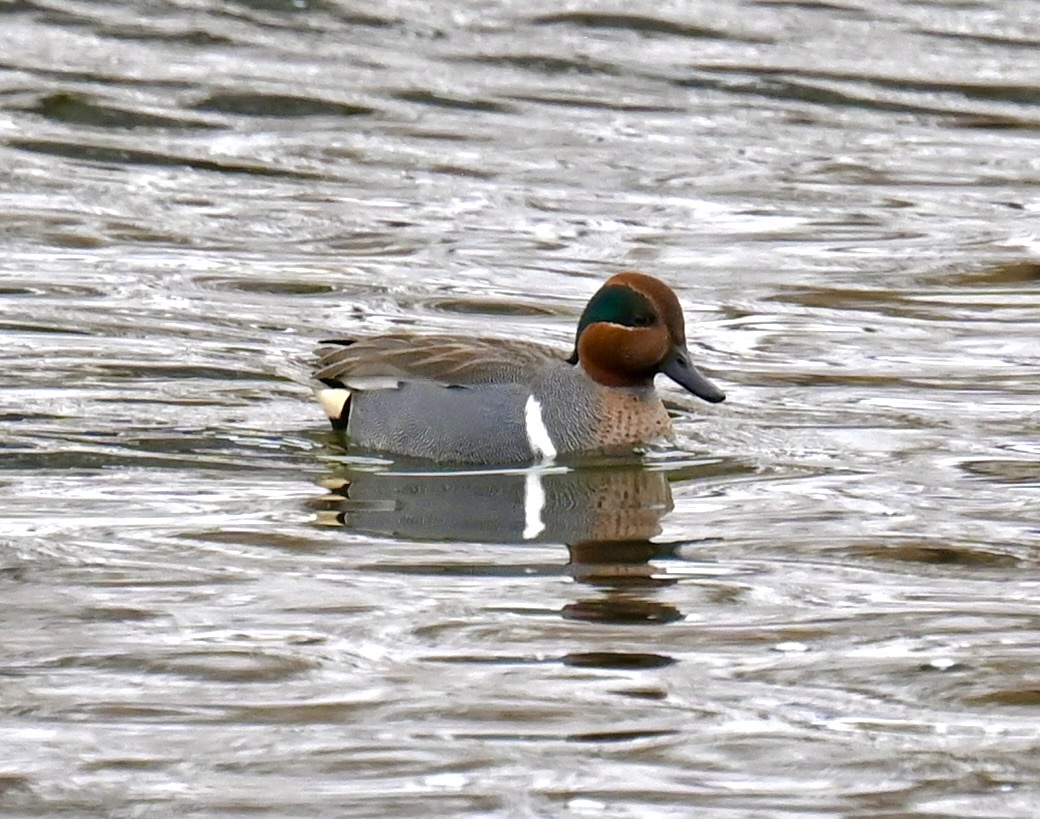
31–39 cm, small and compact, with a short bill. The male has a chestnut head with a broad, glossy green band from the eye to the nape, finely edged cream, a speckled cream breast, a grey vermiculated body with a vertical white stripe on the side of the breast and a yellow patch under the tail. The female is mottled brown, with a dark eye-stripe, a pale streak along the side of the tail and a dark bill. In flight both sexes show a bright green speculum with a buff leading edge.
Confusion species
Blue-winged Teal Spatula discors and Cinnamon Teal Spatula cyanoptera are slightly larger, with a longer bill and pale blue forewings in flight; their females lack the pale streak along the side of the tail. Males of the Eurasian form have no vertical white stripe on the side of the breast but a horizontal white stripe above the flank; such birds are exceptional in the guide area.
Habitat
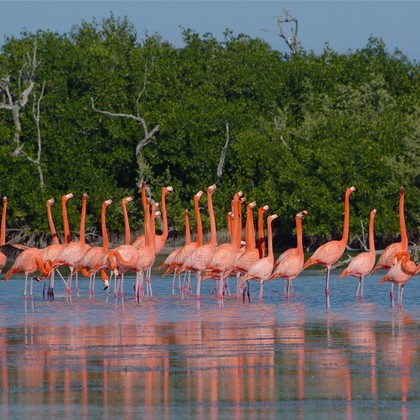
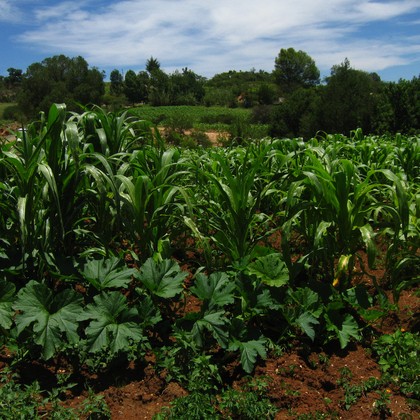
Shallow marshes, muddy margins of lakes, reservoirs and ponds, saline lakes on the plateau, coastal lagoons, mudflats, rice fields and flooded meadows. It feeds in very shallow water and on mud, mainly on seeds of marsh plants and small invertebrates.
Where the bird is most at home, classified by the vegetation units of Mexico and Central America.



Range and movements
Winters throughout Mexico north of the Isthmus of Tehuantepec, with the largest numbers in Baja California, Sonora, Sinaloa, Chihuahua, Coahuila, Durango and on the lakes of the central plateau, and further from Nuevo León and Tamaulipas to Veracruz, Jalisco, Michoacán, Guerrero and Oaxaca. Scarce in south-eastern Mexico and Central America, south to Panama. Breeds in northern North America; the Eurasian form breeds in northern Europe and Asia.
- Winter visitor (c. Oct–Mar)
- dark = core range, pale = thinly spread
How and when to look
On muddy margins of lakes and reservoirs in the north and on the plateau, where small flocks often only show themselves when they take off; the vertical white breast stripe of the male is visible even at a distance. Among Blue-winged Teal the shorter bill is the first thing to stand out.
Conservation status
Not threatened globally. The North American population has increased in recent decades. In Mexico the species is hunted and shallow wetlands are disappearing through drainage and agriculture.
Scientific name
Anas crecca | Linnaeus, 1758
Linnaeus described the species in 1758 and placed it straight away in the genus where it still stands. He introduced the genus Anas in that same work. Anas is the Latin word for 'duck'. crecca comes from kricka, the Swedish name for the bird, an imitation of the male's call. The specimen the first description was based on came from Sweden.