All species › Passerines › Tyrant flycatchers and allies › Dusky-capped Flycatcher
Position in the tree Birds Aves › Birds with a flexible palate Neognathae › All other modern birds Neoaves › Landbirds Telluraves › Falcons, parrots and passerines Australaves › Falcons and passerines Eufalconimorphae › Parrots and passerines Psittacopasserae
Dusky-capped Flycatcher | Myiarchus tuberculifer
Donkerkaptiran | Papamoscas triste
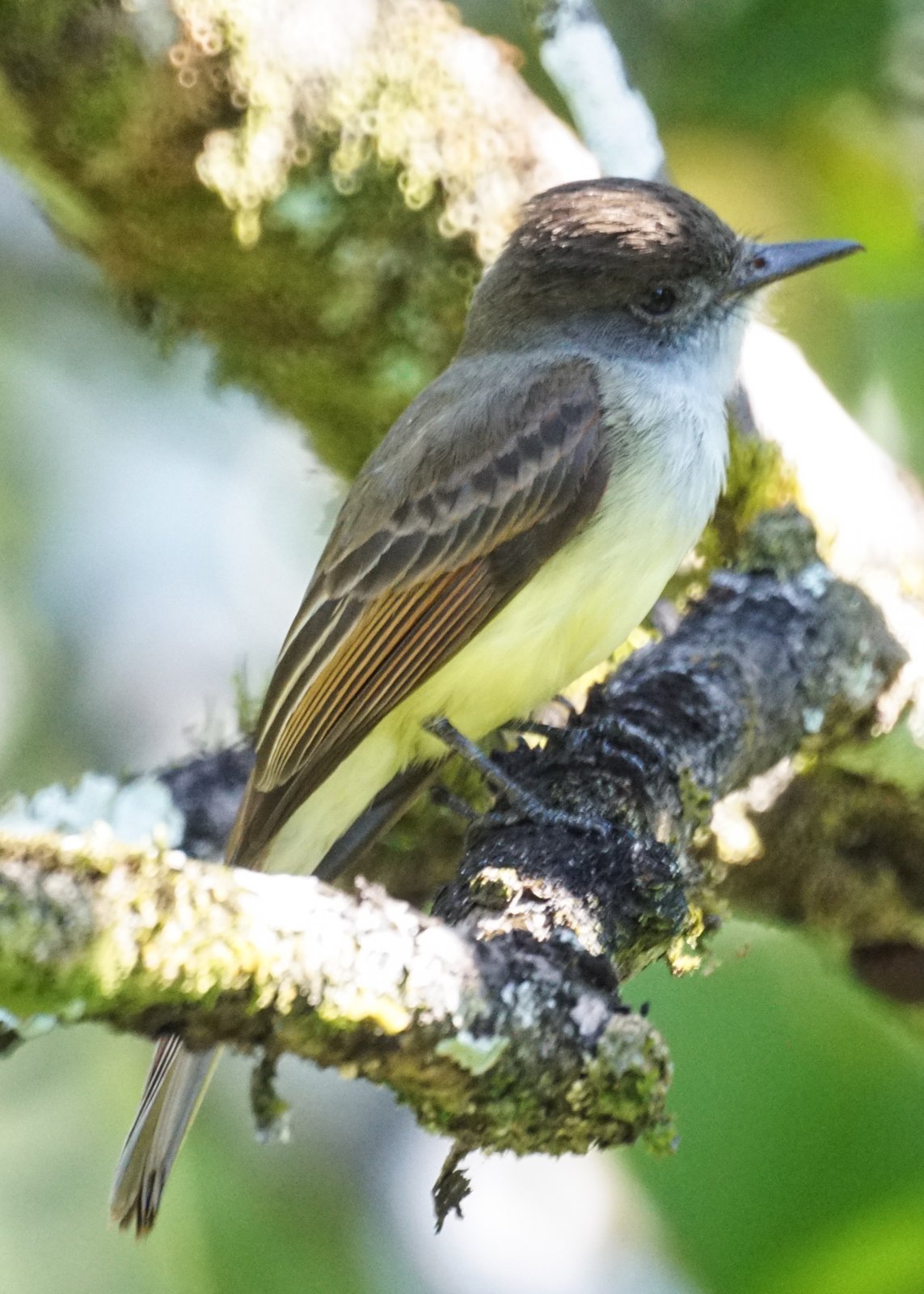
The Dusky-capped Flycatcher is the smallest and most widespread Myiarchus flycatcher of the guide area, with a dark cap, a grey throat and a yellow belly. It lives in many types of forest, from the lowlands into the mountains, and is mainly noticed by its long, falling whistle.
Voice
A long, plaintive, falling whistle, wheeeeu, often repeated. Also a short, sharp whit.
Recording: Juan Freile — CC BY-NC-SA 4.0 · converted to mono · xeno-canto
Identification
16–18 cm. Crown dark blackish-brown, clearly darker than the olive-brown back. Wings dark with pale edges to the coverts and rufous edges to the primaries; tail dark brown with at most narrow rufous edges. Throat and breast grey, belly bright yellow. Bill fairly slender and black. Male and female are alike.
Confusion species
Yucatan Flycatcher Myiarchus yucatanensis (Yucatán Peninsula) is slightly larger, has a crown barely darker than the back and a rising whistle. Nutting's Flycatcher Myiarchus nuttingi, Ash-throated Flycatcher Myiarchus cinerascens and Brown-crested Flycatcher Myiarchus tyrannulus are larger, with a paler head without a dark cap and more rufous in wings and tail. Great Crested Flycatcher Myiarchus crinitus is larger and has a much more rufous tail. Forest pewees (Contopus) lack a yellow belly.
Habitat
Humid and dry lowland forest, forest edges, secondary forest, cloud forest and pine-oak forest, from sea level high into the mountains. It forages mainly at mid-levels and in the lower canopy, sallying for insects from a perch or picking them from leaves. It nests in a tree cavity.
Where the bird is most at home, classified by the vegetation units of Mexico and Central America.







Range and movements
Almost throughout the guide area, from northern Mexico to Panama; absent from Baja California and much of the arid Mexican plateau. Outside the guide area in southern Arizona and New Mexico and over much of South America, to northern Argentina.
- Resident
- dark = core range, pale = thinly spread
How and when to look
The long, falling whistle can be heard in almost every forest type and is often the first sign of the species. In the canopy, look for the dark cap.
Conservation status
Not threatened. Widespread and common; adapts well to secondary forest and forest edges.
Scientific name
Myiarchus tuberculifer | (d'Orbigny, ACVMD & de Lafresnaye, 1837)
D'Orbigny, ACVMD & de Lafresnaye described the species in 1837 as T[yrannus] tuberculifer; because it was later moved to another genus, the author and year stand in brackets. The genus Myiarchus was introduced in 1844 by Cabanis. Myiarchus is Greek, from muia 'fly' and arkhos 'ruler': 'fly-ruler'. tuberculifer is Latin, from tuberculum 'small swelling' and -fer 'bearing'; what the 'swelling' refers to is unclear. The specimen the first description was based on came from Guarayos, Santa Cruz, Bolivia.