All species › Birds of prey › Kites, Old World vultures, eagles and hawks › Double-toothed Kite
Position in the tree Birds Aves › Birds with a flexible palate Neognathae › All other modern birds Neoaves › Landbirds Telluraves › Raptors, owls, kingfishers and woodpeckers Afroaves › Hawks and owls Hieraves
Double-toothed Kite | Harpagus bidentatus
Tandwouw | Gavilán bidentado
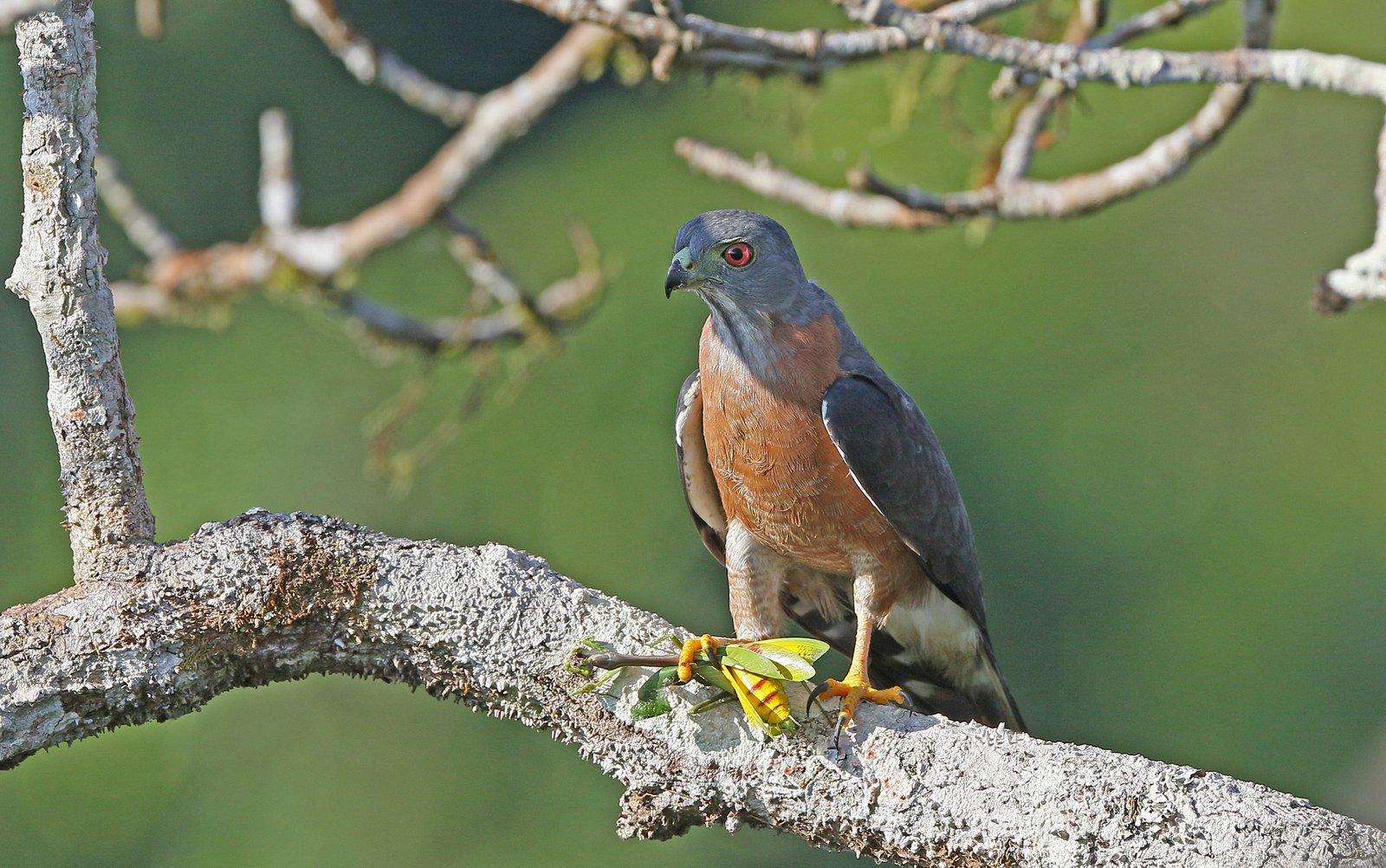
The Double-toothed Kite is a small, hawk-like raptor of humid forest, named after the two notches on the cutting edge of the upper mandible. It hunts large insects and lizards in the canopy, often following troops of monkeys that flush prey. In the guide area it is a resident from southern Mexico to Panama.
Voice
A thin, high, whistled tseeoo-weet or a series of high wee-wee-wee notes, often from a perch in the canopy.
Recording: Fernando Igor de Godoy — CC BY-NC-SA 4.0 · converted to mono · xeno-canto
Identification
29–35 cm. The head is slate grey and the white throat has a narrow dark central stripe. The male has a rufous breast, the female a rufous breast barred with grey; the belly is barred grey and rufous. The upperparts are greyish brown and the tail is dark with three narrow pale bands. The eye is red to orange. In flight the fluffy white undertail coverts stand out, often puffed out to the sides of the rump, as do the fairly short, rounded wings with pale, finely barred flight feathers. Young birds are brown above and white or creamy with dark streaks below, but also have the dark throat stripe.
Confusion species
The Bicolored Hawk Astur bicolor is larger, with a plain grey breast, rufous thighs and no throat stripe. The Roadside Hawk Rupornis magnirostris has a yellow eye, a brown or grey breast without a throat stripe and rufous wing panels in flight. The Barred Forest Falcon Micrastur ruficollis has bare yellow skin around the eye, a longer tail and finely barred underparts without rufous. Young Double-toothed Kites resemble young Sharp-shinned Hawks Accipiter striatus, but have the dark throat stripe.
Habitat
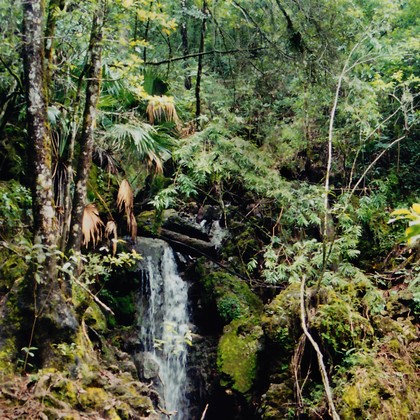
Humid lowland and foothill forest, locally up into lower montane forest, also mature secondary forest, forest edges and gallery forest. It perches quietly for long periods in or below the canopy and in the morning often circles briefly above the forest with its white undertail coverts spread to the sides.
Where the bird is most at home, classified by the vegetation units of Mexico and Central America.






Range and movements
Resident from southern Mexico (southern Veracruz, Oaxaca, Tabasco, Chiapas and the Yucatán Peninsula) through Belize, Guatemala, Honduras and Nicaragua to Costa Rica and Panama, commoner on the Caribbean than on the Pacific side; rare in El Salvador. Also locally on the Pacific slope of western Mexico, mainly in Nayarit, Jalisco and Guerrero. Outside the guide area in tropical South America to Bolivia and southeastern Brazil.
- Resident
- dark = core range, pale = thinly spread
How and when to look
It often follows troops of howler or spider monkeys through the canopy and perches nearby, for example at La Selva and Carara in Costa Rica and along Pipeline Road in Panama.
Conservation status
Not threatened. In the guide area it has declined locally through forest clearance, but it also occurs in mature secondary forest.
Scientific name
Harpagus bidentatus | (Latham, 1790)
Latham described the species in 1790 as Falco bidentatus; because it was later moved to another genus, the author and year stand in brackets. The genus Harpagus was introduced in 1824 by Vigors. Harpagus comes from Greek harpagos 'grappling hook' or harpax 'robber', after the hooked bill and grasping habits. bidentatus is Latin for 'two-toothed', after the two tooth-like projections on the edge of the upper mandible. The specimen the first description was based on came from Cayenne, French Guiana.