All species › Passerines › Tanagers and allies › Crimson-collared Tanager
Position in the tree Birds Aves › Birds with a flexible palate Neognathae › All other modern birds Neoaves › Landbirds Telluraves › Falcons, parrots and passerines Australaves › Falcons and passerines Eufalconimorphae › Parrots and passerines Psittacopasserae
Crimson-collared Tanager | Ramphocelus sanguinolentus
Vuurkraagtangare | Tangara acollarada
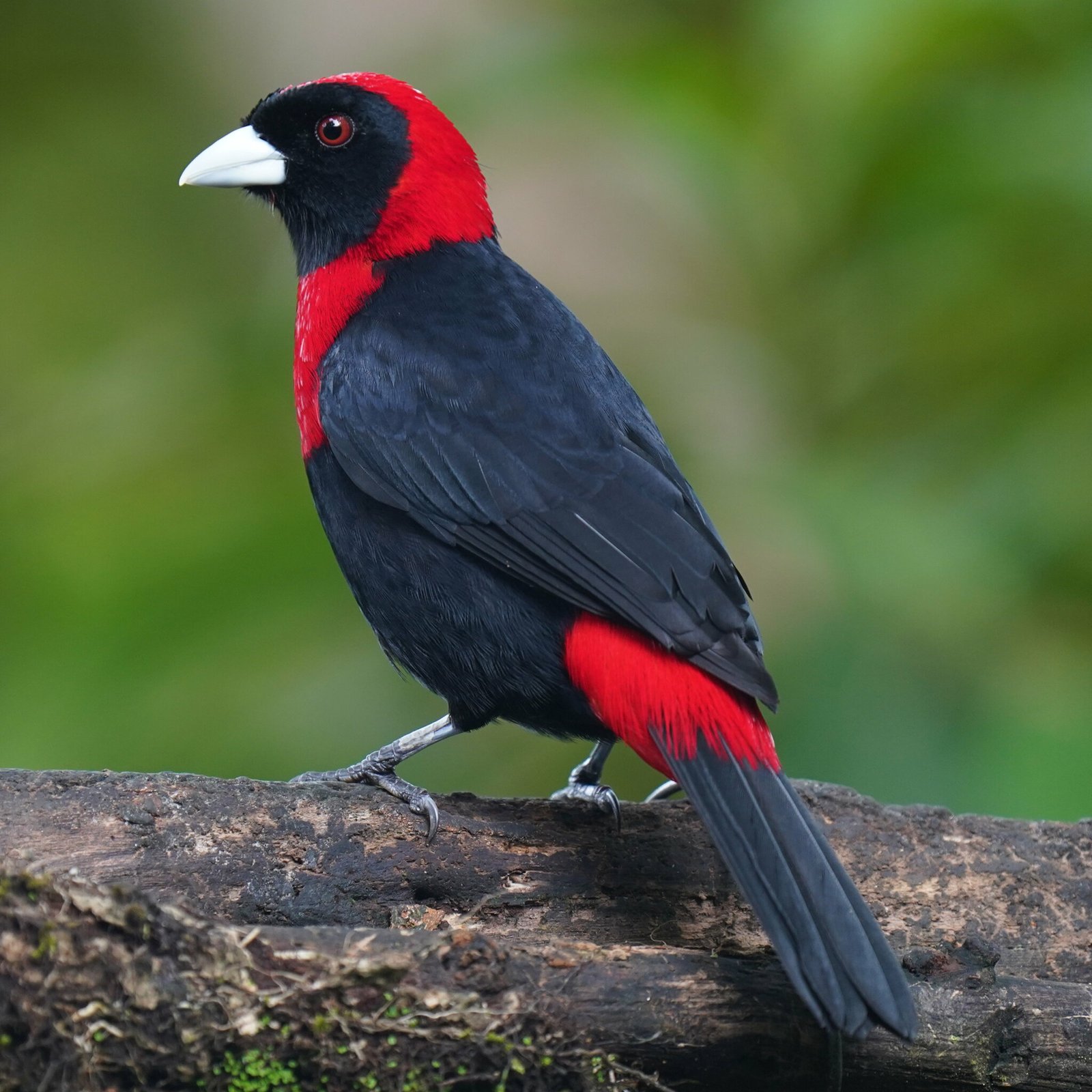
The Crimson-collared Tanager is a black tanager with a deep crimson hood and collar. It lives in pairs or small groups along forest edges and in rank secondary forest. The species occurs only in the guide area, on the Caribbean slope from southern Mexico to western Panama.
Voice
The call is a high, thin tseew or sssit. The song is a short series of shrill, squeaky notes, not very different from the call.
Recording: Max Noack — CC BY-NC-SA 4.0 · converted to mono · xeno-canto
Identification
18–19 cm. A fairly large tanager with a thick, bluish-white bill with a dark tip. Black with deep crimson crown, nape, sides of the neck and upper breast, together forming a broad collar around the black face and throat; the rump is crimson too. Male and female are alike; the female is slightly duller. Young birds are brownish with a dull reddish-brown collar.
Confusion species
The male Scarlet-rumped Tanager Ramphocelus passerinii is black with only a scarlet lower back and rump, without a red collar. Crimson-backed Tanager Ramphocelus dimidiatus (Panama) has a dark red head and breast and a bright red belly, without a black face. No other species in the guide area combines a black face with a red collar.
Habitat
Forest edges, old clearings, rank secondary forest, riverbanks and shaded plantations in the humid lowlands and foothills, from sea level to about 1200 m. It forages mainly at middle levels and in the crowns of shrubs and low trees.
Where the bird is most at home, classified by the vegetation units of Mexico and Central America.





Range and movements
Caribbean slope of southern Mexico (from southern Veracruz and northern Oaxaca to Chiapas, Tabasco and the south of the Yucatán Peninsula) through Belize, Guatemala, Honduras, Nicaragua and Costa Rica to western Panama. It does not occur outside the guide area.
- Resident
- dark = core range, pale = thinly spread
How and when to look
Often seen along riverbanks and forest edges in the Caribbean lowlands, for example at La Selva and Arenal in Costa Rica or around Palenque in Mexico.
Conservation status
Not threatened (LC). Fairly common in the Caribbean lowlands; tolerates partial deforestation.
Scientific name
Ramphocelus sanguinolentus | (Lesson, 1831)
Lesson described the species in 1831 as Tanagra (Tachyphonus) sanguinolentus; because it was later moved to another genus, the author and year stand in brackets. The genus Ramphocelus was introduced in 1805 by Desmarest, A-G. Ramphocelus is Greek, from rhamphos 'bill' and koilos 'hollow, concave', after the conspicuous silvery lower mandible. sanguinolentus is Latin for 'blood-red', after the crimson hood and breast band. The specimen the first description was based on came from Mexico.