All species › Swifts › Hummingbirds › Cozumel Emerald
Position in the tree Birds Aves › Birds with a flexible palate Neognathae › All other modern birds Neoaves › Birds of the elements Elementaves › Nightjars and swifts Strisores
Cozumel Emerald | Cynanthus forficatus
Cozumelsmaragdkolibrie | Esmeralda de Cozumel
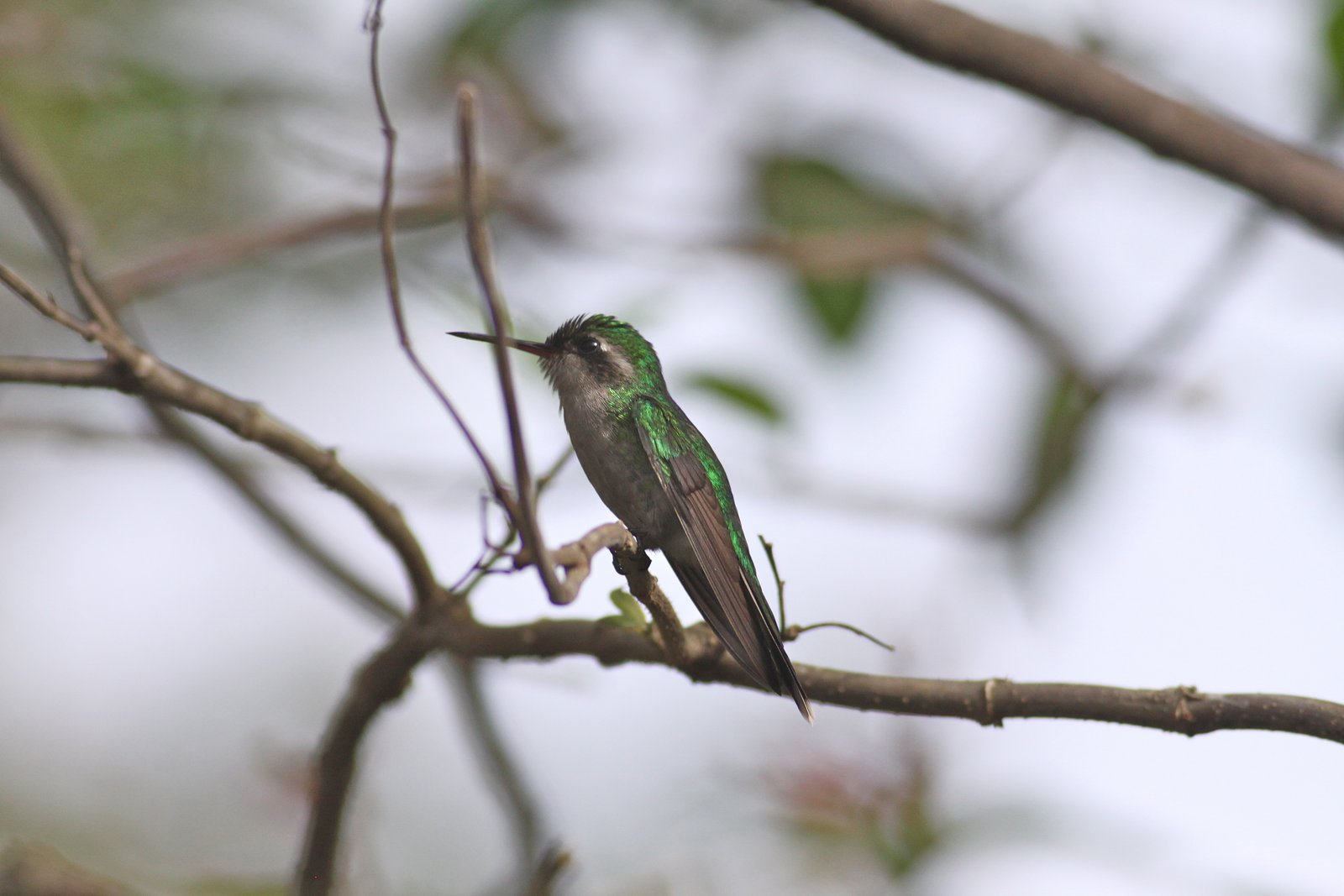
The Cozumel Emerald occurs only on Cozumel Island off the east coast of the Yucatán Peninsula. It was long treated as a subspecies of Canivet's Emerald, but the male has a clearly longer and more deeply forked tail. On the island it is one of the commonest hummingbirds, including in gardens in town.
Voice
A dry, rattling chit or chrr, often in a fast series during chases.
Recording: Joren van Schie — CC BY-NC-SA 4.0 · converted to mono · xeno-canto
Identification
9–10 cm, with a straight red bill with a black tip. The male is entirely glittering green, brighter on the crown and underparts, with a long, deeply forked blue-black tail. The female has green upperparts, a white stripe behind the eye, a dark ear patch, pale grey underparts and a forked dark tail with greyish-white tips to the outer feathers.
Confusion species
No other emeralds occur on Cozumel. Canivet's Emerald Cynanthus canivetii of the mainland and the islands off the north coast of Yucatán is very similar, but the male has a shorter, less deeply forked tail. Cinnamon Hummingbird Amazilia rutila is larger, with cinnamon underparts. Female Ruby-throated Hummingbird Archilochus colubris, a winter visitor, has a black bill and no dark ear patch.
Habitat
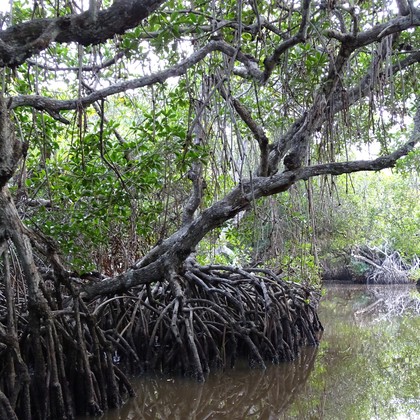
Semi-deciduous forest, scrub, forest edges, mangrove edges and gardens with flowering shrubs, throughout the island. It feeds low to mid-level at flowers and catches small insects.
Where the bird is most at home, classified by the vegetation units of Mexico and Central America.



Range and movements
Endemic to Cozumel Island in Quintana Roo, Mexico. Records from the mainland and from the other islands off Yucatán refer to Canivet's Emerald.
- Resident
- dark = core range, pale = thinly spread
How and when to look
Common on Cozumel, both in gardens and parks in San Miguel de Cozumel and along the roads through the forest to El Cedral and Punta Sur. Often at flowering shrubs along forest edges.
Conservation status
Not threatened. The range is small, but the species is numerous on the island and also lives in gardens. Severe hurricanes can temporarily damage the forest and the supply of flowers; coastal development takes up habitat.
Scientific name
Cynanthus forficatus | (Ridgway, 1885)
Ridgway described the species in 1885 as Chlorostilbon forficatus; because it was later moved to another genus, the author and year stand in brackets. The genus Cynanthus was introduced in 1827 by Swainson. Cynanthus is Greek, from kuanos 'dark blue' and anthos 'blossom, flower', after the glittering blue plumage. forficatus is Latin for 'scissor-like, forked' (from forfex 'scissors'), after the male's deeply forked tail. The specimen the first description was based on came from Cozumel Island, Mexico.