All species › Trogons › Trogons › Coppery-tailed Trogon
Position in the tree Birds Aves › Birds with a flexible palate Neognathae › All other modern birds Neoaves › Landbirds Telluraves › Raptors, owls, kingfishers and woodpeckers Afroaves › Mousebirds, rollers and woodpeckers Coraciimorphae › Trogons and cavity nesters Cavitaves
Coppery-tailed Trogon | Trogon ambiguus
Noordelijke koperstaarttrogon | Coa cola cobriza
The Coppery-tailed Trogon is a red-bellied trogon of dry forest, oak woodland and riparian forest in Mexico, reaching south-eastern Arizona. It is the only trogon that breeds regularly north of Mexico and has only recently been recognised as a separate species from the Elegant Trogon Trogon elegans of Central America. In the north of its range it is present mainly in summer.
Voice
A series of four to ten low, hoarse, croaking kowk notes, somewhat reminiscent of a turkey or a frog, often repeated from a hidden perch. Also a rasping cackle.
Recording: Garrett Craig — CC BY-NC 4.0 · converted to mono · iNaturalist
Identification
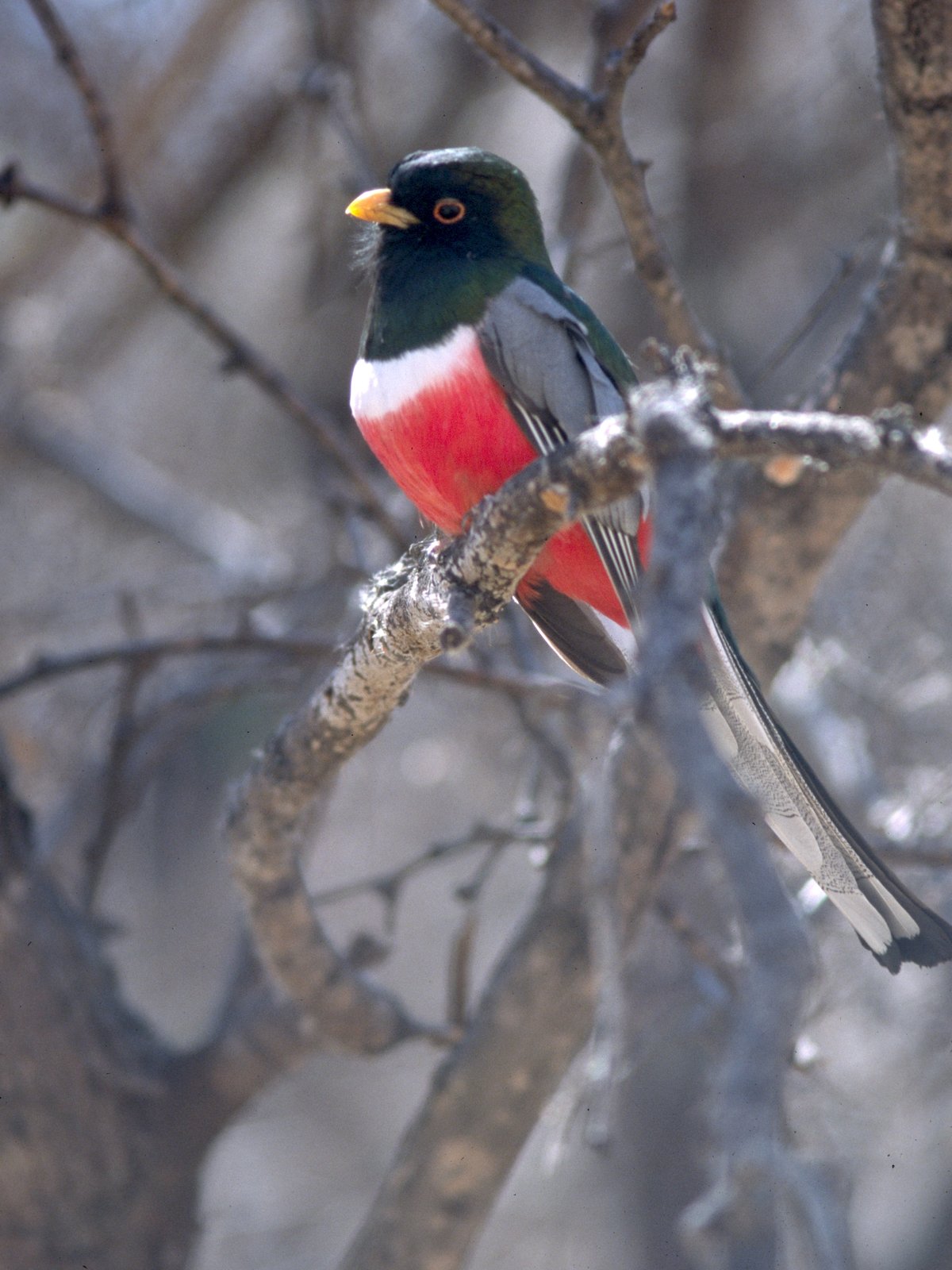
28–31 cm. The male is green on the head, breast and back, with a coppery sheen on the upperside of the tail, a blackish face and throat, an orange-red eye-ring, a yellow bill and a white band between the green breast and the red belly. The underside of the tail is finely vermiculated grey and white with broad white tips. The female is grey-brown on the head, breast and back, with a white patch behind the eye, a white breast band and a whitish belly that becomes pink to red towards the undertail coverts.
Confusion species
Elegant Trogon Trogon elegans is very similar but lives only from Guatemala to Costa Rica; the ranges do not overlap. Mountain Trogon Trogon mexicanus usually lives higher in montane forest, lacks the coppery sheen on the tail and has an almost black undertail with three broad white bands. Eared Quetzal Euptilotis neoxenus is larger and has no white breast band and no yellow bill. Collared Trogon Trogon collaris has a black-and-white barred undertail and lives in more humid forest in eastern and southern Mexico.
Habitat
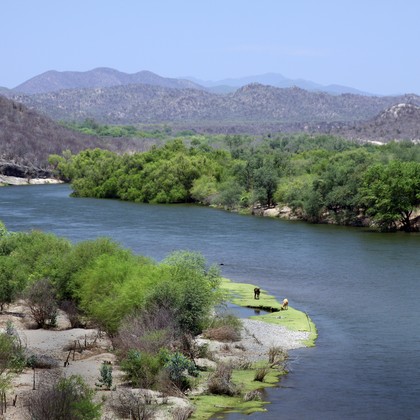
Oak and pine-oak woodland in the mountains, riparian forest with sycamores in canyons, tropical dry forest and thorn forest, from sea level to about 2500 m. In the north mainly in wooded mountain canyons. It eats large insects and fruit and nests in a tree cavity, often an old woodpecker hole.
Where the bird is most at home, classified by the vegetation units of Mexico and Central America.




Range and movements
Mexico: in the west from eastern Sonora and western Chihuahua south through Sinaloa, Durango, Nayarit (including the Islas Marías), Jalisco, Colima and Michoacán to Guerrero and Oaxaca; in the east from Coahuila, Nuevo León and Tamaulipas through San Luis Potosí, Querétaro and Hidalgo to Puebla and Veracruz; also locally in the interior of central Mexico. In northern Sonora and Chihuahua present mainly in summer. It does not occur south of Oaxaca or elsewhere in the guide area. Outside the guide area a breeding bird in south-eastern Arizona and a rare visitor to southern Texas and New Mexico.
- Resident
- Summer visitor (c. Apr–Sep)
- Winter visitor (c. Oct–Mar)
- dark = core range, pale = thinly spread
How and when to look
Regular in the dry forest around San Blas in Nayarit and in the canyons of the Sierra Madre Occidental in Sinaloa and Durango. Just outside the guide area well known from Madera Canyon and Cave Creek Canyon in Arizona. The croaking call is often heard before the bird is seen.
Conservation status
Not threatened. Widespread in Mexico; in Arizona a small population that depends on riparian forest in canyons.
Scientific name
Trogon ambiguus | Gould, 1835 (GBIF: Trogon elegans)
Gould described the species in 1835 and placed it straight away in the genus where it still stands. The genus Trogon was introduced in 1760 by Brisson. Trogon is Greek, from trōgōn 'gnawing, fruit-eating'. ambiguus is Latin for 'doubtful, ambiguous', as the bird closely resembles Trogon elegans. The specimen the first description was based on came from northern Mexico.