All species › Passerines › New World sparrows › Collared Towhee
Position in the tree Birds Aves › Birds with a flexible palate Neognathae › All other modern birds Neoaves › Landbirds Telluraves › Falcons, parrots and passerines Australaves › Falcons and passerines Eufalconimorphae › Parrots and passerines Psittacopasserae
Collared Towhee | Pipilo ocai
Kraagtowie | Toquí de collar
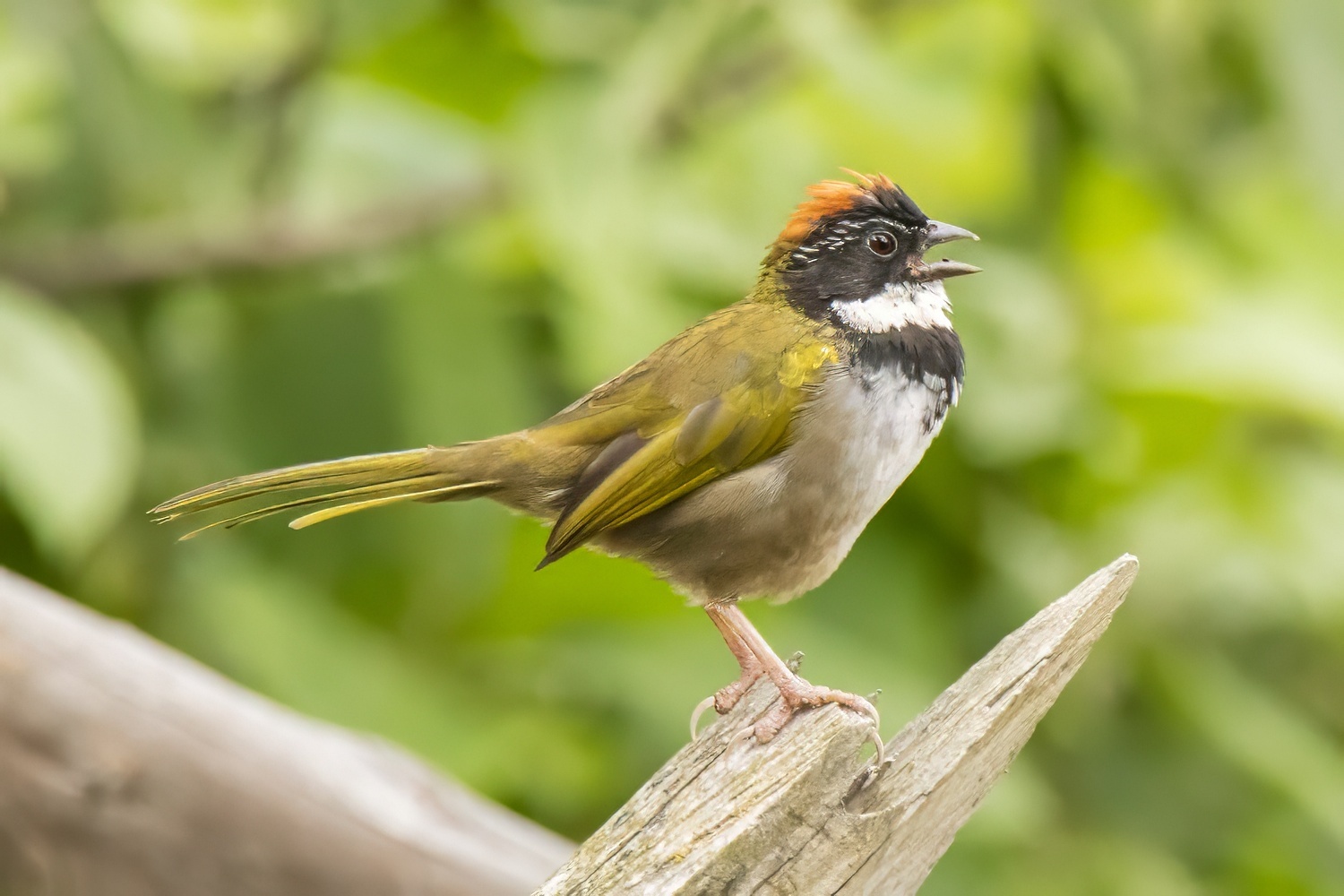
The Collared Towhee is a large towhee of the highlands of central and southern Mexico, with a rufous crown, a white throat, a black breast band and an olive-green back. It lives on the ground in the undergrowth of montane and cloud forest. Where its range meets that of Spotted Towhee, the two species hybridise extensively.
Voice
The call is a thin tseet and a mewing, raspy note. The song is a series of clear, repeated whistles, often ending in a trill.
Recording: Richard E. Webster — CC BY-NC-SA 4.0 · shortened to the first 60 s, mono · xeno-canto
Identification
20–22 cm. Crown and nape rufous; forehead and face black, with a white spot above the bill or a white supercilium in some forms. Throat white, bordered by a broad black breast band. Upperparts, wings and long tail olive-green. Breast and flanks grey to olive-grey, centre of belly white. Bill black, eye reddish brown. The sexes are alike. In the hybrid zone with Spotted Towhee there are birds with a blacker head, white spots on the wings or rufous flanks.
Confusion species
Spotted Towhee Pipilo maculatus has an all-black head and breast with no white throat, rufous flanks and white spots on the back and wings. Green-tailed Towhee Pipilo chlorurus is smaller and slimmer, with a grey breast and no black band. Chestnut-capped Brushfinch Arremon brunneinucha has a chestnut crown, a puffed white throat and a narrow black breast band, but is smaller, with a darker back and a face with small white spots on the forehead.
Habitat
Undergrowth, edges and clearings of pine-oak forest, cloud forest and high-elevation conifer forest, especially with dense scrub, mostly between about 1500 and 3500 m. It searches the ground for seeds, insects and fruit, scratching in the litter with both feet.
Where the bird is most at home, classified by the vegetation units of Mexico and Central America.



Range and movements
Endemic to Mexico and thus to the guide area: highlands of Jalisco, Colima and Michoacán east through the Trans-Mexican Volcanic Belt to Puebla and western Veracruz, and south in the Sierra Madre del Sur of Guerrero and Oaxaca.
- Resident
- dark = core range, pale = thinly spread
How and when to look
Often found along forest edges and scrubby clearings on Nevado de Colima and in the mountains around Oaxaca; early in the morning it sings from a low, exposed branch.
Conservation status
Not threatened (LC). Locally fairly common; logging and the conversion of montane forest to farmland are the main threats.
Scientific name
Pipilo ocai | (Lawrence, 1865)
Lawrence described the species in 1865 as Buarremon ocai; because it was later moved to another genus, the author and year stand in brackets. The genus Pipilo was introduced in 1816 by Vieillot. Pipilo is Latin for 'I chirp', from pipilare 'to chirp, to peep', after the call. ocai honours the Mexican artist and naturalist Rafael Montes de Oca (19th century), who collected birds around Jalapa. The specimen the first description was based on came from Las Vigas, Veracruz, Mexico.