All species › Passerines › Tyrant flycatchers and allies › Cocos Tyrannulet
Position in the tree Birds Aves › Birds with a flexible palate Neognathae › All other modern birds Neoaves › Landbirds Telluraves › Falcons, parrots and passerines Australaves › Falcons and passerines Eufalconimorphae › Parrots and passerines Psittacopasserae
Cocos Tyrannulet | Nesotriccus ridgwayi
Cocostiran | Mosquerito del Coco
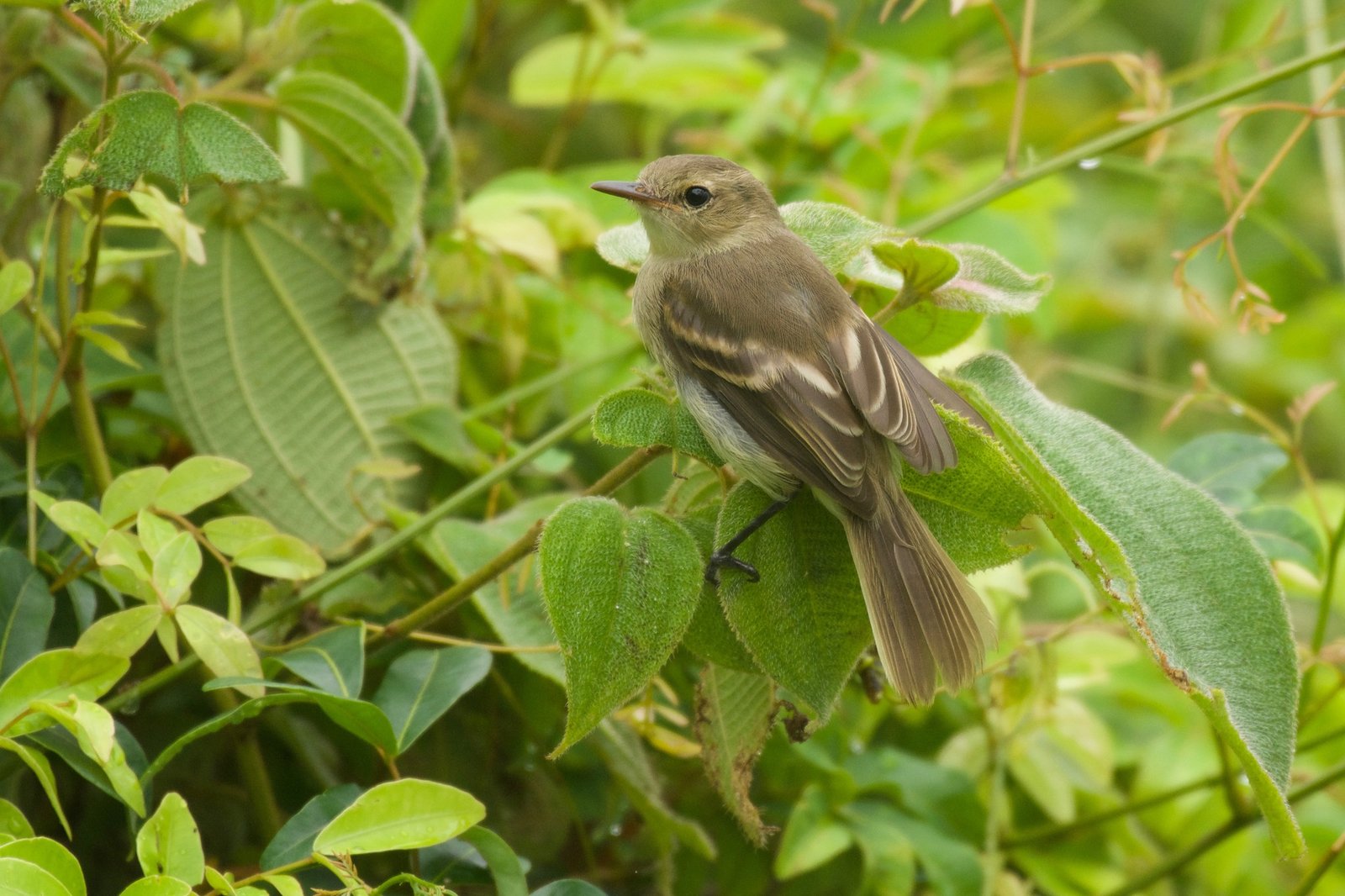
The Cocos Tyrannulet is an inconspicuous olive-brown tyrant flycatcher found only on Isla del Coco, a remote Costa Rican island in the Pacific Ocean. It is one of the few land birds on the island and fairly numerous there. It is closely related to the Mouse-colored Tyrannulet of the mainland.
Voice
High, rather shrill calls and short series of notes, heard mainly in the morning.
No recording with a suitable Creative Commons licence is available for this species yet.
Identification
13 cm, with a fairly long, slender bill and a fairly long tail. Upperparts olive-brown. A faint pale supercilium. Wings dark with two dull ochre-buff wing-bars. Underparts pale, whitish on the throat and becoming dull yellowish towards the belly, with a greyish-brown wash on the breast. Male and female are alike.
Confusion species
Few other small land birds occur on Isla del Coco. Cocos Finch Pinaroloxias inornata is stockier and darker, with a shorter, pointed bill. Mangrove Warbler Setophaga petechia, a resident on the island, is much yellower.
Habitat
Humid evergreen forest covering most of the island, from the coast to the highest summits, also forest edges and clearings. It forages at all levels of the forest for insects and other small invertebrates, both among the foliage and by short sallies.
Where the bird is most at home, classified by the vegetation units of Mexico and Central America.



Range and movements
Endemic to Isla del Coco, about 500 km south-west of mainland Costa Rica. Found nowhere else.
- Resident
- dark = core range, pale = thinly spread
How and when to look
Isla del Coco can only be reached by boat on trips lasting several days and is a strictly protected national park. On the island the species occurs regularly in forest and at forest edges.
Conservation status
Vulnerable. The entire range consists of one small island. Introduced animals such as rats, cats, pigs and deer pose a threat by damaging the vegetation and possibly raiding nests.
Scientific name
Nesotriccus ridgwayi | Townsend, 1895
Townsend described the species in 1895 and placed it straight away in the genus where it still stands. He introduced the genus Nesotriccus in that same work. Nesotriccus is Greek, from nēsos 'island' and trikkos, a small bird (used for tyrant flycatchers), after Cocos Island, home of the first species. ridgwayi honours the American ornithologist Robert Ridgway (1850–1929) of the Smithsonian. The specimen the first description was based on came from Cocos Island, Costa Rica.