All species › Passerines › Crows, jays and magpies › Chihuahuan Raven
Position in the tree Birds Aves › Birds with a flexible palate Neognathae › All other modern birds Neoaves › Landbirds Telluraves › Falcons, parrots and passerines Australaves › Falcons and passerines Eufalconimorphae › Parrots and passerines Psittacopasserae
Chihuahuan Raven | Corvus cryptoleucus
Woestijnraaf | Cuervo llanero
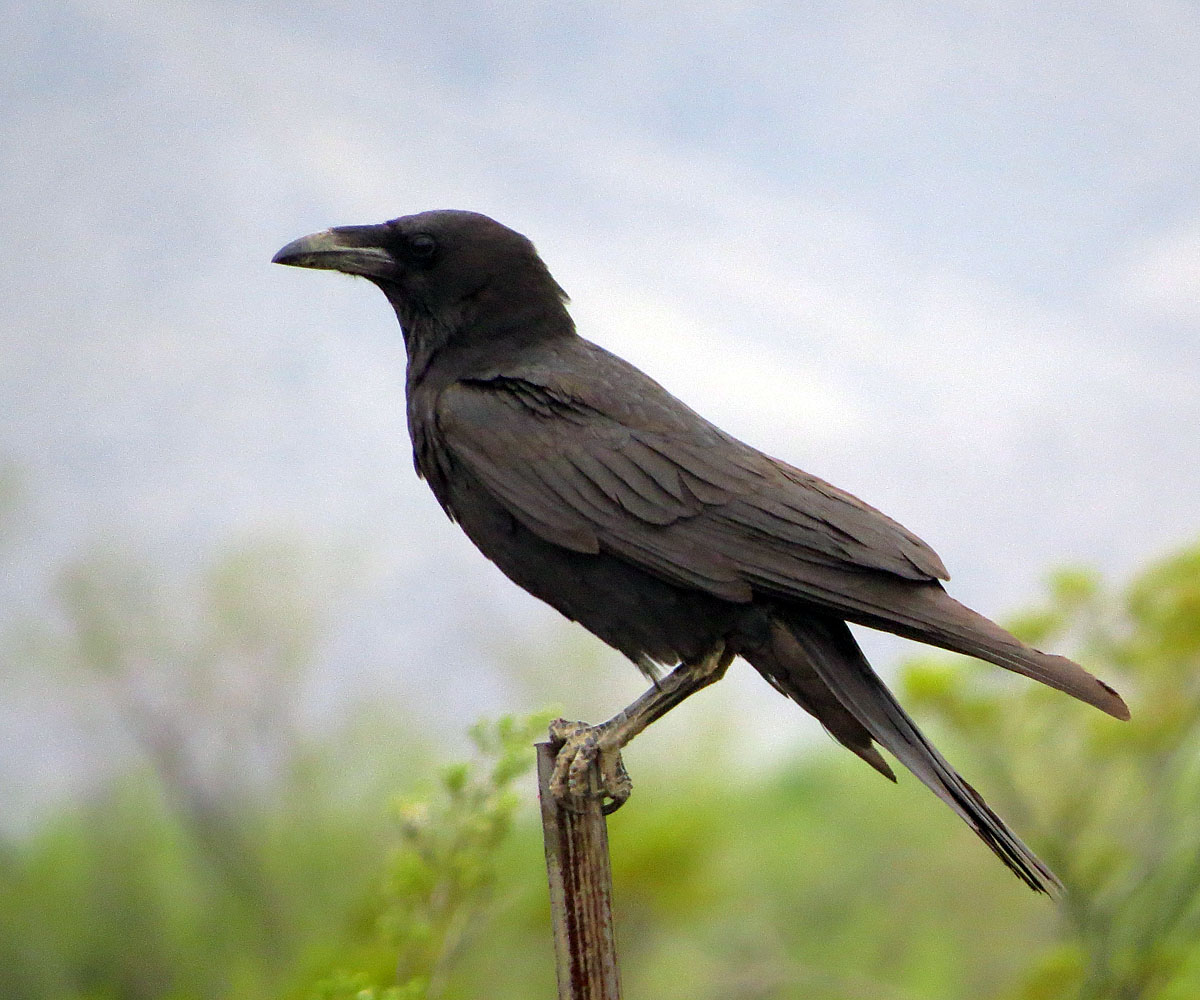
The Chihuahuan Raven is a medium-sized raven of open, dry country in northern and central Mexico. It is smaller than Northern Raven and has white bases to the feathers of the neck and breast, which show only when the wind lifts the feathers. Outside the breeding season it often lives in groups and sleeps in large communal roosts.
Voice
A fairly high, grating kraak, clearly higher and less resonant than the call of Northern Raven; also various hoarse and clicking notes.
Recording: Richard E. Webster — CC BY-NC-SA 4.0 · shortened to the first 60 s, mono · xeno-canto
Identification
46–52 cm. Entirely black with a purplish-blue gloss. The feathers of the nape, neck and breast have white bases, which become visible in wind or during preening. Bill heavy and black; the nasal bristles extend far along the upper mandible. Tail slightly wedge-shaped. Smaller than Northern Raven, with a shorter bill and a less pronounced wedge-shaped tail.
Confusion species
Northern Raven Corvus corax is larger, with a heavier bill, a longer and clearly wedge-shaped tail, shaggier throat feathers and a deeper call; it more often lives in mountains and rocky terrain. American Crow Corvus brachyrhynchos and Tamaulipas Crow Corvus imparatus are smaller, with a square-ended tail and a slimmer bill.
Habitat
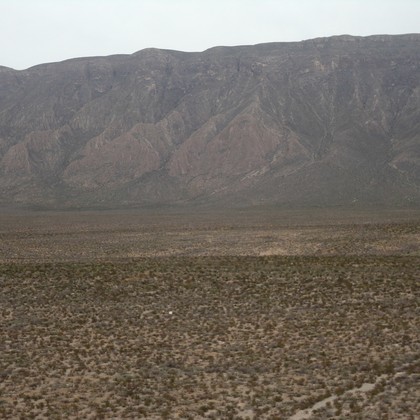
Open, dry and flat country: semi-desert grassland, desert scrub, thorn scrub, fields and pastures, often along roads and at farms and rubbish dumps. It eats insects, carrion, small vertebrates, seeds and refuse. It nests in isolated trees, shrubs or on poles and pylons.
Where the bird is most at home, classified by the vegetation units of Mexico and Central America.






Range and movements
In the guide area in northern and central Mexico, from Sonora and Chihuahua to Coahuila, Nuevo León and Tamaulipas, and south across the central plateau to about the middle of the country. Outside the guide area in the south-western and southern United States; the northernmost birds move south in winter.
- Resident
- dark = core range, pale = thinly spread
How and when to look
Best seen in open grassland and semi-desert in northern Mexico, where groups forage along roads and at livestock farms. In winter there are large communal roosts.
Conservation status
Not threatened. Widespread and locally common in open, dry country.
Scientific name
Corvus cryptoleucus | Couch, 1854
Couch described the species in 1854 and placed it straight away in the genus where it still stands. The genus Corvus was introduced in 1758 by Linnaeus. Corvus is the Latin word for 'raven'. cryptoleucus is Greek, from kruptos 'hidden' and leukos 'white', after the white bases of the neck and breast feathers, visible only when ruffled by the wind. The specimen the first description was based on came from Charco Escondido, Tamaulipas, Mexico.