All species › Passerines › New World sparrows › Cassin's Sparrow
Position in the tree Birds Aves › Birds with a flexible palate Neognathae › All other modern birds Neoaves › Landbirds Telluraves › Falcons, parrots and passerines Australaves › Falcons and passerines Eufalconimorphae › Parrots and passerines Psittacopasserae
Cassin's Sparrow | Peucaea cassinii
Cassins gors | Zacatonero de Cassin
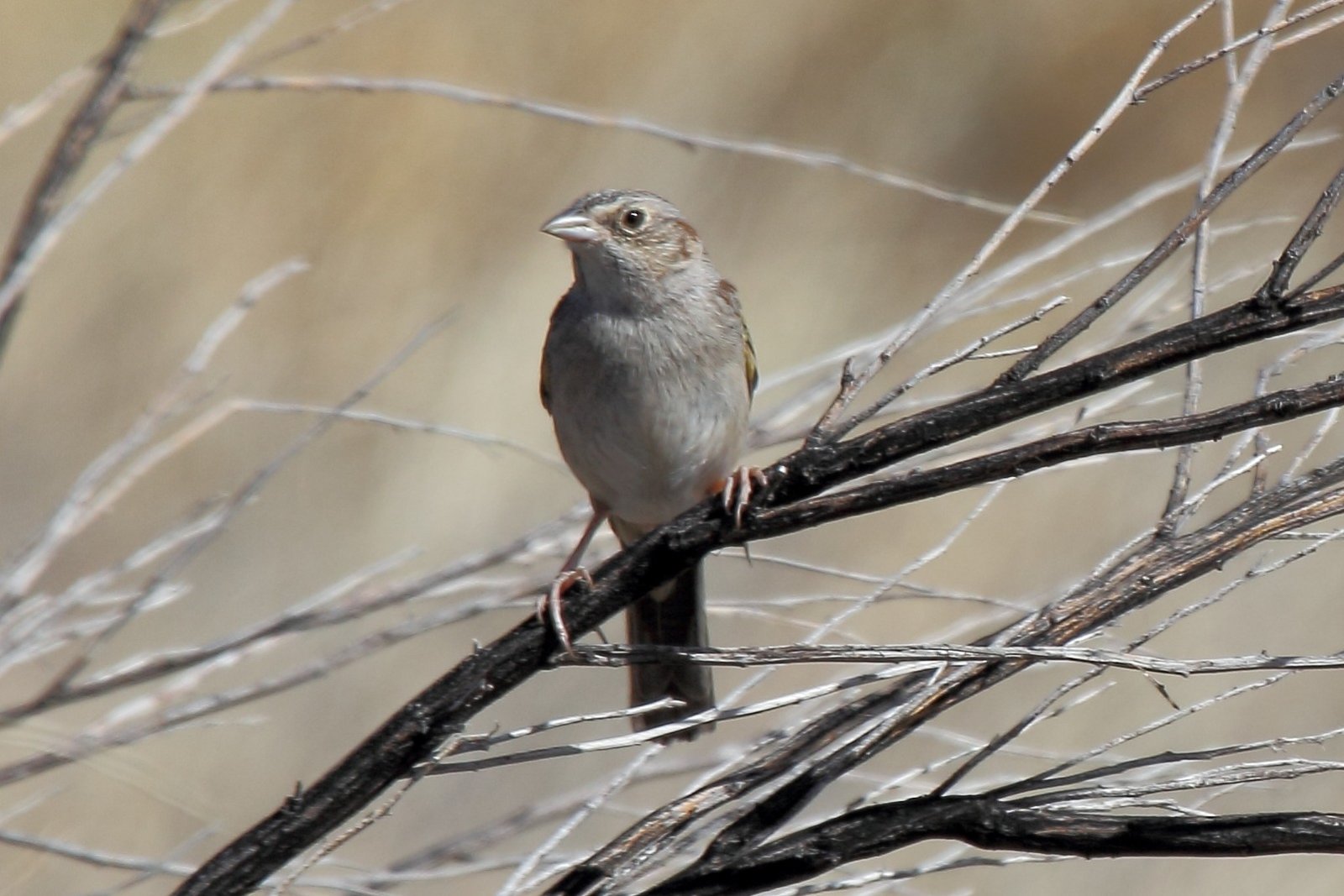
Cassin's Sparrow is a greyish-brown Peucaea sparrow of dry grassland with shrubs. It draws attention mainly through its song flight: the male rises from a bush and sings while gliding down. In the guide area it lives in northern Mexico.
Voice
The song consists of two short, soft notes, a long, clear trill and two lower final notes, something like ti ti tseeeeeee tay tay, often given in song flight. The call is a soft tsip.
Recording: Ken Hall — CC BY-NC-SA 4.0 · shortened to the first 60 s, mono · xeno-canto
Identification
13–15 cm. Greyish brown, with a fairly long, rounded tail and a stout bill. Crown finely streaked; back grey with a dark spot and a pale edge on each feather, giving a scaly pattern. Face plain grey with a weak supercilium and a thin dark malar stripe. Underparts dull greyish white, with fine dark streaks on the rear flanks. The central tail feathers are finely barred and the outer ones have pale tips that are visible in flight. The sexes are alike.
Confusion species
Botteri's Sparrow Peucaea botterii is browner, with a rufous-streaked back without a scaly pattern, unstreaked flanks and a tail without pale tips; it has no song flight. Grasshopper Sparrow Ammodramus savannarum is smaller, with a short tail and a buffy-yellow face. Brewer's Sparrow Spizella breweri is smaller and slimmer, with a small bill and a streaked brown back.
Habitat
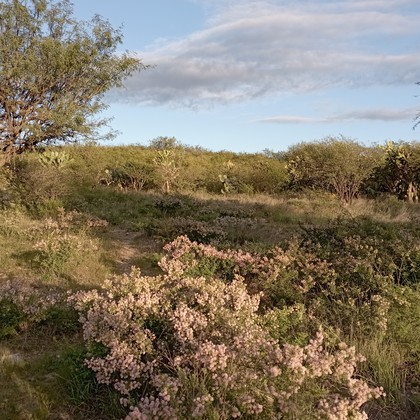
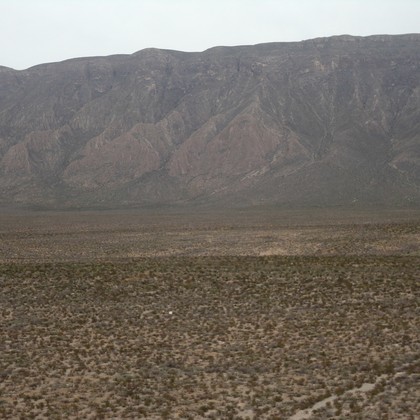
Dry grassland and semi-desert grassland with scattered shrubs, mesquite, yucca and cacti. In winter it stays hidden in the grass and is rarely seen. It eats insects in the breeding season and seeds in winter.
Where the bird is most at home, classified by the vegetation units of Mexico and Central America.

Range and movements
Breeds in the south-western and central United States, from the southern Great Plains to Arizona and Texas, and in northern Mexico. In the guide area mainly in Chihuahua, Coahuila, Nuevo León and Durango; in winter also further south on the central plateau and west to Sonora.
- Resident
- Summer visitor (c. Apr–Sep)
- Winter visitor (c. Oct–Mar)
- Passage (Mar–Apr, Oct–Nov)
- dark = core range, pale = thinly spread
How and when to look
In the breeding season, especially after the first rains, best found by its song flight over grassland with shrubs. The number of breeding birds varies greatly from year to year depending on rainfall.
Conservation status
Not threatened (LC). Still numerous, but declining in the long term through the conversion of grassland into farmland, overgrazing and shrub encroachment.
Scientific name
Peucaea cassinii | (Woodhouse, 1852)
Woodhouse described the species in 1852 as Zonotrichia cassinii; because it was later moved to another genus, the author and year stand in brackets. The genus Peucaea was introduced in 1839 by Audubon. Peucaea is Greek, from peukē 'pine tree'; Audubon called the type species the 'Pinewood-Finch', after the pine woods it inhabits. cassinii honours the American ornithologist John Cassin (1813–1869) of the Academy of Natural Sciences in Philadelphia. The specimen the first description was based on came from near San Antonio, Texas, USA.