All species › Passerines › Wrens › Carolina Wren
Position in the tree Birds Aves › Birds with a flexible palate Neognathae › All other modern birds Neoaves › Landbirds Telluraves › Falcons, parrots and passerines Australaves › Falcons and passerines Eufalconimorphae › Parrots and passerines Psittacopasserae
Carolina Wren | Thryothorus ludovicianus
Carolinawinterkoning | Chivirín de Carolina
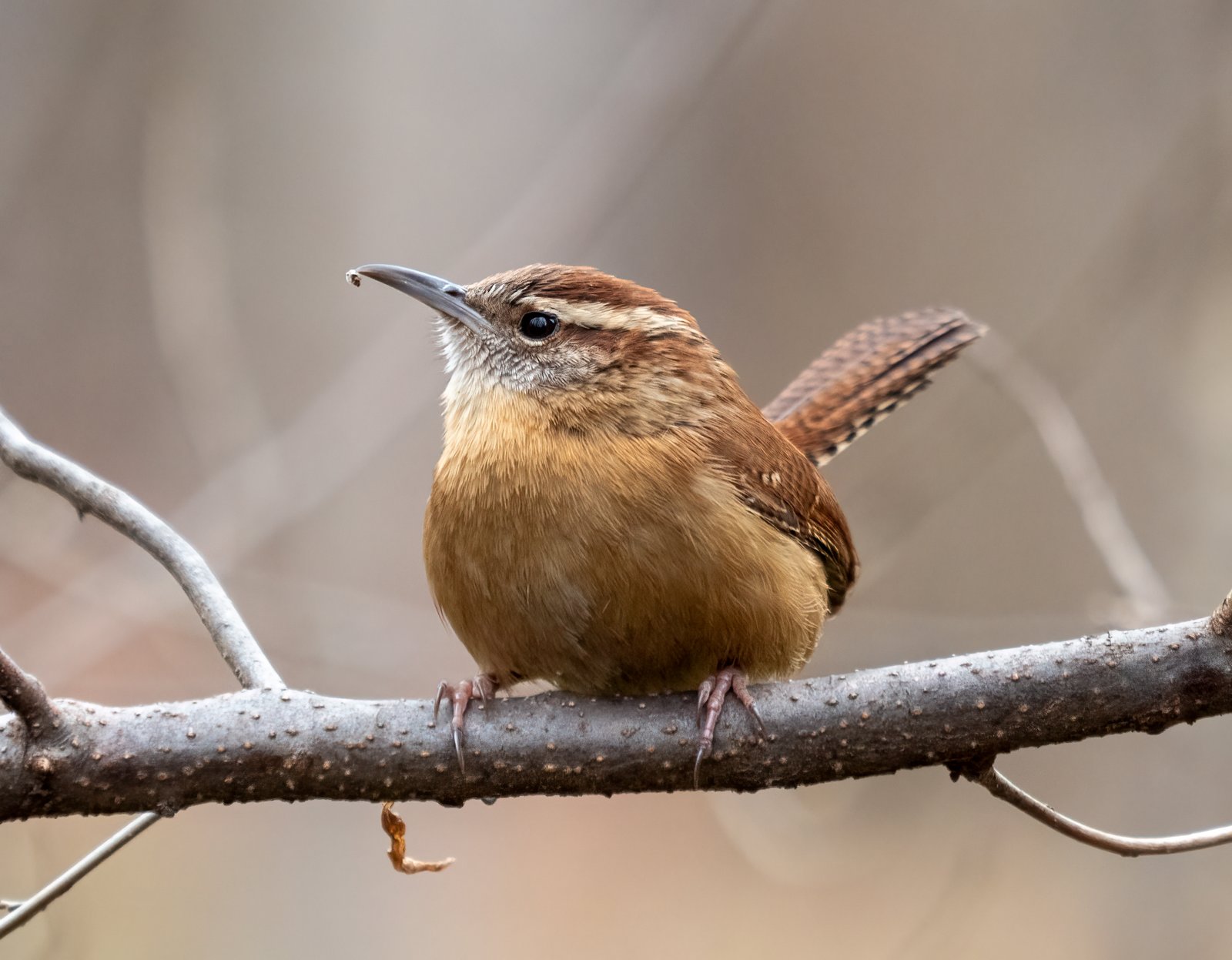
The Carolina Wren is a fairly large, warm brown wren with a long white supercilium and a loud, rolling song. In the arrangement followed here the White-browed group of the Yucatán Peninsula and surroundings also belongs to this species. In the guide area it lives in north-eastern Mexico and, with that group, from Yucatán to Nicaragua.
Voice
The song is a loud, rolling series of repeated two- or three-note phrases, such as chee-pee-ter chee-pee-ter chee-pee-ter. It sings year-round; pairs call to each other with rattling and rasping notes.
Recording: Rory Nefdt — CC BY-NC-SA 4.0 · shortened to the first 60 s, mono · xeno-canto
Identification
12–14 cm. Upperparts warm rufous-brown, tail and wings finely barred dark. Long white supercilium above a dark eye-stripe. Throat white, rest of the underparts warm ochre to cinnamon. Bill fairly long and slightly decurved. Birds of the White-browed group in the south-east are greyer brown, with paler, more dull white underparts and a white supercilium.
Confusion species
Bewick's Wren Thryomanes bewickii is greyer brown, with greyish-white underparts and a longer tail with white corners that it swings from side to side. Spot-breasted Wren Pheugopedius maculipectus has a black-and-white spotted breast and a streaked face. White-bellied Wren Uropsila leucogastra is much smaller and has white underparts.
Habitat
Dense scrub and undergrowth in riparian woodland, dry forest and thorn scrub, forest edges, overgrown ground and gardens with dense vegetation. It forages on and just above the ground for insects and spiders. Pairs remain in their territory all year.
Where the bird is most at home, classified by the vegetation units of Mexico and Central America.






Range and movements
In the guide area in north-eastern Mexico (Coahuila, Nuevo León and Tamaulipas). The White-browed group lives on the Yucatán Peninsula, in Belize and northern Guatemala, and locally further south to Honduras and Nicaragua. Outside the guide area in the eastern United States and extreme south-eastern Canada.
- Resident
- dark = core range, pale = thinly spread
How and when to look
In north-eastern Mexico often heard in dense scrub along rivers and in gardens; the loud, rolling song carries far.
Conservation status
Not assessed in this circumscription; the IUCN treats Carolina Wren and the White-browed group as separate species, both of which are not threatened. Common in suitable scrub.
Scientific name
Thryothorus ludovicianus | (Latham, 1790)
Latham described the species in 1790 as Sylvia ludoviciana; because it was later moved to another genus, the author and year stand in brackets. The genus Thryothorus was introduced in 1816 by Vieillot. Thryothorus is Greek, from thruon 'reed, rush' and thouros 'leaping, rushing': 'reed-leaper'. ludovicianus refers to Louisiana (from Ludovicus, Louis), where the type came from. The specimen the first description was based on came from Louisiana.