All species › Passerines › New World warblers › Buff-rumped Warbler
Position in the tree Birds Aves › Birds with a flexible palate Neognathae › All other modern birds Neoaves › Landbirds Telluraves › Falcons, parrots and passerines Australaves › Falcons and passerines Eufalconimorphae › Parrots and passerines Psittacopasserae
Buff-rumped Warbler | Myiothlypis fulvicauda
Zeemstuitzanger | Reinita culiparda
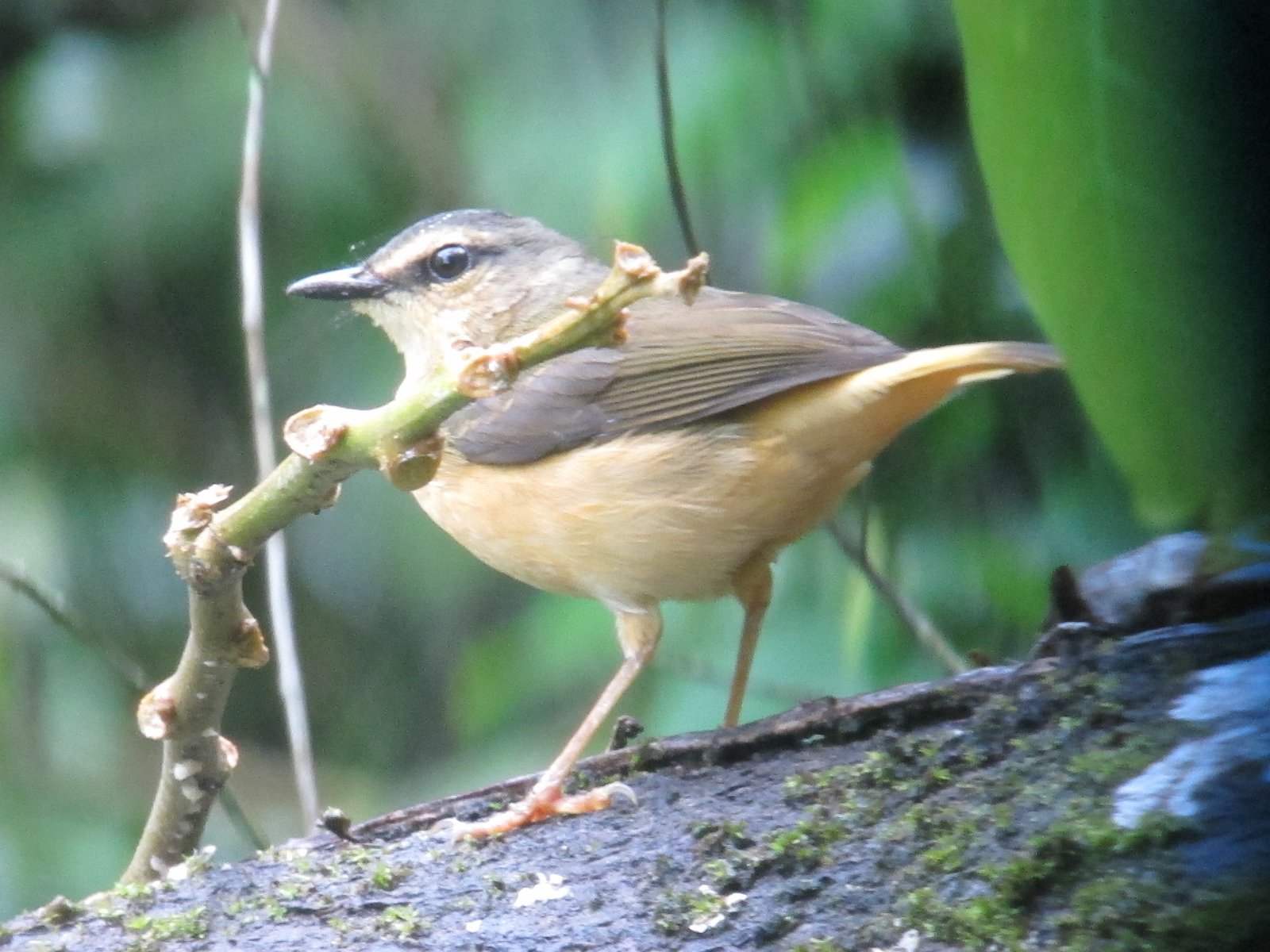
The Buff-rumped Warbler is an olive-brown warbler with a pale buff rump and tail base that lives almost always along streams and rivers in forest. It constantly swings its half-spread tail. In the guide area it occurs from Honduras to Panama.
Voice
The song is a loud series of rapid, clear notes that swells and accelerates, tsee tsee tsee chee-chee-chee-chew, clearly audible over the noise of running water. The call is a sharp chip.
Recording: Sofía Vargas Gómez — CC BY-NC-SA 4.0 · converted to mono · xeno-canto
Identification
13–14 cm. Upperparts greyish olive-brown, with a pale buff eyebrow and a dark eye-stripe. Rump, uppertail coverts and base of the tail bright buff, the outer half of the tail blackish; this contrast is easiest to see in flight. Underparts dull white to pale buff, slightly darker on the flanks and breast. It constantly swings its tail from side to side and half-spreads it while doing so.
Confusion species
Louisiana Waterthrush Parkesia motacilla and Northern Waterthrush Parkesia noveboracensis, winter visitors along the same streams, have streaked underparts, no pale rump, and bob the rear body up and down instead of swinging the tail sideways.
Habitat
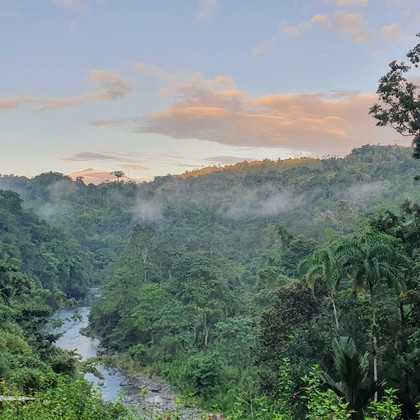
Rocky and stony streams and rivers in humid forest, from sea level to about 1500 m, also along trails and clearings close to water. It searches for insects walking over stones, on banks and on the forest floor.
Where the bird is most at home, classified by the vegetation units of Mexico and Central America.




Range and movements
Occurs from eastern Honduras through Nicaragua, Costa Rica and Panama to north-western South America, on the Caribbean slope and in Costa Rica and Panama also on the Pacific slope. On the range map the northern part of the range, in Honduras and Nicaragua, is incompletely shown because of few records.
- Resident
- dark = core range, pale = thinly spread
How and when to look
Regularly found along streams at lodges and along forest trails in the lowlands and hills of Costa Rica and Panama; the swinging tail and the pale rump give the bird away even in shade.
Conservation status
Not threatened (LC). Common in suitable habitat; depends on forest with clean streams.
Scientific name
Myiothlypis fulvicauda | (Spix, 1825)
Spix described the species in 1825 as Muscicapa fulvicauda; because it was later moved to another genus, the author and year stand in brackets. The genus Myiothlypis was introduced in 1851 by Cabanis. Myiothlypis is Greek, from muia 'fly' and thlupis, an unidentified small bird: 'fly-warbler'. fulvicauda is Latin, from fulvus 'tawny' and cauda 'tail', after the pale buff rump and tail base. The specimen the first description was based on came from São Paulo de Olivença, Solimões River, Brazil.