All species › Kingfishers, bee-eaters and rollers › Motmots › Broad-billed Motmot
Position in the tree Birds Aves › Birds with a flexible palate Neognathae › All other modern birds Neoaves › Landbirds Telluraves › Raptors, owls, kingfishers and woodpeckers Afroaves › Mousebirds, rollers and woodpeckers Coraciimorphae › Trogons and cavity nesters Cavitaves › Hornbills, kingfishers and woodpeckers Picocoraciae › Kingfishers, bee-eaters and woodpeckers Picodynastornithes
Broad-billed Motmot | Electron platyrhynchum
Breedsnavelmotmot | Momoto piquiancho
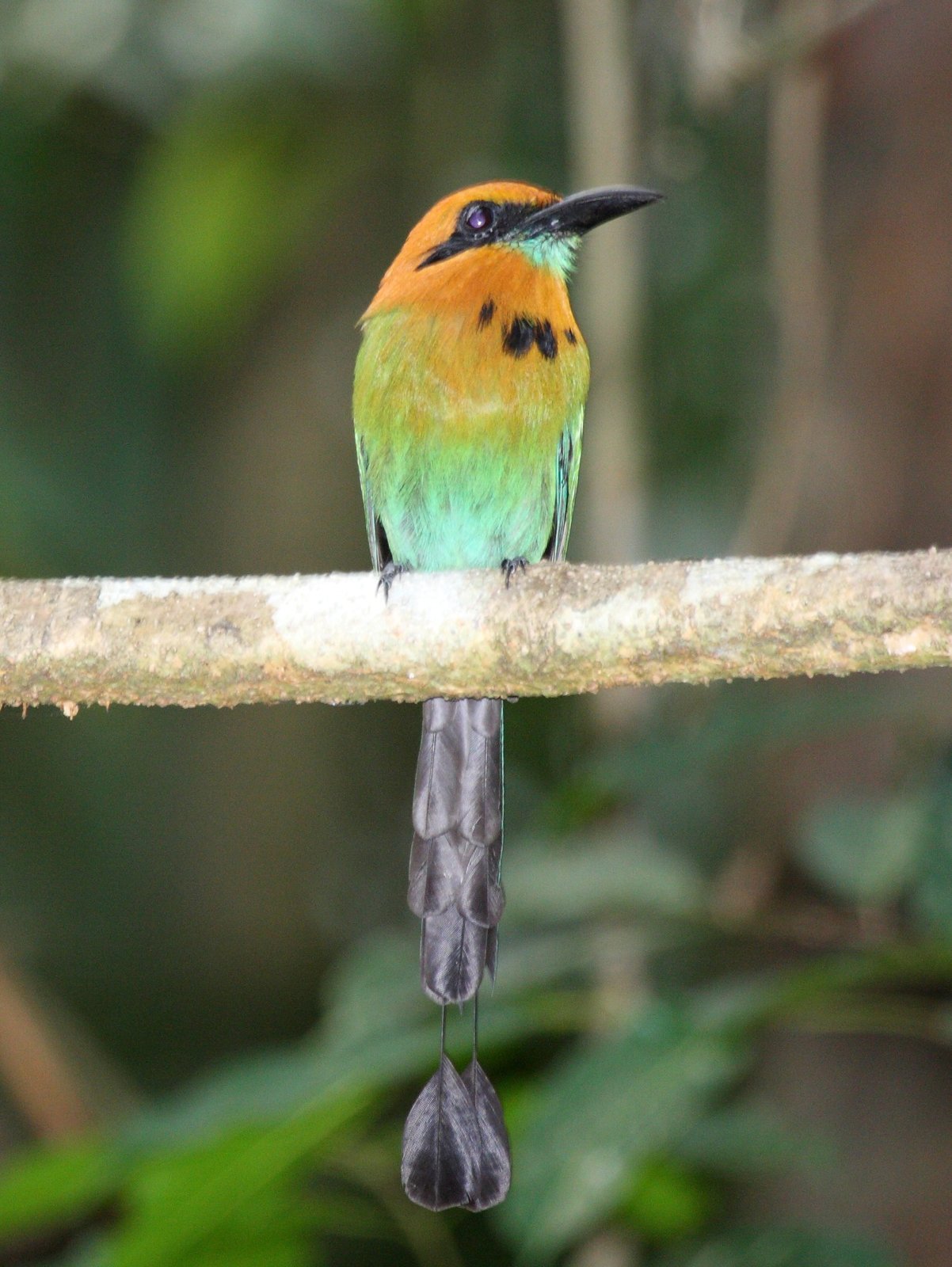
The Broad-billed Motmot is the most widespread motmot in the south of the guide area, in humid lowland forest from Honduras to Panama. It has a rufous head and breast and a broad, flat bill. Its range extends into the Amazon Basin.
Voice
A nasal, resonant kwaanh or aah-hn, repeated at intervals for long periods, mainly in the early morning. It often comes from the shade of the middle tree layer.
Recording: Xavier Riera — CC BY-NC-SA 4.0 · converted to mono · xeno-canto
Identification
30–35 cm, including the tail rackets. The head, neck and breast are rufous, with a black mask through the eye, a turquoise chin and a small black breast spot. The back, wings and belly are green, the flight feathers and tail blue-green. The two central tail feathers end in a small racket on a short stretch of bare shaft; the rackets are sometimes missing. The bill is broad and flat with a slight keel. The sexes are alike.
Confusion species
Rufous Motmot Baryphthengus martii has the same colour pattern but is much larger (42–47 cm) and heavier, with a rufous belly, no turquoise chin and a long tail with large rackets; its call is a deep, rapid series of hoo notes. Keel-billed Motmot Electron carinatum is green with only the forehead rufous. Momotus species such as Whooping Motmot Momotus subrufescens have a black crown ringed blue.
Habitat
Humid lowland and foothill forest up to about 1000 m, also tall secondary forest and forest edges along clearings and roads. It perches in the middle tree layer and takes large insects, spiders and small lizards from branches and leaves as well as from the ground. It nests in a self-dug tunnel in a bank or road cut.
Where the bird is most at home, classified by the vegetation units of Mexico and Central America.




Range and movements
Caribbean side of eastern Honduras and of Nicaragua, Costa Rica, where it occurs mainly on the Caribbean side and locally in the south-west, and Panama on both slopes east to Darién. Outside the guide area in Colombia, Ecuador, Peru, western Brazil and Bolivia.
- Resident
- dark = core range, pale = thinly spread
How and when to look
Common at La Selva in Costa Rica and along Pipeline Road (Camino del Oleoducto) in Soberanía in Panama. A perched bird is often noticed only when it swings its tail from side to side.
Conservation status
Least Concern. Common in closed forest; it disappears where forest is cleared but persists in tall secondary forest.
Scientific name
Electron platyrhynchum | (Leadbeater, 1829)
Leadbeater described the species in 1829 as Momotus platyrhynchus; because it was later moved to another genus, the author and year stand in brackets. The genus Electron was introduced in 1848 by Gistel. Electron is Greek ēlektron 'amber'; Gistel coined it in 1848 to replace a preoccupied name, without explanation, possibly after the plumage colour. platyrhynchum is Greek for 'broad-billed', from platus 'broad' and rhunkhos 'bill'. The specimen the first description was based on came from western Ecuador.