All species › Swifts › Hummingbirds › Blue-throated Mountaingem
Position in the tree Birds Aves › Birds with a flexible palate Neognathae › All other modern birds Neoaves › Birds of the elements Elementaves › Nightjars and swifts Strisores
Blue-throated Mountaingem | Lampornis clemenciae
Blauwkeeljuweelkolibrie | Colibrí garganta azul
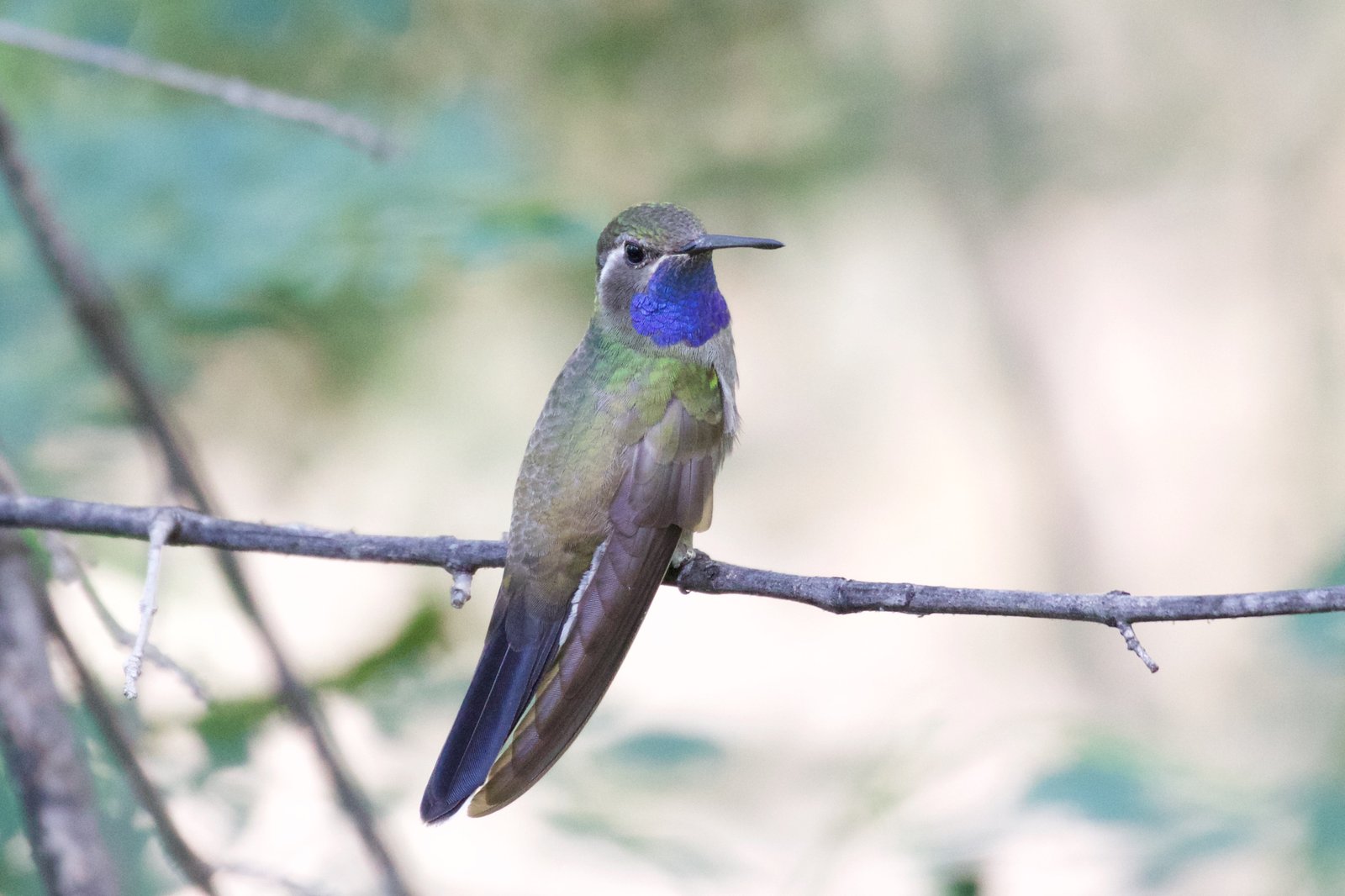
The Blue-throated Mountaingem is the largest mountaingem and one of the largest hummingbirds in the guide area. It lives in the mountains of Mexico, especially in wooded canyons with running water, and breeds north into the south-western United States. At feeders and flowering shrubs it often chases off smaller hummingbirds.
Voice
A high, penetrating seep or tseek, often repeated and audible from afar. In the breeding season males give a soft, squeaky song.
Recording: Manuel Grosselet — CC BY-NC-SA 4.0 · converted to mono · xeno-canto
Identification
12–14 cm, with a straight black bill. The upperparts are bronze-green, the underparts plain grey. Both sexes have a white stripe behind the eye and a white malar stripe, with a dark cheek patch in between. The tail is large and blue-black, with broad white tips to the outer feathers, which stand out when the bird spreads its tail. The male has a glittering blue throat; the female has a plain grey throat.
Confusion species
Rivoli's Hummingbird Eugenes fulgens is as large, but has a longer bill and no large white tail corners; the male has a purple crown and a green throat, the female speckled grey underparts. Amethyst-throated Mountaingem Lampornis amethystinus is smaller, lacks the white malar stripe and has only small grey tail tips. White-eared Hummingbird Basilinna leucotis is much smaller, with a red bill.
Habitat
Pine-oak forest, oak forest and cloud forest in the mountains, especially in humid canyons and along streams with dense riparian growth, at about 1500 to 3000 m. It visits flowering shrubs and herbs along streams and forest edges, and comes readily to feeders in gardens. In winter some birds move down to lower elevations, and birds from the north move south.
Where the bird is most at home, classified by the vegetation units of Mexico and Central America.





Range and movements
In the mountains of Mexico: the Sierra Madre Occidental from Sonora and Chihuahua southwards, the Sierra Madre Oriental from Coahuila and Nuevo León, the Trans-Mexican Volcanic Belt and the mountains of Guerrero and Oaxaca. Outside the guide area it breeds in south-eastern Arizona, south-western New Mexico and western Texas; those birds winter largely in Mexico.
- Resident
- Summer visitor (c. Apr–Sep)
- Winter visitor (c. Oct–Mar)
- Passage (Mar–Apr, Oct–Nov)
- dark = core range, pale = thinly spread
How and when to look
In wooded canyons in the mountains of northern and central Mexico, especially at feeders at lodges and gardens and along streams with flowering salvias. At feeders the species can be told from other hummingbirds by its size and white tail corners.
Conservation status
Not threatened. Fairly common in suitable habitat. The species benefits from feeders, but depends on humid canyons with riparian vegetation.
Scientific name
Lampornis clemenciae | (Lesson, 1830)
Lesson described the species in 1830 as Ornismya Clemenciae; because it was later moved to another genus, the author and year stand in brackets. The genus Lampornis was introduced in 1827 by Swainson. Lampornis is Greek, from lampē 'torch, light' and ornis 'bird': 'light-bird', after the glittering throat. clemenciae honours Marie-Clémence Lesson, née Dumont de Sainte-Croix (1800–1834), French botanical illustrator and wife of the naturalist René Primevère Lesson, who described the species. The specimen the first description was based on came from Mexico (not specified).