All species › Swifts › Hummingbirds › Amethyst-throated Mountaingem
Position in the tree Birds Aves › Birds with a flexible palate Neognathae › All other modern birds Neoaves › Birds of the elements Elementaves › Nightjars and swifts Strisores
Amethyst-throated Mountaingem | Lampornis amethystinus
Groene juweelkolibrie | Colibrí garganta amatista
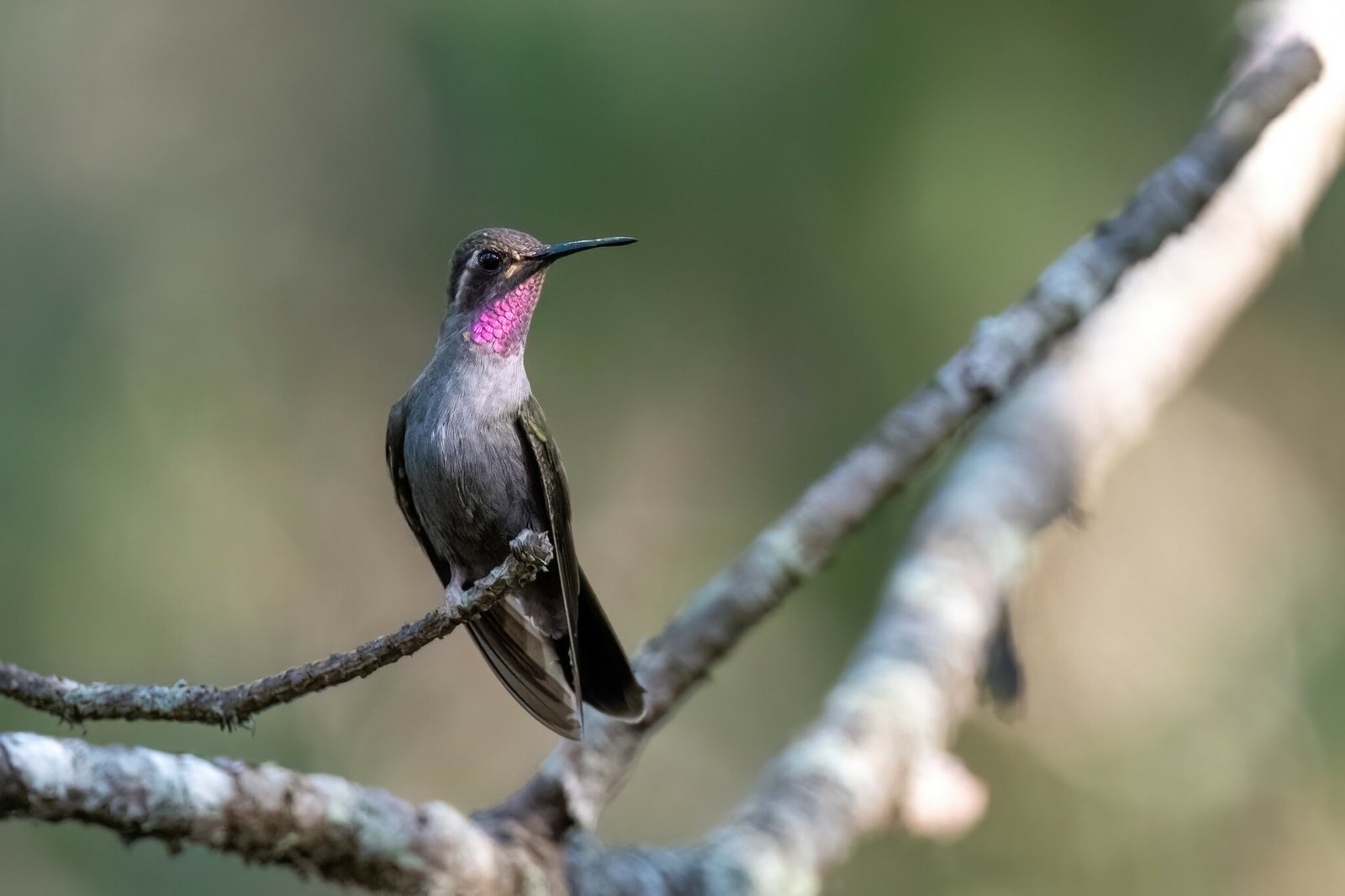
The Amethyst-throated Mountaingem is the most widespread mountaingem of the mountains of Mexico and northern Central America, from the Sierra Madre in Mexico to Honduras. The male has a coloured throat that varies between populations from rose-amethyst to blue-violet. In the forest it is inconspicuous, usually feeding in the understorey and middle strata.
Voice
A dry, sharp chik or chit, and in chases a rattling twitter.
Recording: Matthew L. Brady — CC BY-NC-SA 4.0 · shortened to the first 60 s, mono · xeno-canto
Identification
11–12 cm, with a straight black bill. The upperparts are green, with a white stripe behind the eye and a dark facial mask. The male has a glittering throat that varies between populations from rose-amethyst to blue-violet, dark grey underparts and a dark tail with grey tips to the outer feathers. The female has a cinnamon throat and grey to greyish-brown underparts.
Confusion species
Blue-throated Mountaingem Lampornis clemenciae is larger, has a white malar stripe as well as the white eyestripe, and a large, dark tail with broad white tips to the outer feathers. Green-throated Mountaingem Lampornis viridipallens and Green-breasted Mountaingem Lampornis sybillae have a white, green-spotted throat and a white belly. White-eared Hummingbird Basilinna leucotis has a red bill with a black tip and a broader white eyestripe. Garnet-throated Hummingbird Lamprolaima rhami has rufous wings.
Habitat
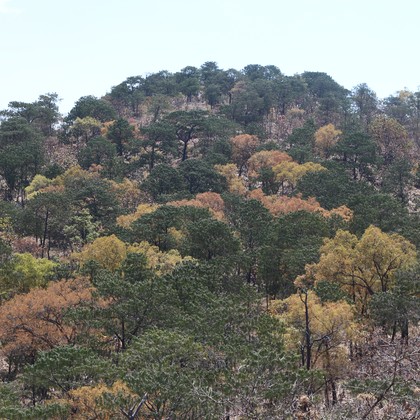
Humid oak and pine-oak forest, cloud forest and forest edges in the mountains, at about 900 to 3000 m, most often between 1500 and 2500 m. It feeds in the understorey and middle strata at flowers of shrubs, epiphytes and vines, and catches small insects. Outside the breeding season some birds move down to lower elevations.
Where the bird is most at home, classified by the vegetation units of Mexico and Central America.



Range and movements
Endemic to the guide area. In Mexico in the western mountains from Jalisco and Colima, the Trans-Mexican Volcanic Belt, the Sierra Madre Oriental from southern Nuevo León and Tamaulipas, and the mountains of Guerrero, Oaxaca and Chiapas; further in the highlands of Guatemala, El Salvador and Honduras.
- Resident
- dark = core range, pale = thinly spread
How and when to look
In the El Cielo biosphere reserve in Tamaulipas, in the cloud forest around Xalapa in Veracruz and in the mountains of Oaxaca and Chiapas; in Guatemala on the volcano slopes around Antigua and Lake Atitlán. Often at flowering shrubs along forest trails.
Conservation status
Not threatened. Fairly common in suitable montane forest. Loss of cloud forest and oak forest affects the species locally, but its range is large.
Scientific name
Lampornis amethystinus | Swainson, 1827
Swainson described the species in 1827 and placed it straight away in the genus where it still stands. He introduced the genus Lampornis in that same work. Lampornis is Greek, from lampē 'torch, light' and ornis 'bird': 'light-bird', after the glittering throat. amethystinus is Latin for 'amethyst-coloured', after the male's purplish-red throat. The specimen the first description was based on came from Temascaltepec and Real del Monte, Mexico.