All species › Parrots › African and New World parrots › Blue-headed Parrot
Position in the tree Birds Aves › Birds with a flexible palate Neognathae › All other modern birds Neoaves › Landbirds Telluraves › Falcons, parrots and passerines Australaves › Falcons and passerines Eufalconimorphae › Parrots and passerines Psittacopasserae
Blue-headed Parrot | Pionus menstruus
Zwartoormargrietje | Loro cabeciazul
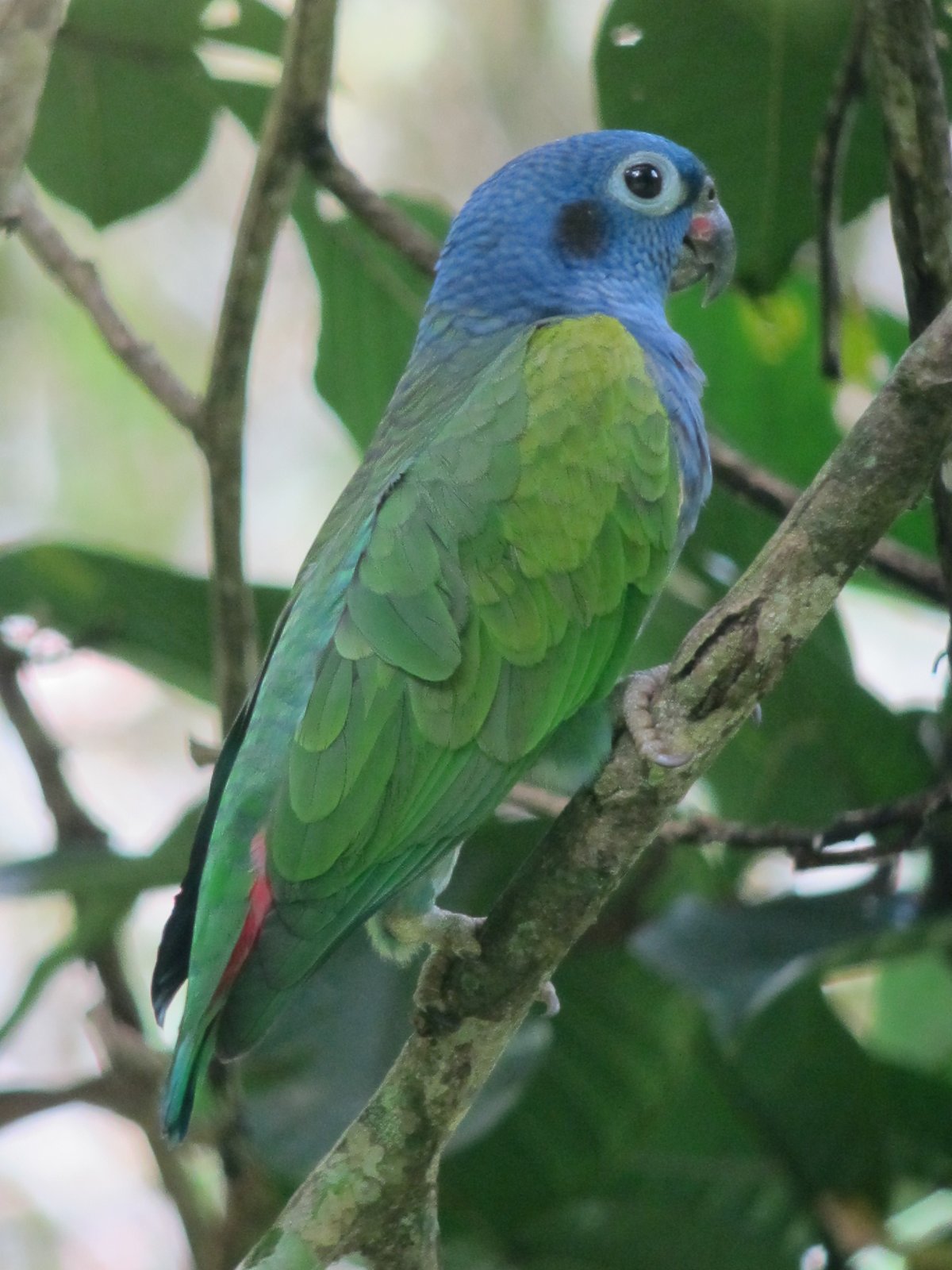
The Blue-headed Parrot is a medium-sized green parrot with a cobalt-blue head and neck, a short tail and red undertail coverts. It is the most widespread parrot of tropical South America and reaches the northern limit of its range in Costa Rica. In Panama it is one of the commonest parrots of forest and forest edge.
Voice
A high, shrill, metallic kweek-kweek or sweenk, mainly in flight and often repeated; perched groups give a softer chatter.
Recording: Paul Molina Abril — CC BY-NC-SA 4.0 · converted to mono · xeno-canto
Identification
24–28 cm. Head, neck and upper breast are cobalt blue, with a blackish patch on the ear coverts. The body is green, the undertail coverts are red and the outer tail feathers are red at the base. The bill is dark with a pink spot on each side of the upper mandible. In flight the deep, powerful wingbeat stands out, with the wings swinging well below the body. Young birds have a mostly green head with little blue and sometimes some red on the forehead. Male and female are alike.
Confusion species
The White-crowned Parrot Pionus senilis has the same shape and flight, but a white forehead and throat and olive-brown wing coverts. Amazons such as the Red-lored Amazon Amazona autumnalis are larger, with a longer tail, a stiffer, shallow wingbeat and a red wing speculum. The Brown-hooded Parrot Pyrilia haematotis is smaller, with a brown head and red underwing coverts.
Habitat
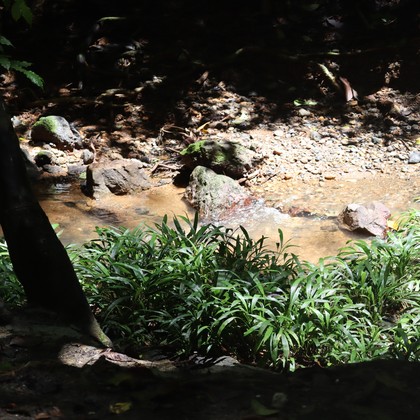
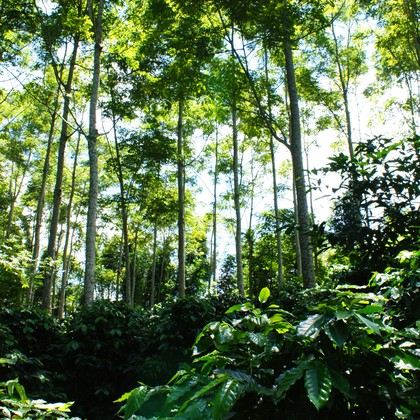
Humid lowland and foothill forest, forest edges, gallery forest, secondary forest and semi-open country with large trees, also shade coffee, cacao and other plantations; mostly below 1000 m. It eats fruit, seeds and flowers in the canopy, including those of coral trees. It nests in a cavity in a tree or palm.
Where the bird is most at home, classified by the vegetation units of Mexico and Central America.





Range and movements
In the guide area from Costa Rica to Panama. In Costa Rica mainly in the Caribbean lowlands and more scarcely in the south of the Pacific side, around the Golfo Dulce. In Panama fairly common on both sides of the country, from Bocas del Toro and Chiriquí to Darién. Outside the guide area in much of tropical South America, south to Bolivia and central Brazil, and on Trinidad.
- Resident
- dark = core range, pale = thinly spread
How and when to look
In Panama groups fly over the forest along the Panama Canal every day, for example at Pipeline Road in Soberanía National Park, especially early in the morning and late in the afternoon. The blue head is often more visible in flight than when perched in the canopy.
Conservation status
Not threatened. Locally declining through deforestation and trapping for the cage-bird trade, but still widespread and fairly common in Panama.
Scientific name
Pionus menstruus | (Linnaeus, 1766)
Linnaeus described the species in 1766 as Psittacus menstruus; because it was later moved to another genus, the author and year stand in brackets. The genus Pionus was introduced in 1832 by Wagler. Pionus is Greek, from piōn, pionos 'fat', after the stocky build. menstruus is Latin for 'monthly, of menstruation', meaning 'blood-red' here, after the red undertail coverts. The specimen the first description was based on came from Suriname.