All species › Pigeons and doves › Doves and pigeons › Blue Ground Dove
Position in the tree Birds Aves › Birds with a flexible palate Neognathae › All other modern birds Neoaves › Doves, turacos and allies Columbaves › Doves and sandgrouse Columbimorphae
Blue Ground Dove | Claravis pretiosa
Blauwe grondduif | Tórtola azul
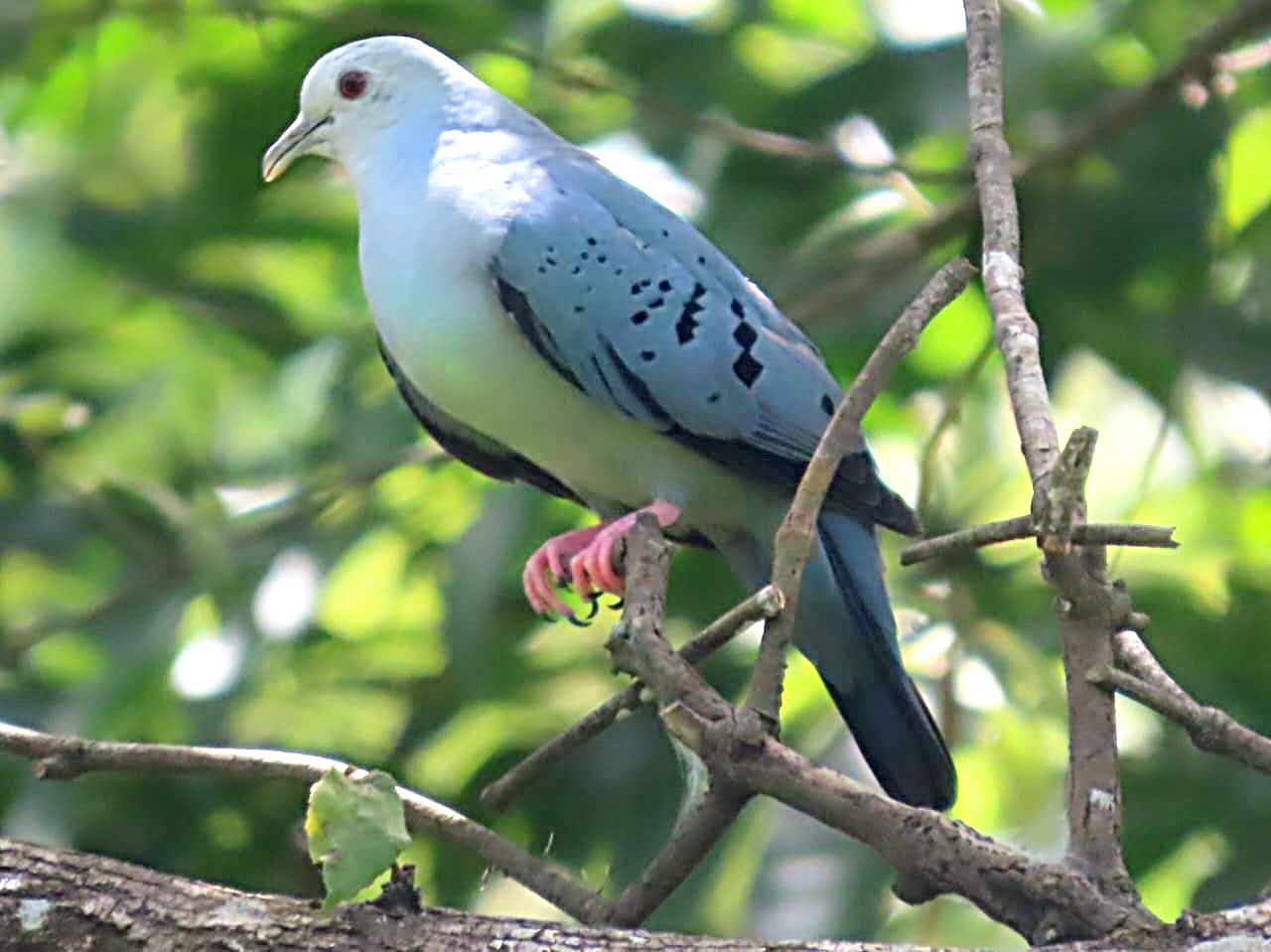
Blue Ground Dove is a small dove of forest edges and clearings in the humid lowlands, from southern Mexico to Panama. Male and female differ so strongly that they could pass for two species: the male is almost entirely blue-grey, the female warm brown. Unlike most small ground doves, the male often calls from high in a tree.
Voice
The male gives a loud, single boop from the treetops, repeated at regular intervals and carrying far. The calling bird often sits high and hidden. On take-off the wings clatter audibly.
Recording: Richard E. Webster — CC BY-NC-SA 4.0 · converted to mono · xeno-canto
Identification
19–21 cm, slimmer and longer-tailed than Ruddy Ground Dove. The male is uniform blue-grey above and paler grey below, becoming almost white towards the face. The wing has a few large black spots and bars, and the outer tail feathers are black, which shows when the bird flushes. The female is grey-brown to warm brown on the head, neck and breast, with chestnut spots on the wing, a rufous rump and tail and a paler belly. Young birds resemble the female but are duller, with pale fringes to the feathers of the upperparts.
Confusion species
The male Maroon-chested Ground Dove Paraclaravis mondetoura is darker slate-grey, with a maroon-purple breast, purple wing bars and white tail corners; it lives in bamboo in montane forest. The female Ruddy Ground Dove Columbina talpacoti is smaller and more compact, with black wing spots, and lives mainly in open, built-up terrain. Plain-breasted Ground Dove Columbina minuta is clearly smaller and grey-brown with a short tail. White-tipped Dove Leptotila verreauxi is much larger, with a pale belly and white tail tips.
Habitat
Forest edges, clearings and trails in humid forest, secondary forest, riparian forest, plantations and pasture with trees bordering forest, mainly in the lowlands and foothills up to about 1200 m. Singly, in pairs or in small groups. Searches for seeds and small insects on the ground. The nest is a thin, flat structure of twigs in a tree, with two white eggs.
Where the bird is most at home, classified by the vegetation units of Mexico and Central America.





Range and movements
On the Gulf slope of Mexico from south-eastern San Luis Potosí and southern Tamaulipas through Veracruz, Oaxaca, Tabasco and Chiapas to the southern Yucatán Peninsula. Further in Belize, Guatemala, El Salvador, Honduras, Nicaragua, Costa Rica and Panama, on both slopes but mainly on the humid Caribbean side. Outside the guide area in South America to north-western Peru and, east of the Andes, to northern Argentina.
- Resident
- dark = core range, pale = thinly spread
How and when to look
The call is the best lead: a repeated, loud boop from the treetops along a forest road or edge. Birds feeding on a trail flush fast and low when disturbed; the blue-grey of the male and the black outer tail feathers are then the first things to show. The lowlands of Costa Rica and Panama, such as around La Selva and Pipeline Road, offer good chances.
Conservation status
Not threatened globally. In the guide area widespread and locally fairly common. As a forest-edge bird the species is less sensitive to fragmentation than true forest dwellers, but it disappears where forest gives way entirely to open land.
Scientific name
Claravis pretiosa | (Ferrari-Pérez, 1886)
Ferrari-Pérez described the species in 1886 as Peristera pretiosa; because it was later moved to another genus, the author and year stand in brackets. The genus Claravis was introduced in 1899 by Oberholser. Claravis is Latin, from clarus 'clear, bright' and avis 'bird'. pretiosa is Latin for 'precious', after the handsome blue-grey plumage of the male. The specimen the first description was based on came from Brazil.