All species › Passerines › Tanagers and allies › Blue-grey Tanager
Position in the tree Birds Aves › Birds with a flexible palate Neognathae › All other modern birds Neoaves › Landbirds Telluraves › Falcons, parrots and passerines Australaves › Falcons and passerines Eufalconimorphae › Parrots and passerines Psittacopasserae
Blue-grey Tanager | Thraupis episcopus
Bisschopstangare | Tangara azuleja
The Blue-grey Tanager is a medium-sized, blue-grey tanager of semi-open and inhabited country. It lives in pairs or small groups in forest edges, plantations, gardens and parks, even in the middle of villages and towns. In the guide area it occurs from southern Mexico to Panama.
Voice
Calls are thin, high squeaks, such as tsee and tsoo. The song is a rapid, squeaky and somewhat scratchy series of twittering notes, often kept up for a long time from a branch or wire.
Recording: JAYRSON ARAUJO DE OLIVEIRA — CC BY-NC-SA 4.0 · converted to mono · xeno-canto
Identification
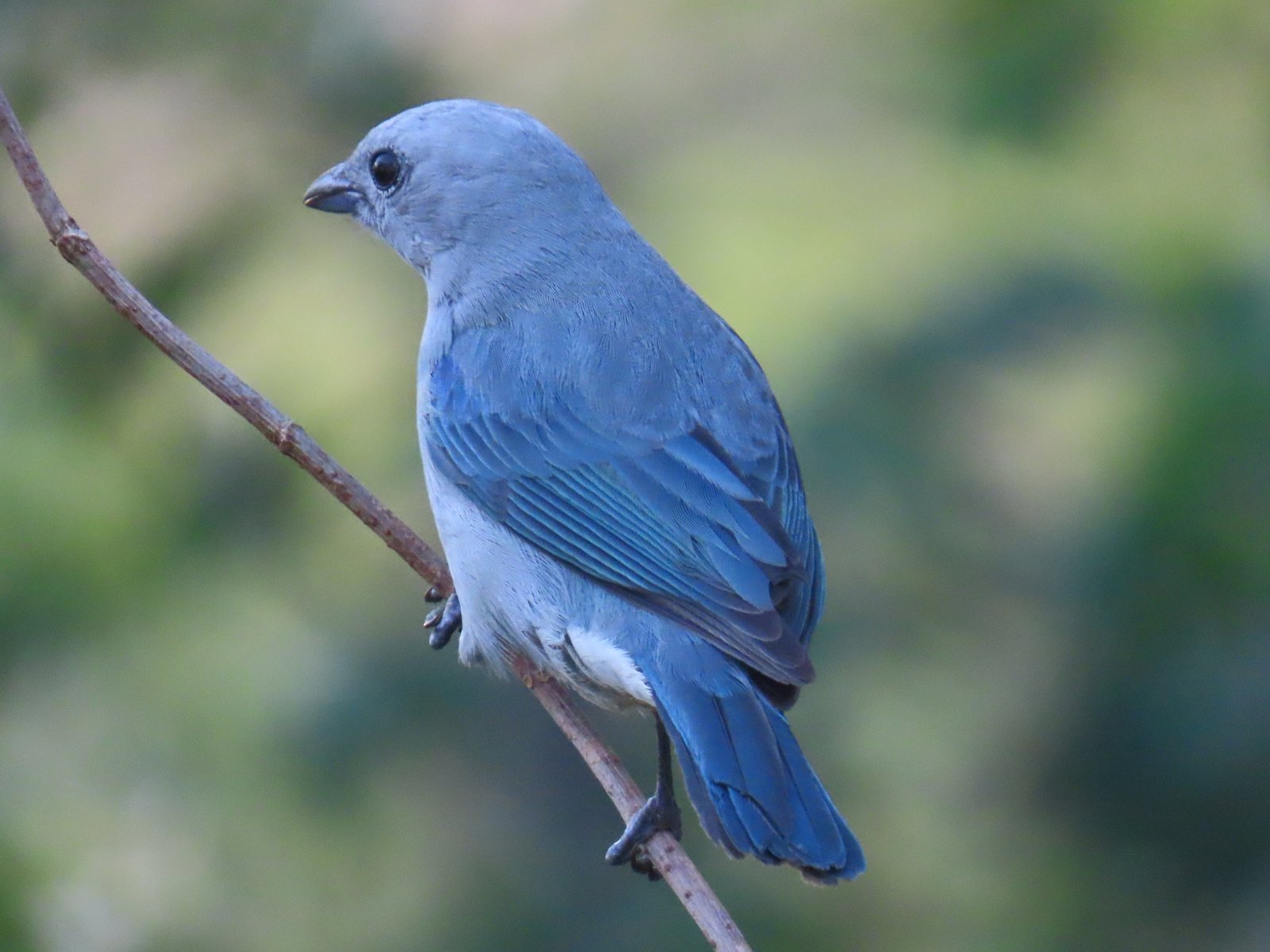
16–18 cm. A fairly slender tanager with a short, stout, dark bill. Head and underparts pale greyish blue, back slightly darker blue-grey. Wings and tail brighter blue; the lesser wing coverts form a violet-blue to pale blue shoulder patch. No markings on the head or wings. Male and female are alike; the female and young birds are duller and greyer.
Confusion species
Palm Tanager Thraupis palmarum has the same shape but is greyish olive with a black rear half to the wing. Yellow-winged Tanager Thraupis abbas (southern Mexico to Nicaragua) is larger, with a lilac-blue head, an olive-grey back and black wings with a yellow patch. Plain-colored Tanager Tangara inornata (Costa Rica and Panama) is smaller and darker grey, with a blackish mask and a small blue shoulder patch.
Habitat
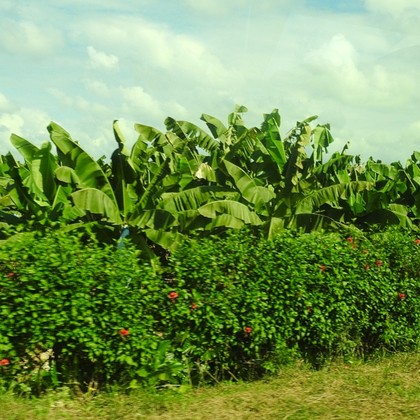
Forest edges, open woodland, secondary forest, riverine forest, plantations, shade coffee, pasture with trees, gardens and parks; avoids closed forest. Mainly in lowlands and hills up to about 2000 m, locally higher. It eats fruit, nectar, leaf buds and insects, and comes to bananas and other fruit in gardens.
Where the bird is most at home, classified by the vegetation units of Mexico and Central America.





Range and movements
From southern Veracruz and northern Oaxaca and Chiapas through Tabasco, the southern Yucatán Peninsula, Belize and Guatemala; from Honduras to Panama on both slopes, but scarcer in the driest Pacific lowlands. Outside the guide area across much of tropical South America, south to Bolivia and Amazonian Brazil, and on Trinidad and Tobago. Central American birds have a blue shoulder patch; in parts of Amazonia there are forms with white shoulders. All these forms are treated as a single species.
- Resident
- dark = core range, pale = thinly spread
How and when to look
One of the commonest tanagers in gardens and parks in Costa Rica and Panama; at feeders with bananas it is often among the first visitors.
Conservation status
Not threatened (LC). Common and widespread; benefits from deforestation and from the spread of gardens and plantations.
Scientific name
Thraupis episcopus | (Linnaeus, 1766)
Linnaeus described the species in 1766 as Tanagra Episcopus; because it was later moved to another genus, the author and year stand in brackets. The genus Thraupis was introduced in 1826 by Boie. Thraupis is the Ancient Greek word for an unidentified small bird mentioned by Aristotle. episcopus is Latin for 'bishop', a name going back to Buffon's 'L'Évêque', after the blue colour. The specimen the first description was based on came from Brazil (probably Cayenne, French Guiana).