All species › Passerines › Cotingas › Black-tipped Cotinga
Position in the tree Birds Aves › Birds with a flexible palate Neognathae › All other modern birds Neoaves › Landbirds Telluraves › Falcons, parrots and passerines Australaves › Falcons and passerines Eufalconimorphae › Parrots and passerines Psittacopasserae
Black-tipped Cotinga | Carpodectes hopkei
Witte cotinga | Cotinga blanco
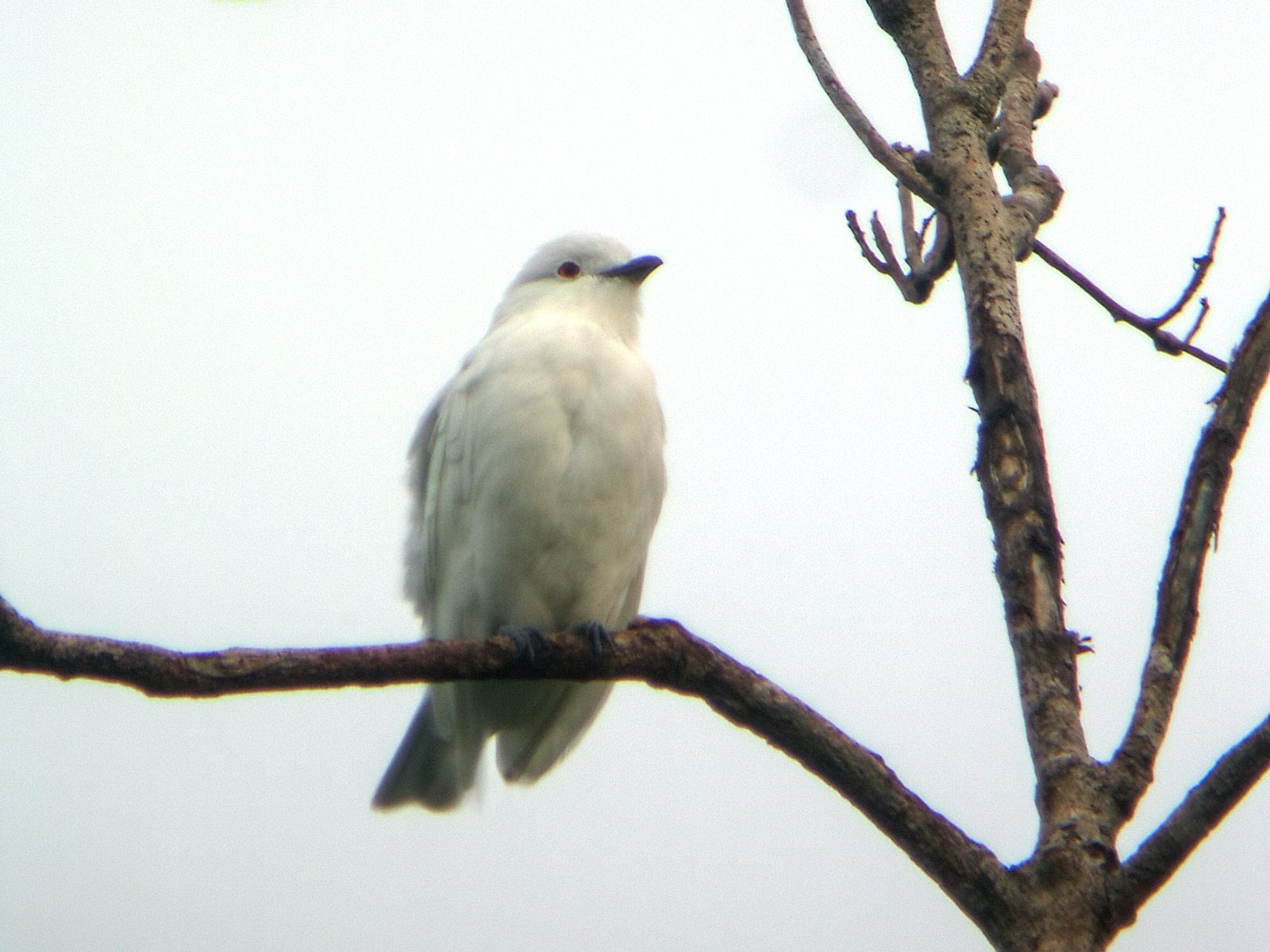
The Black-tipped Cotinga is the largest Carpodectes, an almost entirely white cotinga of the canopy of the Chocó rainforest. It often perches conspicuously on bare treetops above the canopy. In the guide area it lives only in eastern Panama.
Voice
Usually silent; sometimes a soft, short tchk or a squeaky note.
Recording: Niels Krabbe — CC BY-NC-SA 4.0 · shortened to the first 60 s, mono · xeno-canto
Identification
24–25 cm. The male is pure white with small black tips to the outer primaries and central tail feathers; bill dark, eye dark. The female is grey on head and back, whitish below, with dark wings and tail and white edges to the coverts and tertials. Wings long and fairly pointed; flight undulating and dove-like.
Confusion species
Snowy Cotinga Carpodectes nitidus and Yellow-billed Cotinga Carpodectes antoniae are smaller and live farther west, so they do not occur alongside this species in the guide area. Tityras, such as Masked Tityra Tityra semifasciata, are greyish white with black wings and tail and have red bare skin around the eye and bill base. White Hawk Pseudastur albicollis is much larger, with black wings.
Habitat
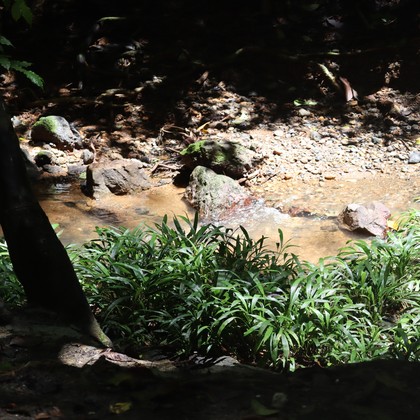
Canopy and edges of humid lowland and foothill forest up to about 900 m, also along rivers and in tall secondary forest with fruiting trees. It eats mainly fruit. It often sits on high, bare branches above the canopy and travels long distances over the forest.
Where the bird is most at home, classified by the vegetation units of Mexico and Central America.



Range and movements
Eastern Panama, mainly in Darién. Outside the guide area in the Chocó region of western Colombia and north-western Ecuador.
- Resident
- dark = core range, pale = thinly spread
How and when to look
Can be looked for in Darién, for example around Cana and on the slopes of Cerro Pirre. Scanning the tops of tall trees and bare branches above the canopy helps.
Conservation status
Not threatened. Rather scarce in Panama; dependent on large areas of continuous forest.
Scientific name
Carpodectes hopkei | Berlepsch, 1897
Berlepsch described the species in 1897 and placed it straight away in the genus where it still stands. The genus Carpodectes was introduced in 1865 by Salvin. Carpodectes is Greek, from karpos 'fruit' and dēktēs 'biter': 'fruit-biter', after the fruit diet. hopkei honours Gustav Hopke (fl. 1897), a German collector in tropical America. The specimen the first description was based on came from San José, Río Dagua, Colombia.