All species › Cranes, rails and allies › Rails, gallinules and coots › Black Rail
Position in the tree Birds Aves › Birds with a flexible palate Neognathae › All other modern birds Neoaves › Birds of the elements Elementaves › Cranes and waders Gruimorphae
Black Rail | Laterallus jamaicensis
Zwarte dwergral | Polluela negra
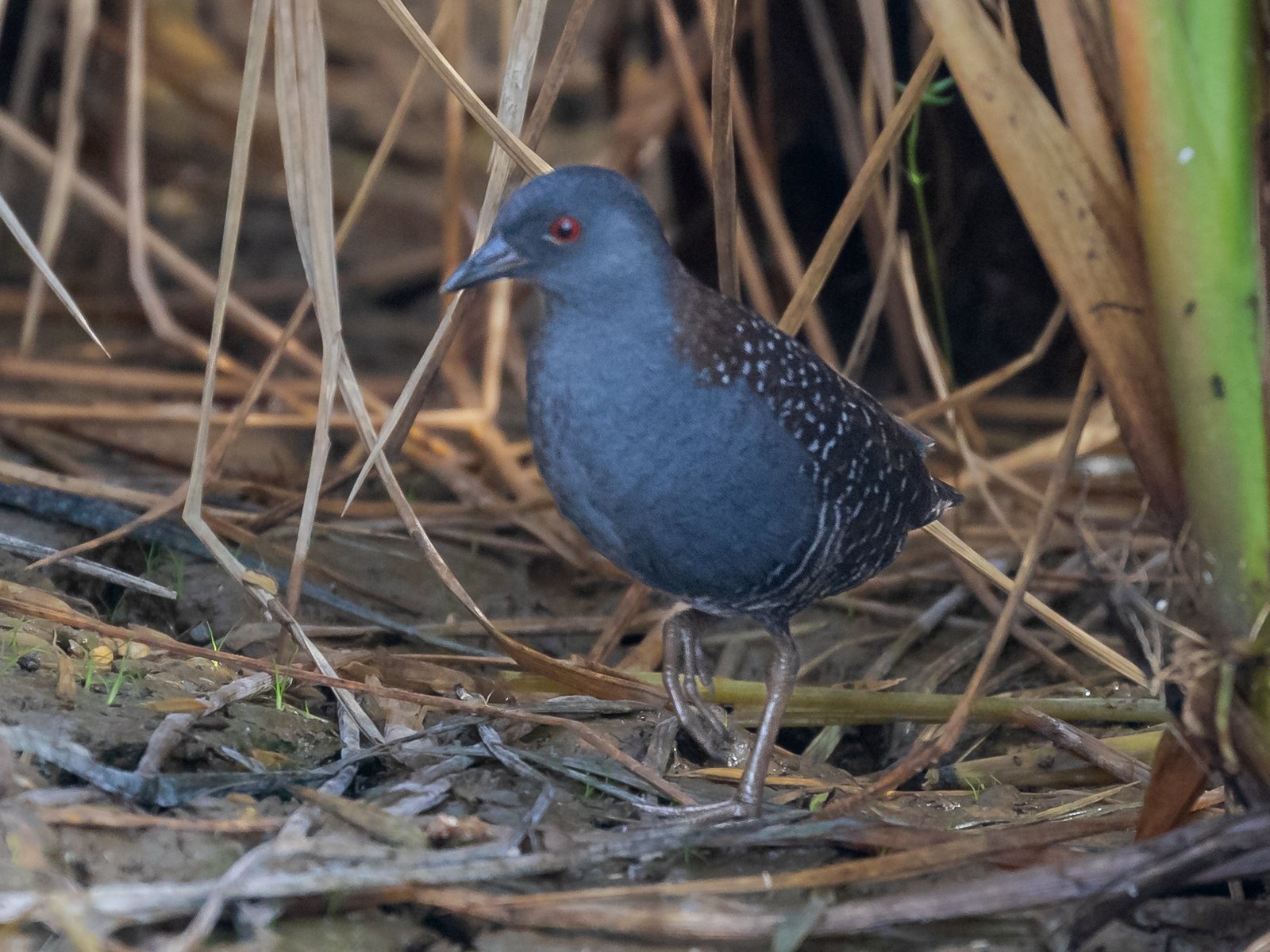
The Black Rail is one of the smallest rails in the world and is seldom seen in the guide area. It lives in the densest, shallowest parts of marshes and wet grasslands, calls mainly at night and almost never flies. In the guide area it is known from the Colorado River delta in northwestern Mexico and from a handful of savanna areas in Belize, Guatemala and Honduras.
Voice
A repeated, three-part kee-kee-durr, the last note lower, heard mainly around midnight in the breeding season; also a rapid, growling grr-grr-grr and hard ticking notes. By day the bird is usually silent.
Recording: Paul Lenrumé — CC BY-NC-SA 4.0 · converted to mono · xeno-canto
Identification
12–15 cm, sparrow-sized, round, with a short tail and a short, black bill. The plumage is dark slate-grey to blackish, the head slightly paler grey. The nape and upper back are rufous. The back and wings have fine white speckles, the flanks and undertail are narrowly barred white. The eye is red in adults; juveniles have a brown eye that turns red in the first months. The legs are dark. Male and female are alike.
Confusion species
Grey-breasted Crake Laterallus exilis has a pale grey head and breast, a white throat and an olive-brown back without speckles. Yellow-breasted Crake Laterallus flaviventer is just as small, but has an ochre-yellow face and breast, a white supercilium and yellow legs. Sora Porzana carolina is much larger, with a thick yellow bill. Black downy chicks of other rails, such as Sora and Virginia Rail Rallus limicola, lack the white speckles and the rufous nape and usually walk close to a parent.
Habitat
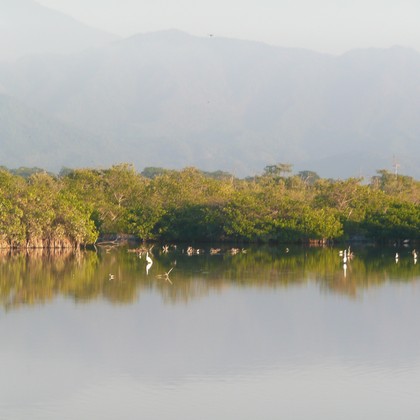
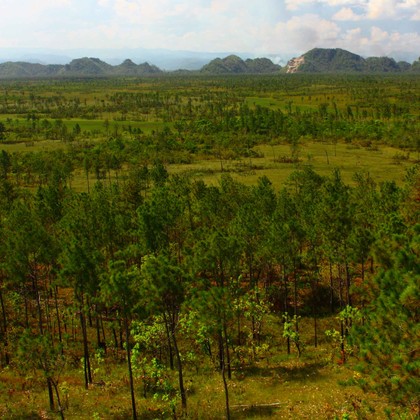
In northwestern Mexico salt marsh and brackish and freshwater marshes with low, dense growth of rushes, saltgrass and cattail at the edges, where the water is only a few centimetres deep. In Belize, Guatemala and Honduras wet, grassy hollows and shallow marshes in pine and grass savannas. Avoids open water and deeply flooded vegetation. Feeds on small invertebrates and seeds. The nest is a small cup of grass on or just above the ground, under a roof of bent stems.
Where the bird is most at home, classified by the vegetation units of Mexico and Central America.


Range and movements
In Mexico a small resident population (L. j. coturniculus) in the marshes of the Colorado River delta in Baja California and Sonora, including the Ciénega de Santa Clara. Further scattered records in Veracruz, San Luis Potosí and on the Yucatán Peninsula, probably of winter visitors from eastern North America. In Belize locally in the savannas of Orange Walk, Cayo, Belize and Stann Creek, in Guatemala in the savannas of Petén and in Honduras in the pine savannas of the Mosquitia; very rare in northeastern Nicaragua and in Panama. Outside the guide area in the United States, on a few Caribbean islands and very locally on the west coast and in the Andes of South America.
- Summer visitor (c. Apr–Sep)
- Winter visitor (c. Oct–Mar)
- Passage (Mar–Apr, Oct–Nov)
- dark = core range, pale = thinly spread
How and when to look
The species can almost only be detected by voice at night. In the Colorado River delta birds call in spring from the edges of marshes; in Belize and Petén the wet savannas in the rainy season are the most promising. Playing recordings disturbs the birds and is not permitted in protected areas; listening quietly from a dyke or track works best.
Conservation status
Endangered, owing to a steep decline in North America. Major threats are the loss and fragmentation of shallow marshes, changes in water management, grazing and burning at the wrong time, and sea-level rise. The population in the Colorado River delta depends on the supply of water, and little is known about the numbers in the savannas of Central America.
Scientific name
Laterallus jamaicensis | (Gmelin, 1789)
Gmelin described the species in 1789 as Rallus jamaicensis; because it was later moved to another genus, the author and year stand in brackets. The genus Laterallus was introduced in 1855 by Gray. Laterallus is a contraction of Rallus lateralis, an old synonym of the Rufous-sided Crake; Latin lateralis 'of the side' refers to the coloured flanks. jamaicensis means 'of Jamaica', where the species was described. The specimen the first description was based on came from Jamaica.