All species › Passerines › Cardinals and allies › Black-headed Grosbeak
Position in the tree Birds Aves › Birds with a flexible palate Neognathae › All other modern birds Neoaves › Landbirds Telluraves › Falcons, parrots and passerines Australaves › Falcons and passerines Eufalconimorphae › Parrots and passerines Psittacopasserae
Black-headed Grosbeak | Pheucticus melanocephalus
Zwartkopkardinaal | Picogordo tigrillo
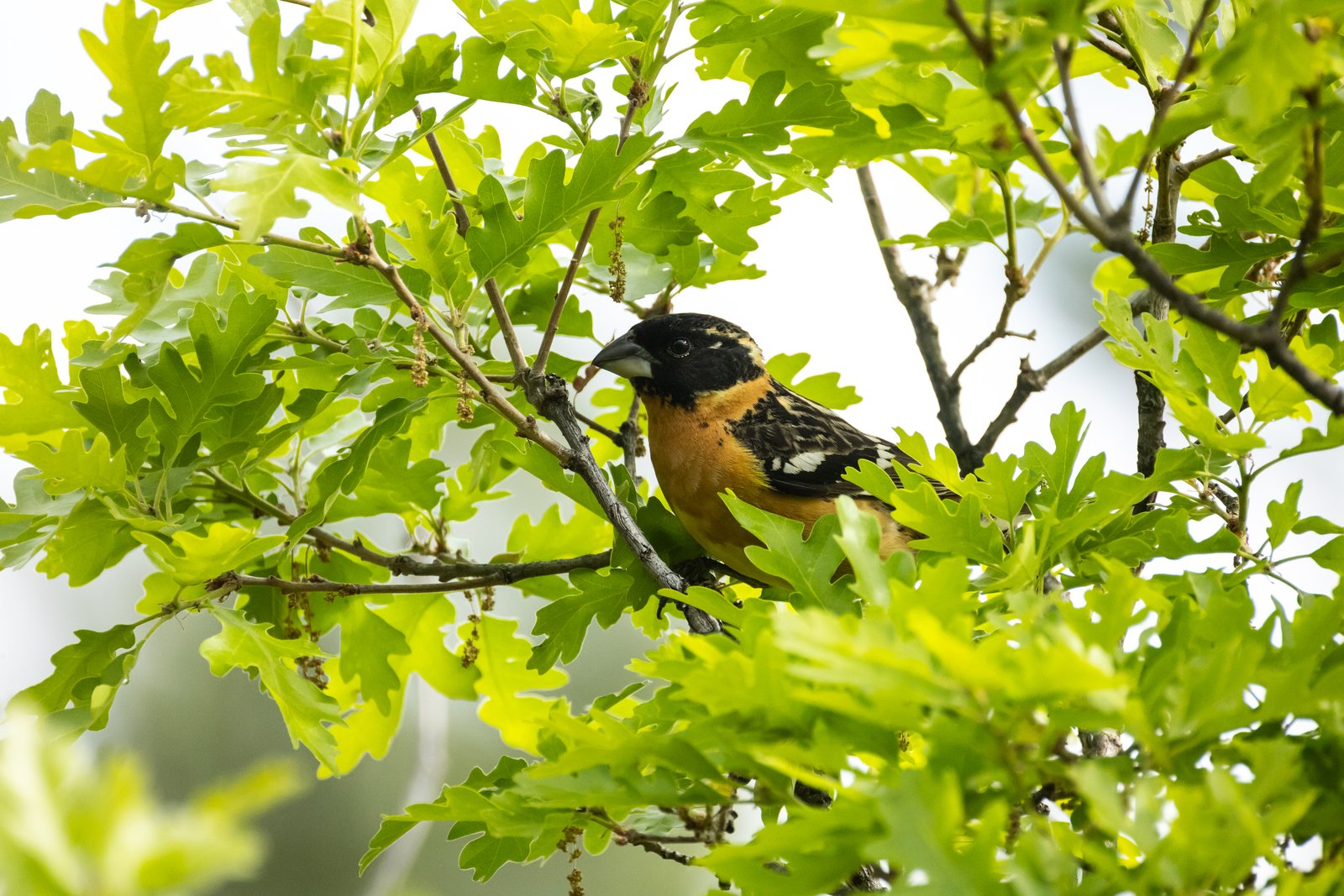
The Black-headed Grosbeak is a grosbeak with a heavy, two-toned bill; the male has a black head and an orange-buff breast and collar. It breeds in western North America and in the highlands of Mexico. In winter it is found mainly in Mexico, from the lowlands up into the mountains.
Voice
The song is a long series of rich, whistled phrases that rise and fall, similar to the song of a thrush. The call is a sharp, flat peek, less squeaky than that of Rose-breasted Grosbeak.
Recording: Greg Irving — CC BY-NC-SA 4.0 · shortened to the first 60 s, mono · xeno-canto
Identification
18–21 cm. Bill heavy and triangular, the upper mandible dark and the lower pale. The male has a black head, an orange-buff collar, breast and rump, a yellow patch in the centre of the belly, a black back streaked orange-buff, black wings with broad white wing bars and white patches, and a black tail with white corners; the underwing coverts are yellow. The female has a brown head with a whitish eyebrow and moustache, an orange-buff breast with fine streaks only on the flanks and brown wings with white wing bars. Young males resemble the female, with more orange and fewer streaks.
Confusion species
Females and young of Rose-breasted Grosbeak Pheucticus ludovicianus have a whitish, densely streaked breast and an entirely pale bill. Yellow Grosbeak Pheucticus chrysopeplus is larger and yellow, with a heavier, dark bill. Western Tanager Piranga ludoviciana has a much smaller bill.
Habitat
Breeds in pine-oak forest, oak woodland, gallery forest and semi-open woodland in the mountains, in Mexico mostly between 1500 and 3000 m. In winter also in tropical dry forest, forest edges, scrub, orchards and gardens, from sea level into the mountains. It eats seeds, fruit and insects.
Where the bird is most at home, classified by the vegetation units of Mexico and Central America.






Range and movements
Breeds from south-western Canada through the western United States and south in the highlands of Mexico to Oaxaca. Winters mainly in Mexico, from southern Baja California and Sonora to Oaxaca, and in smaller numbers to Veracruz; scarce further south, in Guatemala and beyond.
- Resident
- Summer visitor (c. Apr–Sep)
- Winter visitor (c. Oct–Mar)
- Passage (Mar–Apr, Oct–Nov)
- dark = core range, pale = thinly spread
How and when to look
In winter often seen at fruiting trees and feeders on the Pacific slope of Mexico, for example in Jalisco and Colima; in spring it sings from treetops in pine-oak forest.
Conservation status
Not threatened (LC). Common and widespread; the breeding population in North America appears stable.
Scientific name
Pheucticus melanocephalus | (Swainson, 1827)
Swainson described the species in 1827 as Guiraca melanocephalus; because it was later moved to another genus, the author and year stand in brackets. The genus Pheucticus was introduced in 1850 by Reichenbach. Pheucticus is Greek, from pheuktikos 'shy, inclined to avoid'. melanocephalus is Greek, from melas 'black' and kephalē 'head', after the male's black head. The specimen the first description was based on came from Temascaltepec, State of Mexico, Mexico.