All species › Passerines › Thrushes and allies › Black-faced Solitaire
Position in the tree Birds Aves › Birds with a flexible palate Neognathae › All other modern birds Neoaves › Landbirds Telluraves › Falcons, parrots and passerines Australaves › Falcons and passerines Eufalconimorphae › Parrots and passerines Psittacopasserae
Black-faced Solitaire | Myadestes melanops
Zwartmaskersolitaire | Solitario carinegro
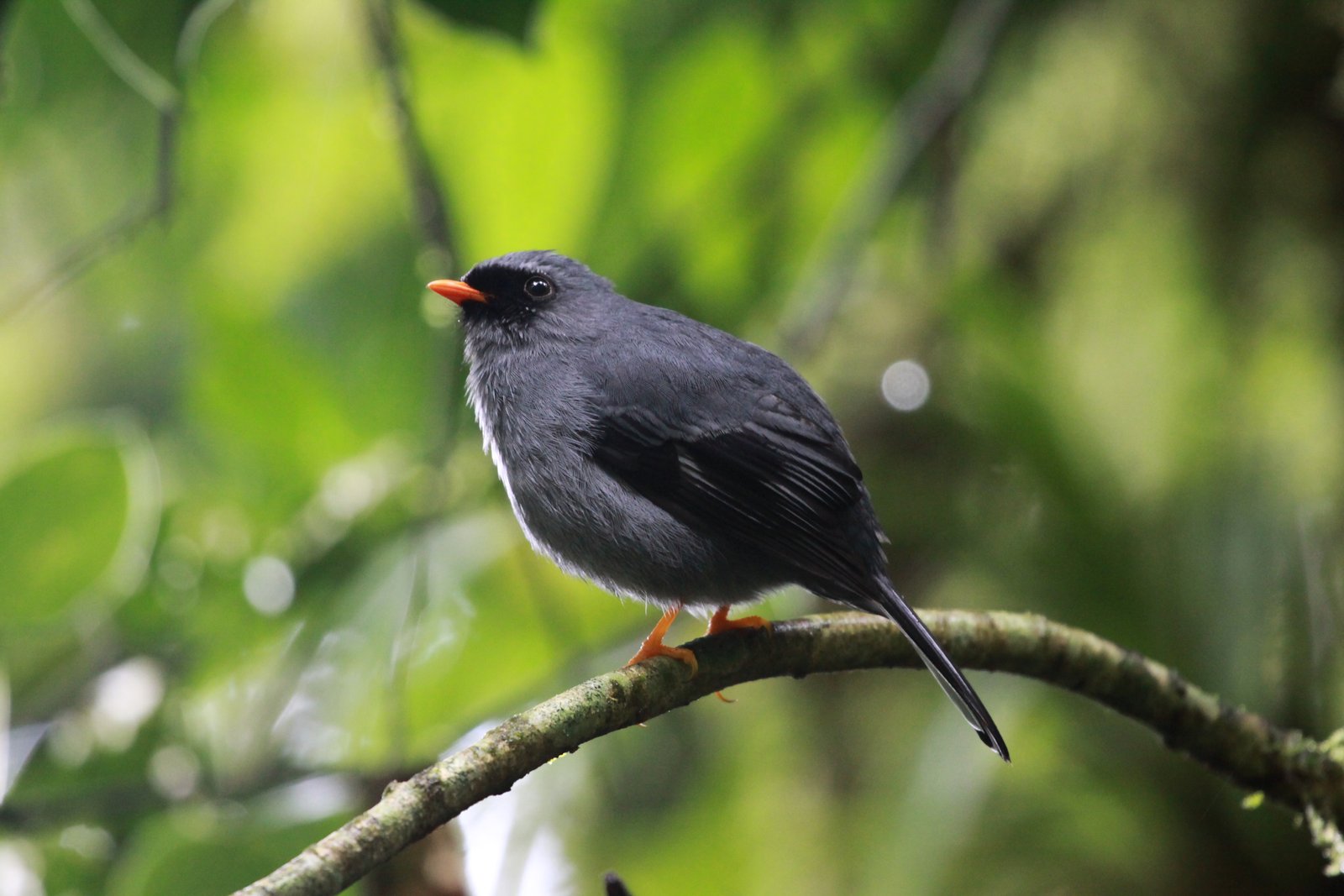
The Black-faced Solitaire is a slate-grey thrush with a black face and a bright orange bill and legs. Its slow, whistled song with creaking notes in between rings through the montane forests of Costa Rica and western Panama, but the bird itself often stays hidden in the canopy. It occurs only in those two countries.
Voice
The song is a slow, ethereal series of clear whistled notes at varying pitch, interspersed with metallic, creaking notes recalling a rusty hinge. The call is a soft, nasal wenk.
Recording: Stephan Risch — CC BY-NC-SA 4.0 · shortened to the first 60 s, mono · xeno-canto
Identification
17–18 cm. Fairly stocky for a solitaire, with a short, broad bill. Entirely slate-grey, slightly paler on the belly; forehead, lores, area around the eye and chin black. Bill and legs orange. Wings and tail darker grey; in flight a pale band on the underwing. The sexes are alike. Juveniles brownish with buff spots.
Confusion species
Varied Solitaire Myadestes coloratus of eastern Panama has a rufous-brown back and wings; the ranges do not overlap. Slaty-backed Nightingale-Thrush Catharus fuscater also has an orange bill and orange legs, but is darker with a paler belly, has a white iris and walks mainly on the ground. Confusion with other grey thrushes is unlikely given the black face and orange bill.
Habitat
Humid montane forest and cloud forest, especially in the forest interior and wooded ravines, mostly between 900 and 2500 m; outside the breeding season some birds move lower, into foothill forest at about 700 m. It lives mainly in the mid-storey and canopy. It eats many small fruits and berries, also insects. It nests in a niche in a moss-covered trunk or bank.
Where the bird is most at home, classified by the vegetation units of Mexico and Central America.


Range and movements
Occurs only in the guide area: in the mountains of Costa Rica, from the Cordillera de Tilarán and Cordillera Central to the Cordillera de Talamanca, and in western Panama, in Chiriquí, Bocas del Toro and Veraguas.
- Resident
- dark = core range, pale = thinly spread
How and when to look
Regularly heard and sometimes seen at Monteverde, near San Gerardo de Dota and at Tapantí in Costa Rica, and around Boquete and Volcán Barú in Panama. The bird often sits still in the mid-storey; searching the spot the song comes from helps.
Conservation status
Not threatened. Fairly common in continuous montane forest; locally trapped as a cage bird for its song.
Scientific name
Myadestes melanops | Salvin, 1865
Salvin described the species in 1865 and placed it straight away in the genus where it still stands. The genus Myadestes was introduced in 1838 by Swainson. Myadestes is Greek, from muia 'fly' and edestēs 'eater': 'fly-eater'. melanops is Greek, from melas 'black' and ōps 'face', after the black mask around the orange bill. The specimen the first description was based on came from Tucurrique, Costa Rica.