All species › Pelicans, herons and ibises › Herons, egrets and bitterns › Black-crowned Night-Heron
Position in the tree Birds Aves › Birds with a flexible palate Neognathae › All other modern birds Neoaves › Birds of the elements Elementaves › Tropicbirds and waterbirds Phaethoquornithes › Core waterbirds Aequornithes
Black-crowned Night-Heron | Nycticorax nycticorax
Kwak | Martinete común
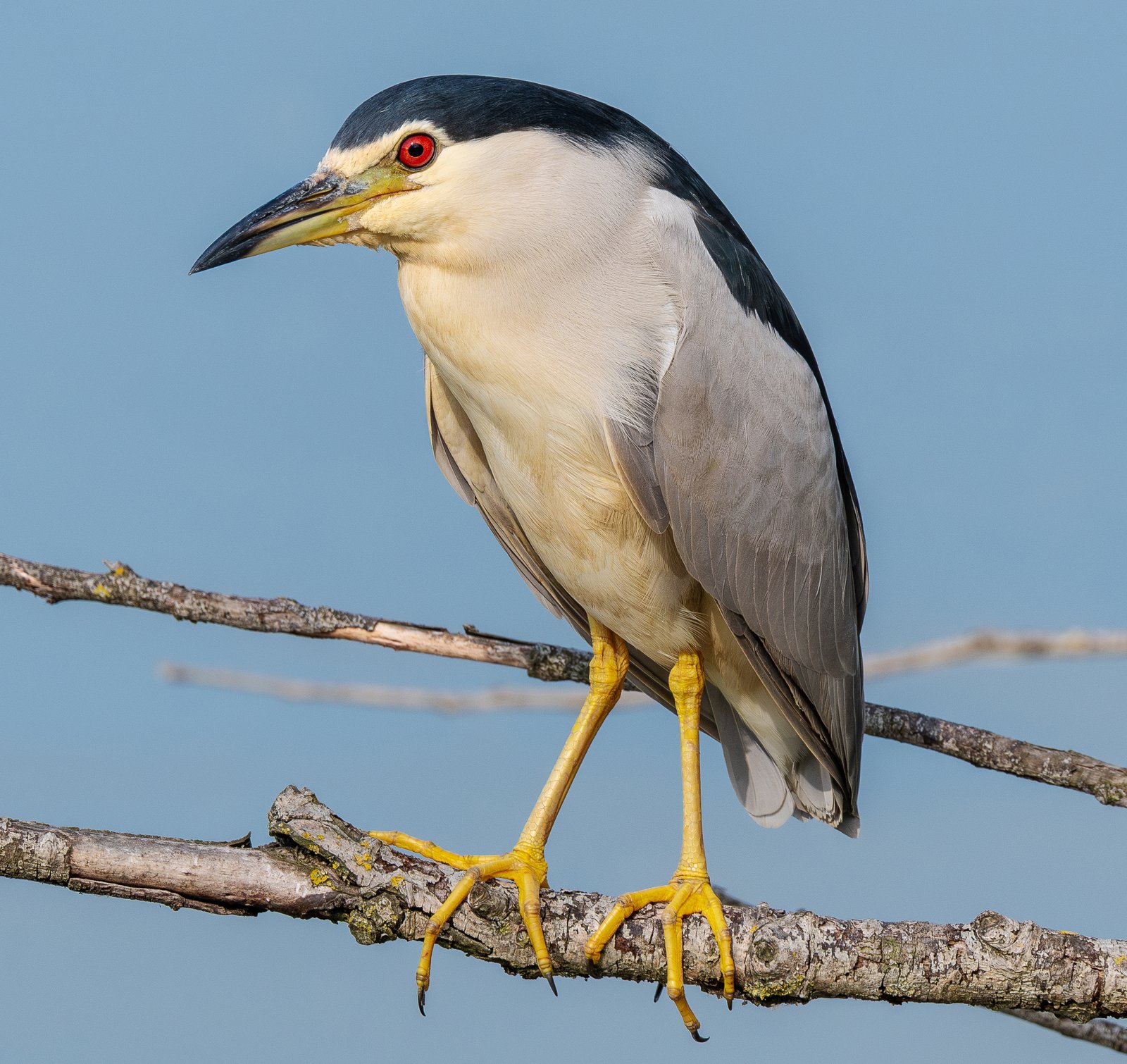
The Black-crowned Night Heron is a stocky night heron with short legs and a thick neck, which usually rests hidden in dense trees by day and flies out at dusk to hunt. It is one of the most widespread herons in the world. In the guide area it is a locally common resident of marshes, lagoons and lakes, from northern Mexico to Panama.
Voice
A low, hollow, croaking kwok or wok, especially at dusk and at night in flight; at the colony a variety of croaking and clucking sounds.
Recording: Timeo CONSTANT — CC BY-NC-SA 4.0 · converted to mono · xeno-canto
Identification
58–66 cm, stocky, with a short, thick black bill and short yellow legs. Adults have a black crown and mantle, grey wings and tail, and white to pale grey cheeks and underparts. Two to four long white plumes hang from the nape. The eye is red; in the breeding season the legs turn pink to reddish. Juveniles are grey-brown with large, drop-shaped white spots on the wings and pale underparts streaked brown; they have an orange eye and a yellowish bill base. Adult plumage is reached after several years. In flight a compact shape with blunt wings; the legs barely project beyond the tail. The sexes are alike.
Confusion species
Young Yellow-crowned Night Herons Nyctanassa violacea are greyer, with finer white spots, a thicker, all-dark bill and longer legs that project clearly beyond the tail in flight. Adult Yellow-crowned Night Herons are plain blue-grey with a black-and-white head. Boat-billed Heron Cochlearius cochlearius also has a black crown and mantle, but a very broad, boat-shaped bill and large dark eyes. Young tiger herons Tigrisoma are finely barred rather than spotted. American Bittern Botaurus lentiginosus is warmer brown, with dark streaks down the neck and no white wing spots.
Habitat
Freshwater marshes, lakes, ponds, rivers, rice fields and fish farms, but also mangroves, coastal lagoons and estuaries; mainly in the lowlands, locally also at lakes on the Mexican Plateau. It eats fish, frogs, crustaceans, insects and sometimes chicks of other birds, mainly from the bank at dusk and at night. It breeds in colonies, often together with other herons, in mangroves, swamp forest or trees near water.
Where the bird is most at home, classified by the vegetation units of Mexico and Central America.






Range and movements
In Mexico locally through almost the whole country, along the Pacific coast from Baja California and Sonora to Chiapas, on the Gulf side from Tamaulipas through Veracruz and Tabasco to the Yucatán Peninsula, and at lakes and marshes on the plateau. Further locally throughout Central America, from Belize and Guatemala to Panama, on both coasts and inland. In the northern winter birds from North America join them. Birds in the guide area belong to the subspecies N. n. hoactli. Outside the guide area across large parts of North and South America, Europe, Africa and Asia.
- Resident
- dark = core range, pale = thinly spread
How and when to look
At dusk at ponds, river channels and mangroves, when the birds leave their roosts. By day resting groups sit in dense trees over the water, often in or near heron colonies, such as in the marshes of Palo Verde in Costa Rica and the Pantanos de Centla in Tabasco.
Conservation status
Not threatened. In the guide area locally common, but colonies are sensitive to disturbance, and habitat is locally lost through drainage of wetlands and mangrove clearance.
Scientific name
Nycticorax nycticorax | (Linnaeus, 1758)
Linnaeus described the species in 1758 as Ardea Nycticorax; because it was later moved to another genus, the author and year stand in brackets. The genus Nycticorax was introduced in 1817 by Forster. Nycticorax is Greek, from nux, genitive nuktos, 'night' and korax 'raven': night raven. In Aristotle and Hesychius it is a bird of ill omen, perhaps an owl; Conrad Gessner used the word for this heron in 1555. The specific epithet repeats the genus name. The specimen the first description was based on came from southern Europe.