All species › Passerines › Antbirds › Black-crowned Antshrike
Position in the tree Birds Aves › Birds with a flexible palate Neognathae › All other modern birds Neoaves › Landbirds Telluraves › Falcons, parrots and passerines Australaves › Falcons and passerines Eufalconimorphae › Parrots and passerines Psittacopasserae
Black-crowned Antshrike | Thamnophilus atrinucha
Westelijke gevlekte mierklauwier | Batará pizarroso occidental
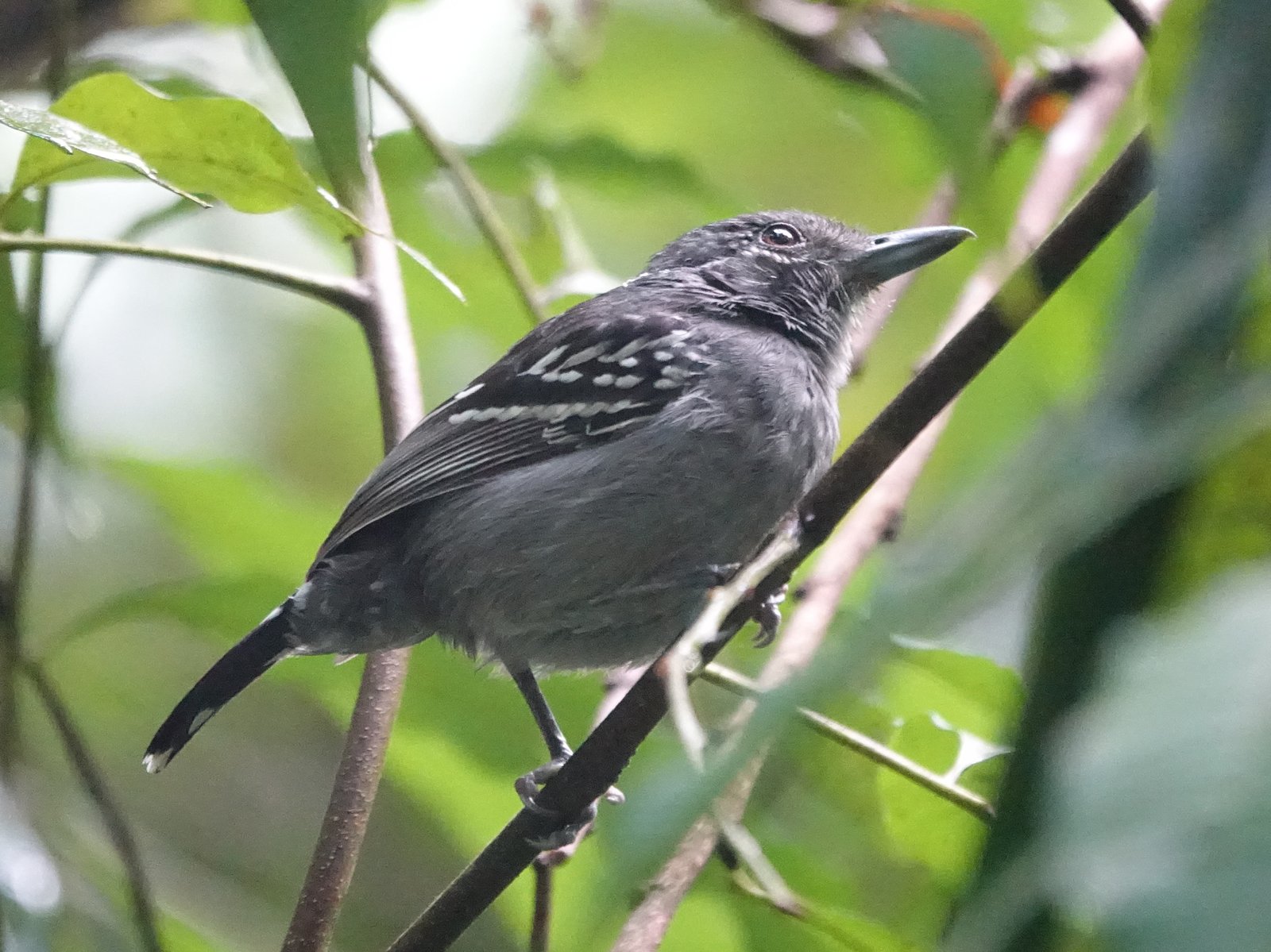
The Black-crowned Antshrike is a small grey antshrike of the lower and middle levels of humid lowland forest. The male has a black crown and white spots on the black wings; the female is brown with a rufous crown. It is fairly tame and often seen at close range, including along forest trails. In the guide area it lives from Belize and Guatemala to Panama.
Voice
The song is an accelerating series of nasal notes ending in an emphatic, lower final note. Also a nasal, plaintive call.
Recording: Juan Freile — CC BY-NC-SA 4.0 · shortened to the first 60 s, mono · xeno-canto
Identification
14–15 cm. Male: slate grey, slightly paler below; crown black; wings black with white spots and edges on the coverts; tail black with white tips. Female: upperparts olive-brown, crown rufous, wing coverts with small buff spots; underparts ochraceous olive-brown. Bill fairly heavy with a hooked tip.
Confusion species
Black-hooded Antshrike Thamnophilus bridgesi (Pacific slope of southern Costa Rica and western Panama) is much darker: the male has a black head and breast. Dusky Antbird Cercomacroides tyrannina is smaller and slimmer, with a finer bill and no black crown. Plain Antvireo Dysithamnus mentalis is smaller and stockier, with a short tail and an olive-green back.
Habitat
Lower and middle levels of humid evergreen lowland and foothill forest, especially at edges, in clearings and in mature secondary forest; mostly below 900 m. Often joins mixed flocks of insectivores. It eats insects and spiders gleaned from leaves and twigs.
Where the bird is most at home, classified by the vegetation units of Mexico and Central America.




Range and movements
Caribbean slope of Belize and Guatemala through Honduras and Nicaragua to Costa Rica, in south-western Costa Rica also on the Pacific slope, and in Panama on both slopes. Outside the guide area in northern and western Colombia, western Ecuador and north-western Venezuela.
- Resident
- dark = core range, pale = thinly spread
How and when to look
One of the commonest antshrikes along forest trails; regularly seen at La Selva in Costa Rica and along Pipeline Road (Camino del Oleoducto) in Panama.
Conservation status
Not threatened. Common in humid lowland forest and mature secondary forest.
Scientific name
Thamnophilus atrinucha | Salvin & Godman, 1892
Salvin & Godman described the species in 1892 and placed it straight away in the genus where it still stands. The genus Thamnophilus was introduced in 1816 by Vieillot. Thamnophilus is Greek, from thamnos 'bush' and philos 'loving': 'bush-lover'. atrinucha is Latin, from ater 'black' and medieval nucha 'nape', after the male's black hindcrown. The specimen the first description was based on came from Panama (designated later).