All species › Swifts › Hummingbirds › Beautiful Sheartail
Position in the tree Birds Aves › Birds with a flexible palate Neognathae › All other modern birds Neoaves › Birds of the elements Elementaves › Nightjars and swifts Strisores
Beautiful Sheartail | Calothorax pulcher
Prachtkolibrie | Colibrí oaxaqueño
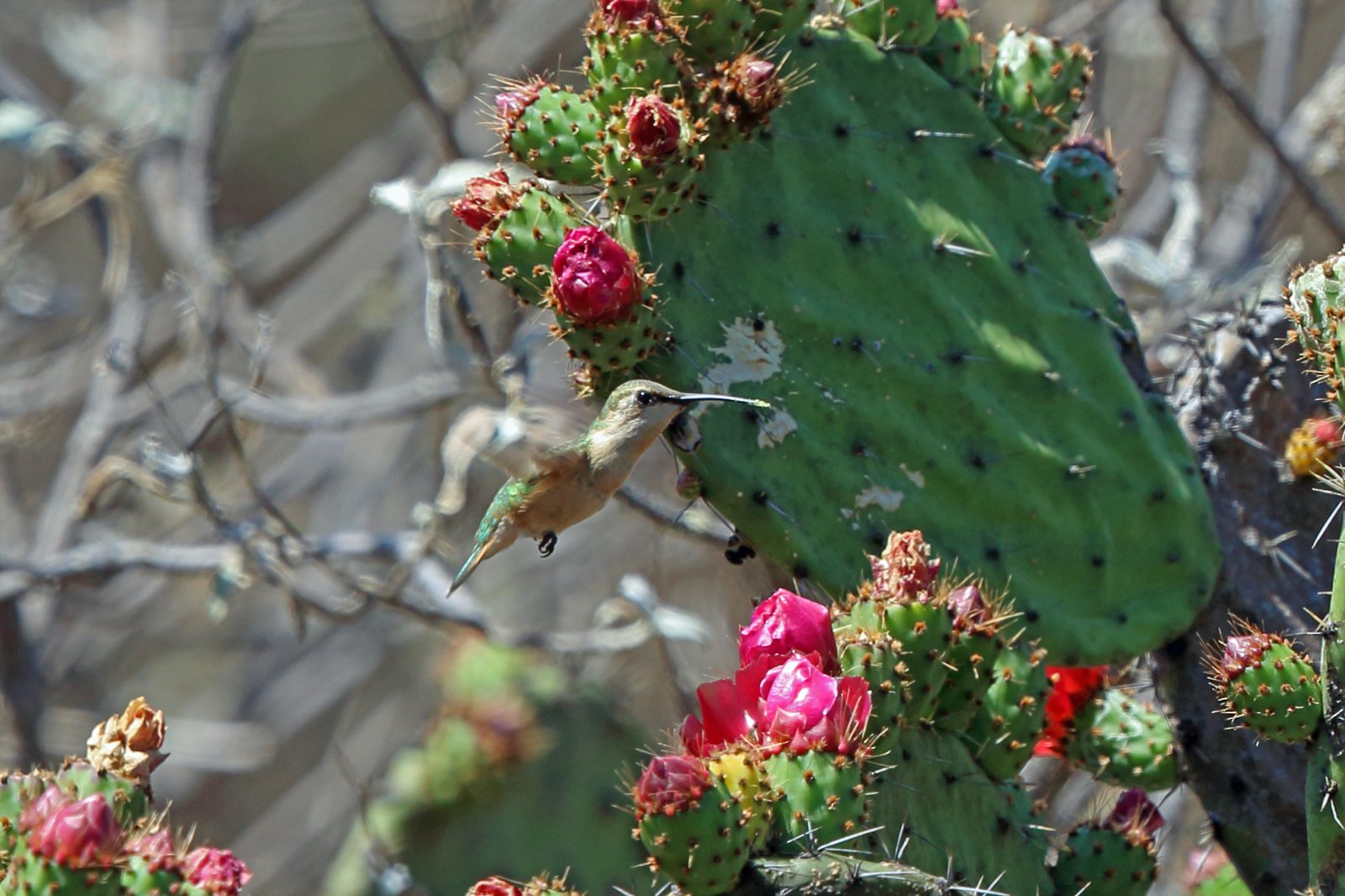
The Beautiful Sheartail is a small hummingbird found only in the dry interior valleys and slopes of southern Mexico, mainly in Oaxaca. It closely resembles the Lucifer Sheartail but has a shorter, less decurved bill. Where both species occur together in winter, the bill is the main feature.
Voice
A dry chip or chik, and in chases a short, rapid twitter.
Recording: Andrew Spencer — CC BY-NC-SA 3.0 · converted to mono · xeno-canto
Identification
8–9 cm, with a medium-length, slightly decurved black bill. The male is green above, with a glittering rose-purple to violet throat with elongated side points, a white breast, green and cinnamon flanks and a long, deeply forked dark tail with fairly broad outer feathers. The female has a dark eyestripe with a pale supercilium, buff underparts and a rounded tail with a rufous base, a black band and white tips.
Confusion species
Lucifer Sheartail Calothorax lucifer has a longer, more distinctly decurved bill; the male has a shorter, narrower tail. Outside Oaxaca and Puebla that species occurs mainly in the central highlands, but in winter both species can be seen together. Female Sparkling-tailed Woodstar Tilmatura dupontii has a straight, shorter bill and white patches on the rump. Female Ruby-throated Hummingbird Archilochus colubris has a straight bill and white underparts.
Habitat
Dry scrub, thorn scrub and cactus woodland, tropical dry forest and the edges of open oak woodland on dry slopes, at about 1000 to 2200 m; also in gardens and field margins with flowering shrubs. It feeds mainly low at flowers of shrubs and herbs.
Where the bird is most at home, classified by the vegetation units of Mexico and Central America.




Range and movements
Endemic to the guide area and to Mexico. In the dry interior valleys and on the dry slopes of southern Mexico, in Oaxaca, Puebla, Morelos and Guerrero; best known from the Central Valley of Oaxaca and the Tehuacán-Cuicatlán valley.
- Resident
- Winter visitor (c. Oct–Mar)
- Passage (Mar–Apr, Oct–Nov)
- dark = core range, pale = thinly spread
How and when to look
In the Central Valley of Oaxaca at flowering shrubs in dry scrub and at the archaeological sites, such as Monte Albán and Yagul, and around Teotitlán del Valle.
Conservation status
Least Concern. The range is small, but within it the species is fairly common and also occurs in farmland and gardens. Conversion of dry scrub to farmland affects it locally.
Scientific name
Calothorax pulcher | Gould, 1859
Gould described the species in 1859 and placed it straight away in the genus where it still stands. The genus Calothorax was introduced in 1840 by Gray. Calothorax is Greek, from kalos 'beautiful' and thōrax 'breast', after the male's splendid throat and breast. pulcher is Latin for 'beautiful'. The specimen the first description was based on came from Oaxaca, Mexico.