All species › Gamebirds › New World quail › Bearded Wood Partridge
Position in the tree Birds Aves › Birds with a flexible palate Neognathae › Fowl Galloanserae
Bearded Wood Partridge | Dendrortyx barbatus
Grijskeelbospatrijs | Codorniz coluda veracruzana
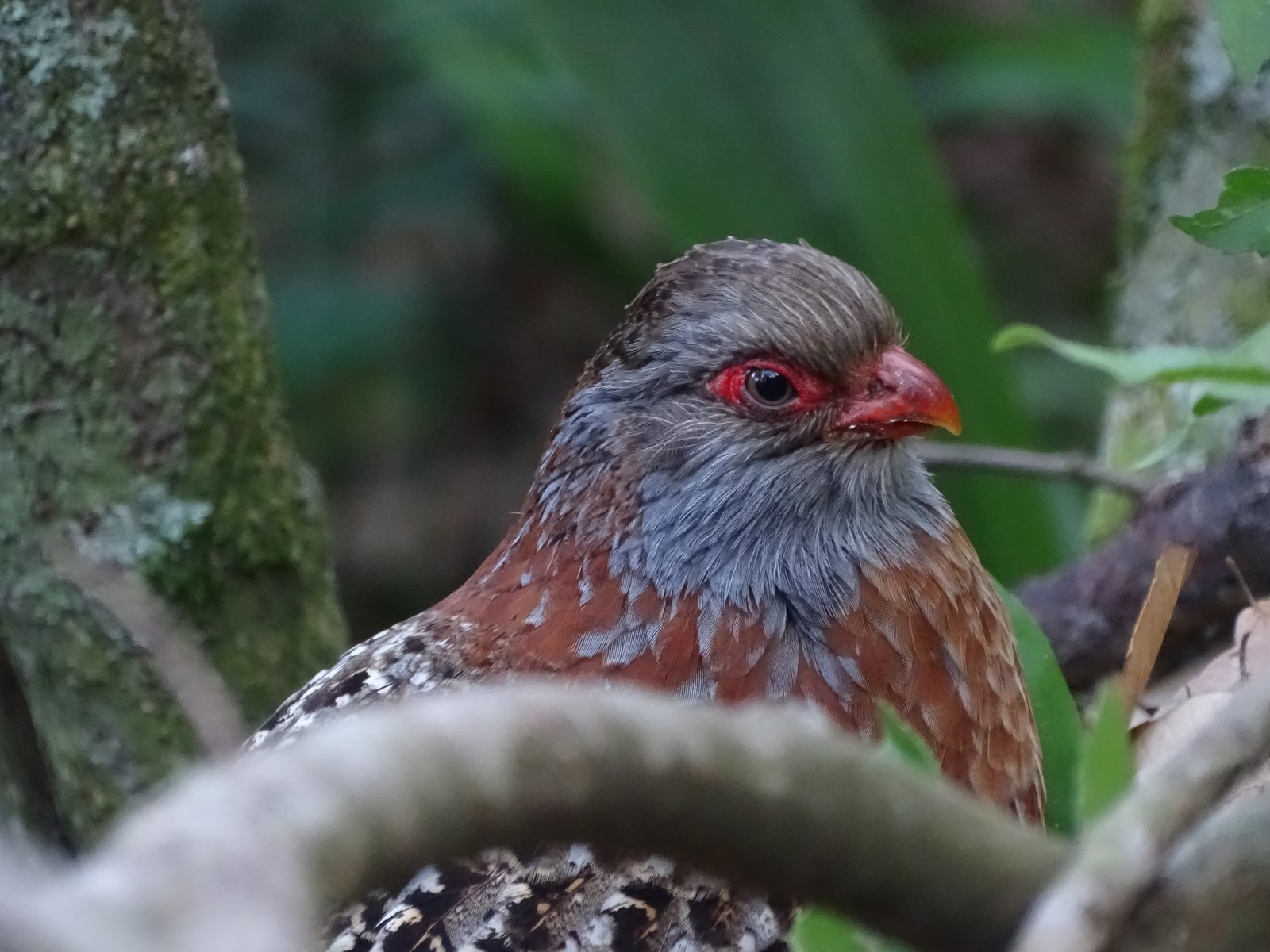
The Bearded Wood Partridge is the rarest of the three wood partridges and lives only in the cloud forests and humid montane forests of the Sierra Madre Oriental in eastern Mexico. It is a shy ground bird that is noticed mainly by its loud duets at dusk and dawn. For a long time little was known about it.
Voice
A series of loud, rollicking whistles, repeated rapidly and often sung as a duet; the female sings more softly than the male. Mainly in the early morning and at dusk; groups also keep in contact with song.
Recording: James Bradley — CC BY-NC-SA 4.0 · converted to mono · xeno-canto
Identification
33–36 cm; a large, long-tailed quail with a small crest. The cheeks, neck and upper breast are blue-grey, with red bare skin around the eye. The crown is buff, the hindneck and breast cinnamon with rufous streaks. The back and wings are a mixture of buff, brown and grey, finely marked. Male and female are almost alike. Young birds have a duller breast and brown-barred flanks.
Confusion species
Long-tailed Wood Partridge Dendrortyx macroura lives in other mountain ranges and has a black head with white stripes and a blue-grey breast. Singing Quail Dactylortyx thoracicus occurs in the same forest, but is much smaller and shorter-tailed, without a grey throat. Tinamous such as Slaty-breasted Tinamou Crypturellus boucardi have an almost invisible tail and no crest.
Habitat
The interior and edges of humid evergreen montane forest and cloud forest and of pine-oak forest, both old and secondary; also gardens, shade coffee and sometimes fields next to forest. Often found in narrow strips of forest along streams. It lives in pairs and small groups on the forest floor.
Where the bird is most at home, classified by the vegetation units of Mexico and Central America.



Range and movements
Only in Mexico, in the Sierra Madre Oriental, in a fragmented area from south-eastern San Luis Potosí through Querétaro and Hidalgo to Puebla, central Veracruz and northern Oaxaca. The species does not occur outside the guide area.
- Resident
- dark = core range, pale = thinly spread
How and when to look
The duets can be heard at dusk in the cloud forests around Xalapa and Coatepec in Veracruz and in the Sierra Norte of Puebla. A sighting is rare; the best chance is on quiet trails along forest edges and streams early in the morning.
Conservation status
Vulnerable. The range is highly fragmented and the population is small and declining continuously through forest loss. Surveys have shown that the species is more widespread and numerous than previously thought.
Scientific name
Dendrortyx barbatus | Gould, 1846
Gould described the species in 1846 and placed it straight away in the genus where it still stands. The genus Dendrortyx was introduced in 1844 by Gould. Dendrortyx is Greek, from dendron 'tree' and ortux 'quail': 'tree quail', after its forest life. barbatus is Latin for 'bearded', after the grey, beard-like throat. The specimen the first description was based on came from Xalapa, Veracruz, Mexico.