All species › Swifts › Hummingbirds › Band-tailed Barbthroat
Position in the tree Birds Aves › Birds with a flexible palate Neognathae › All other modern birds Neoaves › Birds of the elements Elementaves › Nightjars and swifts Strisores
Band-tailed Barbthroat | Threnetes ruckeri
Bandstaartbaardkolibrie | Ermitaño barbudo colibandeado
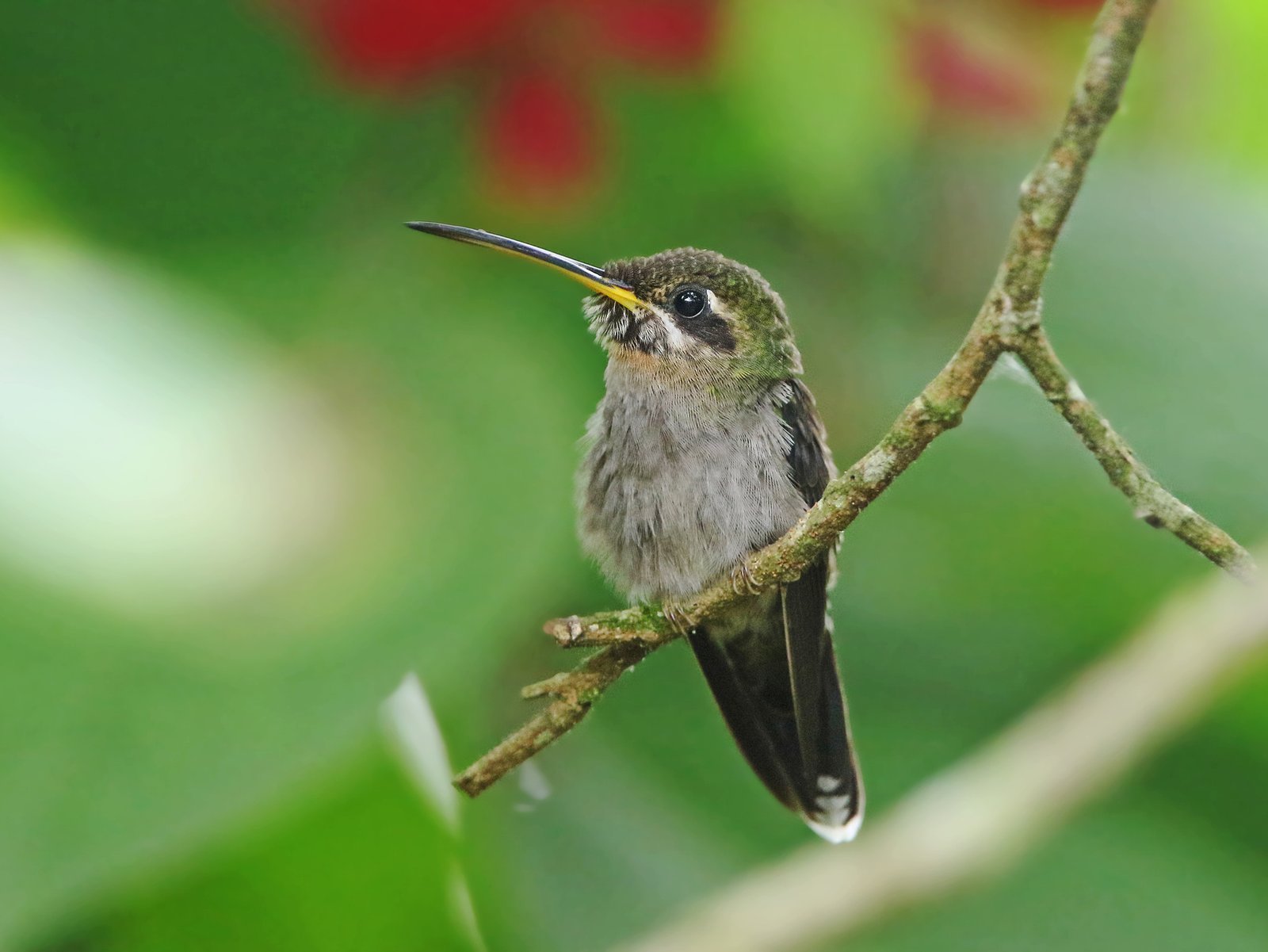
The Band-tailed Barbthroat is a hermit of the understorey of humid lowland forest, recognisable by a blackish throat with a cinnamon band below it and a tail with much white. It is the only barbthroat in the guide area. Like other hermits it flies a fixed route past scattered flowers, mainly heliconias.
Voice
The call is a high, sharp tseep. The song is a rapid, high, squeaky series of notes that rises and falls, often given from a low branch in the understorey.
Recording: Paul Driver — CC BY-NC-SA 4.0 · converted to mono · xeno-canto
Identification
10–11 cm, with a long, slightly curved bill of about 3 cm; the lower mandible is yellow at the base. The upperparts are bronze-green. Throat and face are blackish, with a buff moustachial stripe and a pale stripe behind the eye; below the throat runs a cinnamon breast band, and the belly is grey. The rounded tail is white at the base of the outer feathers, with a broad black band and white tips; the central feathers are green. The sexes are almost alike.
Confusion species
Bronzy Hermit Glaucis aeneus and Rufous-breasted Hermit Glaucis hirsutus have uniform rufous underparts without a dark throat and a rufous tail without white at the base. Long-billed Hermit Phaethornis longirostris and Stripe-throated Hermit Phaethornis striigularis have a pale throat and elongated, white-tipped central tail feathers. White-tipped Sicklebill Eutoxeres aquila has a strongly hooked bill and streaked underparts.
Habitat
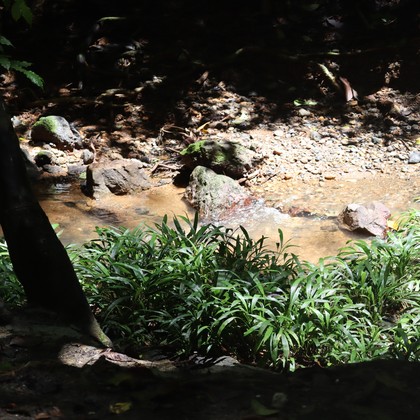
Understorey and edges of humid lowland and foothill forest, secondary forest, heliconia thickets along streams and clearings in the forest, from sea level to about 900 m. It forages along a fixed route at heliconias and other flowers with a long corolla, and searches for small arthropods among the leaves. The nest hangs from the underside of a heliconia or palm leaf.
Where the bird is most at home, classified by the vegetation units of Mexico and Central America.




Range and movements
On the Caribbean side from southern Belize and eastern Guatemala through Honduras and Nicaragua to Costa Rica; in Costa Rica on the Caribbean slope and in the south of the Pacific slope, in Panama on both sides from west to east. Fairly common in Costa Rica and Panama, scarcer and local further north. Outside the guide area in northern and western Colombia, north-western Venezuela and western Ecuador.
- Resident
- dark = core range, pale = thinly spread
How and when to look
At heliconias along streams and forest edges in the Caribbean lowlands of Costa Rica, such as around Sarapiquí, and along the forest trails of the Canal Area in Panama. The song often comes from a low, sheltered branch; the bird itself usually draws attention only when it hovers in front of a flower.
Conservation status
Not threatened. It tolerates secondary forest and forest edges as long as there is understorey with suitable flowers.
Scientific name
Threnetes ruckeri | (Bourcier, 1847)
Bourcier described the species in 1847 as Trochilus Ruckeri; because it was later moved to another genus, the author and year stand in brackets. The genus Threnetes was introduced in 1852 by Gould. Threnetes is Greek, from thrēnētēs 'mourner', hence 'sombre', after the dull plumage. ruckeri honours the English merchant, hummingbird collector and art collector Sigismund Rucker (1815–1890). The specimen the first description was based on came from unknown.