All species › Passerines › New World sparrows › Baird's Sparrow
Position in the tree Birds Aves › Birds with a flexible palate Neognathae › All other modern birds Neoaves › Landbirds Telluraves › Falcons, parrots and passerines Australaves › Falcons and passerines Eufalconimorphae › Parrots and passerines Psittacopasserae
Baird's Sparrow | Centronyx bairdii
Bairds gors | Gorrión de Baird
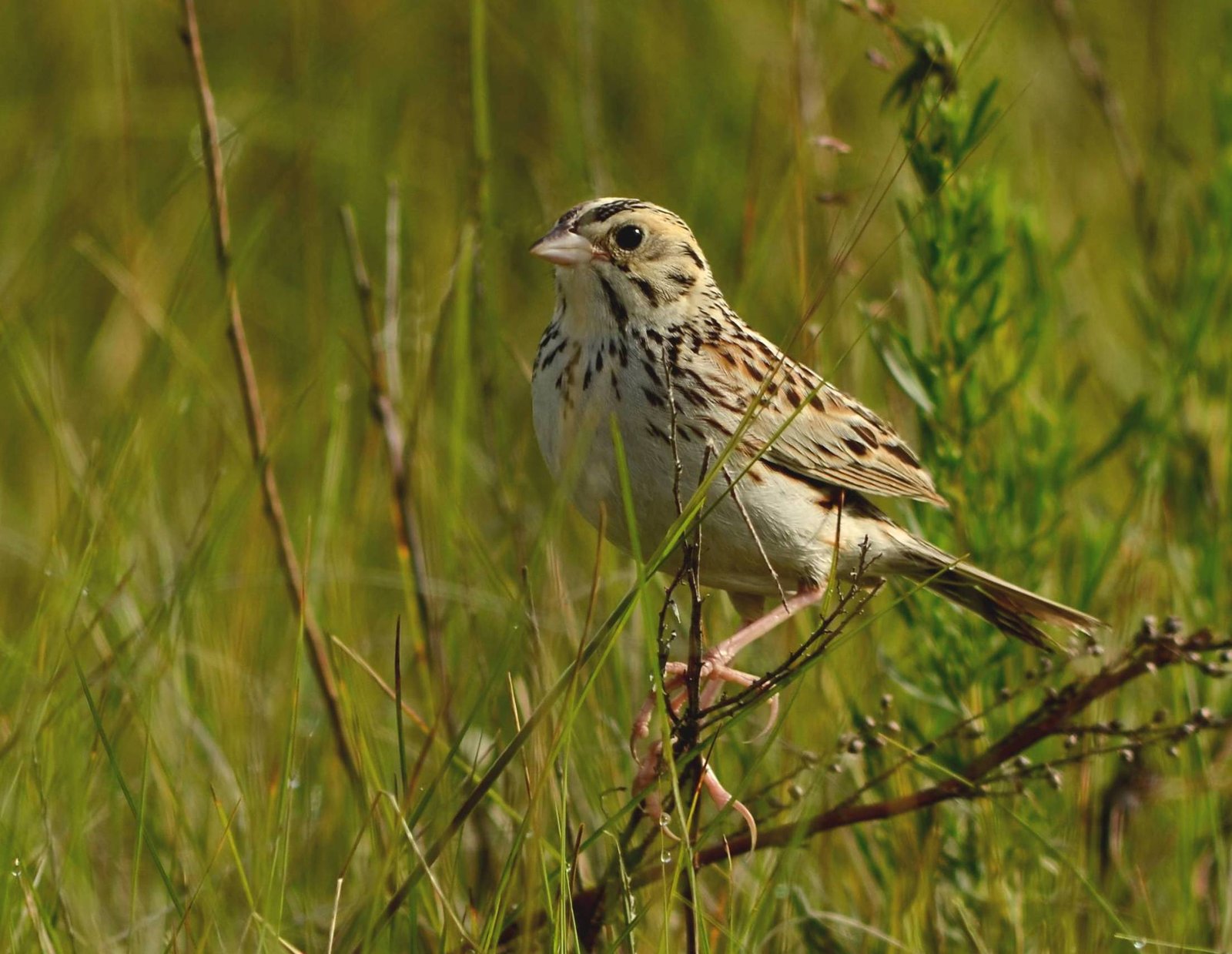
Baird's Sparrow is a small, ochre-toned sparrow of extensive, intact grasslands. It breeds on the prairies of the northern Great Plains and winters in the grasslands of the Chihuahuan Desert. Outside the breeding season it lives very secretively low in the grass and is rarely seen.
Voice
The song begins with two or three high, clear notes and ends in a lower, musical trill. In winter mainly a soft, thin tsip and a short, dry tick; the bird is then usually silent.
Recording: Jacob Saucier — CC BY-NC-SA 4.0 · converted to mono · xeno-canto
Identification
13–14 cm. Head warm ochre-buff with a broad ochre central crown stripe, finely black-streaked sides to the crown and two dark spots at the rear of the ear-coverts. A dark malar stripe and a thin moustachial stripe frame a pale cheek. Across the breast a narrow band of fine black streaks that continues along the flanks; throat and belly white. Upperparts brown with dark centres and broad ochre fringes, giving the back a scaly look. Tail fairly short. The sexes are alike.
Confusion species
Grasshopper Sparrow Ammodramus savannarum has an unstreaked buff breast as an adult, a larger, flatter head and a plainer face without a dark malar stripe. Savannah Sparrow Passerculus sandwichensis is more coarsely and densely streaked on the breast and flanks, often has yellow lores and a notched tail, and perches in the open on fences and shrubs more often. Botteri's Sparrow Peucaea botterii and Cassin's Sparrow Peucaea cassinii are larger, longer-tailed and lack the ochre head and necklace of streaks on the breast.
Habitat
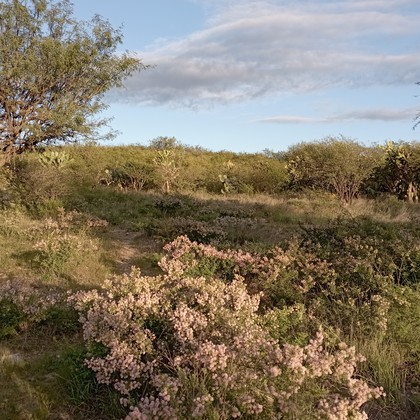
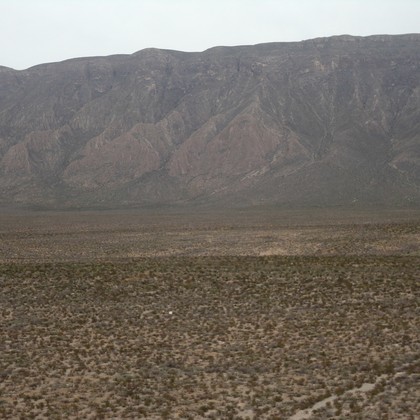
In winter tall, dense grassland with few shrubs, especially semi-desert grassland with bunchgrasses on level plateaus and in broad valleys. It runs off through the grass like a mouse and flushes only at close range, dropping back into cover after a short, low flight. In winter it eats mainly grass seeds.
Where the bird is most at home, classified by the vegetation units of Mexico and Central America.

Range and movements
Breeds in the south of the Canadian prairie provinces and in Montana and the Dakotas. Winters in south-eastern Arizona, south-western New Mexico and western Texas and in northern Mexico. In the guide area mainly in Chihuahua, Sonora, Durango and Coahuila; migrants are also reported in north-eastern Mexico.
- Winter visitor (c. Oct–Mar)
- dark = core range, pale = thinly spread
How and when to look
In winter best found in large, well-developed grasslands, such as those around Janos in north-western Chihuahua. A flushed bird usually lands after a short distance; by watching the spot it can sometimes still be seen briefly on the ground.
Conservation status
Not threatened (LC). It has, however, declined steeply since the mid-twentieth century. On the breeding grounds native prairie is lost to conversion to cropland; in the guide area winter grasslands disappear through conversion to farmland, overgrazing and encroachment by shrubs.
Scientific name
Centronyx bairdii | (Audubon, 1844)
Audubon described the species in 1844 as Emberiza bairdii; because it was later moved to another genus, the author and year stand in brackets. The genus Centronyx was introduced in 1858 by Baird. Centronyx is Greek, from kentron 'spur' and onux 'claw', after the unusually long hind claw. bairdii honours the American ornithologist Spencer Fullerton Baird (1823–1887), Secretary of the Smithsonian Institution. The specimen the first description was based on came from Fort Union, North Dakota.