All species › Waders, gulls and terns › Skimmers, noddies, terns and gulls › Arctic Tern
Position in the tree Birds Aves › Birds with a flexible palate Neognathae › All other modern birds Neoaves › Birds of the elements Elementaves › Cranes and waders Gruimorphae
Arctic Tern | Sterna paradisaea
Noordse stern | Charrán ártico
The Arctic Tern makes the longest migration of any bird, from Arctic breeding sites to the seas around Antarctica and back. Part of the population migrates through the eastern Pacific and passes the guide area far offshore. From land the species is a rarity here.
Voice
Usually silent at sea. It gives a high, piercing kee-arr stressed on the second syllable, and short kip calls; the voice is shorter and higher than that of Common Tern.
Recording: Stanislas Wroza — CC BY-NC-SA 4.0 · shortened to the first 60 s, mono · xeno-canto
Identification
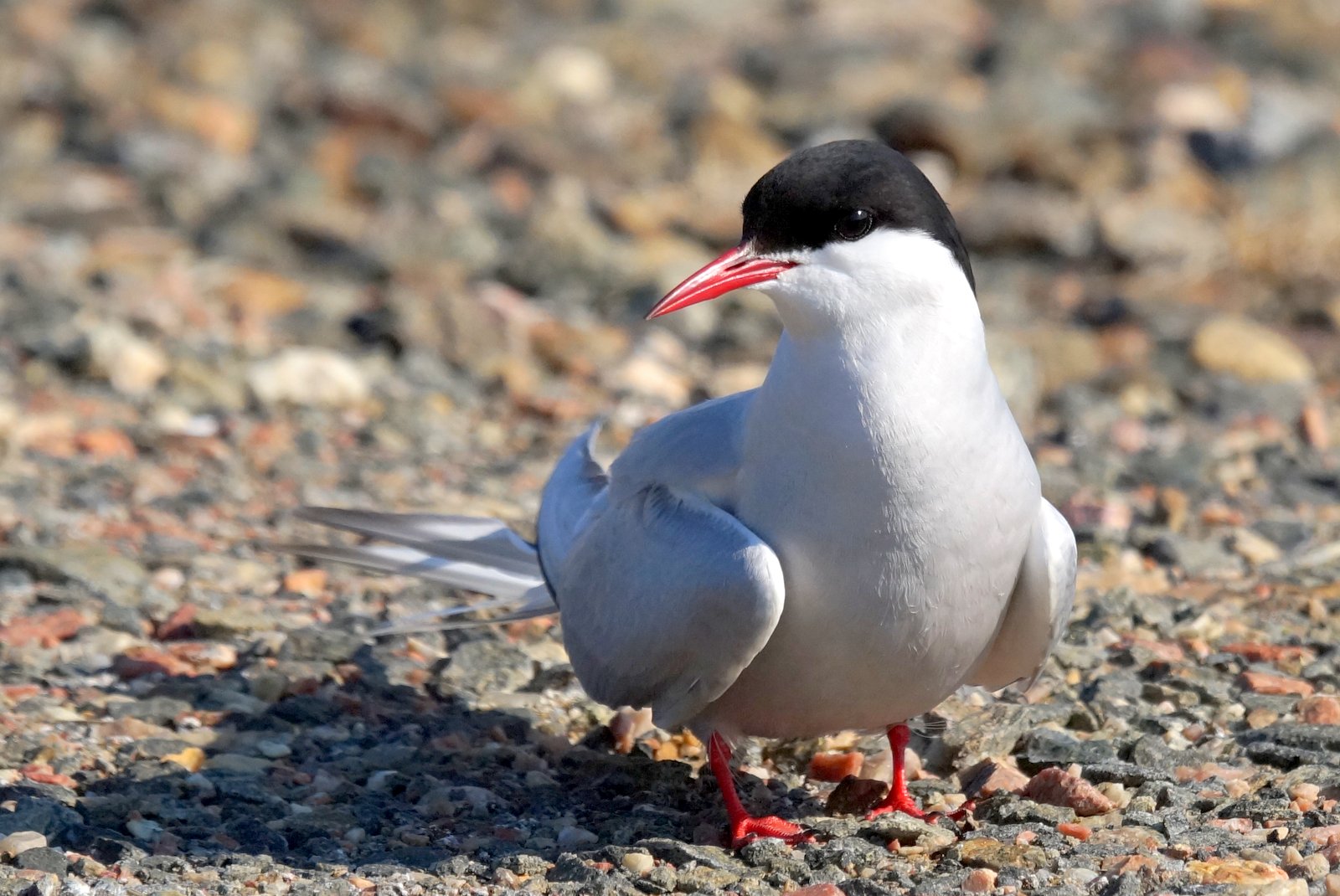
29–33 cm without the tail streamers; with the streamers of breeding adults up to about 39 cm. Very similar to Common Tern, but with a rounder head, a shorter bill and very short legs, so that a perched bird sits low to the ground. Breeding adults have an all-red bill without a black tip, a black cap, grey underparts with a white cheek stripe and streamers that project beyond the wingtips at rest. In flight all the primaries are translucent from below, with a narrow, sharply defined black trailing edge. Outside the breeding season and in juveniles the forehead and underparts are white and the bill is dark; juveniles have a faint dark carpal bar and white secondaries, forming a pale trailing edge to the wing.
Confusion species
Common Tern Sterna hirundo has a longer, black-tipped bill, longer legs and a broad, blurred dark trailing edge under the primaries, with only the inner primaries translucent; juvenile Common Terns have a dark carpal bar and greyer secondaries. Forster's Tern Sterna forsteri has silvery-white primaries and an isolated black eye patch outside the breeding season. Roseate Tern Sterna dougallii is paler, with white underparts and a dark bill, and occurs mainly on the Caribbean side.
Habitat
Open sea, especially over the edge of the continental shelf and further offshore, sometimes closer inshore after storms. It fishes by plunge-diving from a few metres, often after a brief hover, and rests on floating debris.
Where the bird is most at home, classified by the vegetation units of Mexico and Central America.


Range and movements
Passage migrant along the entire Pacific coast, from Baja California to Panama, mainly far offshore; most sightings come from boat trips. On the Caribbean side only a few records. Because of its route over open sea and its similarity to Common Tern the species is probably under-recorded. Outside the guide area it breeds around the Arctic in northern North America, Greenland and northern Eurasia, and winters in the Southern Ocean.
- Passage (Mar–Apr, Oct–Nov)
- dark = core range, pale = thinly spread
How and when to look
Pelagic trips off the Pacific coast during migration, especially in September and October, offer the best chance. With any short-legged tern with translucent primaries it pays to check the trailing edge of the wing and the bill length carefully; a photograph of the underwing is often decisive.
Conservation status
Not threatened globally. In parts of the breeding range numbers are declining because of food shortages and predation at colonies. In the guide area a passage migrant at sea with no breeding records.
Scientific name
Sterna paradisaea | Pontoppidan, 1763
Pontoppidan described the species in 1763 and placed it straight away in the genus where it still stands. The genus Sterna was introduced in 1758 by Linnaeus. Sterna goes back to Old English stearn, which appears in the poem The Seafarer; the Frisians used a related word for terns. paradisaea is Late Latin for 'of paradise', from paradisus 'paradise'. The specimen the first description was based on came from Christiansø, Denmark.