All species › Gannets and cormorants › Anhinga and darters › Anhinga
Position in the tree Birds Aves › Birds with a flexible palate Neognathae › All other modern birds Neoaves › Birds of the elements Elementaves › Tropicbirds and waterbirds Phaethoquornithes › Core waterbirds Aequornithes
Anhinga | Anhinga anhinga
Amerikaanse slangenhalsvogel | Anhinga americana
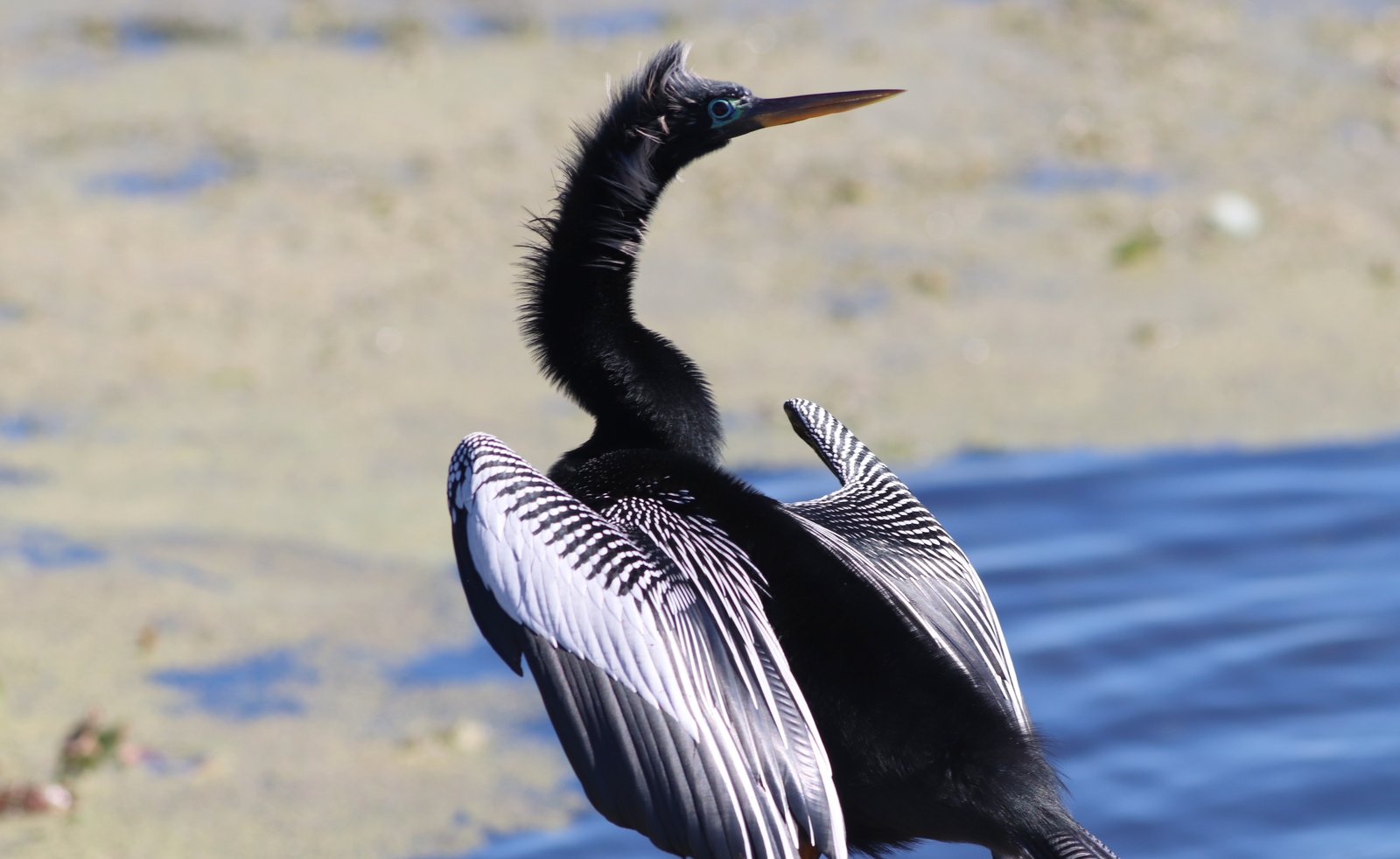
The Anhinga is a dark waterbird with a long, thin, kinked neck, a small head and a dagger-shaped bill with which it spears fish underwater. It often swims with only its head and neck above water, like a snake, and afterwards perches with its wings spread to dry. In the guide area it is resident on fresh and brackish water in the lowlands, from Mexico to Panama.
Voice
Usually silent. At the nest and at roosts a dry, clicking or rattling krr-krr-krr, and a soft cooing when approaching the nest.
Recording: Jacob Wijpkema — CC BY-NC-SA 4.0 · shortened to the first 60 s, mono · xeno-canto
Identification
75–95 cm, with a long, fan-shaped tail. The male is glossy black with a green sheen, with silvery-white spots and streaks on the mantle and upperwing and a pale terminal band on the tail; in the breeding season it has pale plumes on the head and hindneck. The female has the same wing pattern but a pale buff-brown head, neck and breast, sharply separated from the black belly. The bill is pointed and yellowish, the eye red. Juveniles are browner, with less white on the wing. It often soars high on thermals with the neck outstretched and the tail spread, like a cross in the sky.
Confusion species
Neotropic Cormorant Nannopterum brasilianum and Double-crested Cormorant Nannopterum auritum have a shorter, thicker neck, a hooked bill, a shorter tail and no silvery-white wing pattern; they swim with the body higher in the water. In flight, cormorants are recognised by their fast wingbeats and shorter tail; they are rarely seen soaring on thermals. Swimming grebes such as Western Grebe Aechmophorus occidentalis also have a long neck, but white underparts.
Habitat
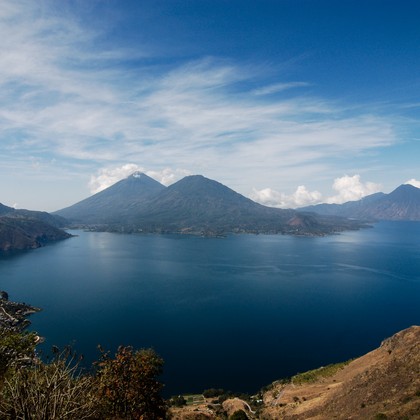
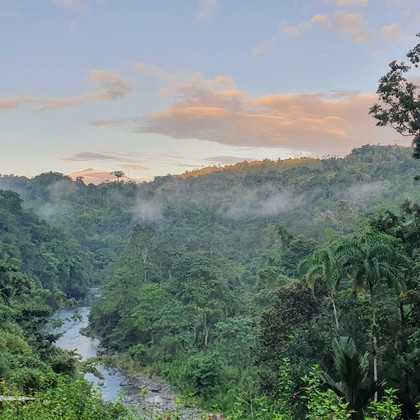
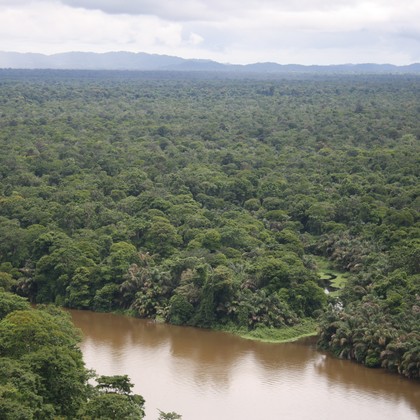
Calm fresh and brackish water with trees or shrubs along the banks: lakes, lagoons, slow rivers, canals, swamp forest, floodplain forest, mangroves and reservoirs, also rice fields; mainly in the lowlands, locally up to about 1000 m. It hunts fish by swimming underwater and spearing them with the bill, tosses them up above the water and swallows them head first. It breeds in colonies, often together with herons and cormorants, in trees and shrubs over water.
Where the bird is most at home, classified by the vegetation units of Mexico and Central America.



Range and movements
In Mexico on the Pacific side from southern Sonora and Sinaloa south to Chiapas, and on the Gulf side from Tamaulipas through Veracruz and Tabasco to the whole Yucatán Peninsula. Further in the lowlands of all of Central America, on both coasts, from Belize and Guatemala to Panama; most numerous in large wetlands. Birds in the guide area belong to the northern subspecies A. a. leucogaster. Outside the guide area from the south-eastern United States and Cuba to Argentina.
- Resident
- dark = core range, pale = thinly spread
How and when to look
Good places are the mangroves and lagoons around San Blas in Nayarit, the Pantanos de Centla in Tabasco, Crooked Tree in Belize, Palo Verde and Caño Negro in Costa Rica and Gatún Lake near Gamboa in Panama. Perched birds with spread wings on dead branches over the water are often noticed first; swimming birds often show only a thin neck above the water.
Conservation status
Not threatened. In the guide area locally common, but dependent on the conservation of freshwater marshes and waterside trees. Birds sometimes become entangled in fishing lines and nets.
Scientific name
Anhinga anhinga | (Linnaeus, 1766)
Linnaeus described the species in 1766 as Plotus anhinga; because it was later moved to another genus, the author and year stand in brackets. The genus Anhinga was introduced in 1760 by Brisson. Anhinga goes back to a Tupi name for the bird from Brazil; the often-quoted meaning 'devil bird' is uncertain. anhinga is the bird's name in Tupi, an Indigenous language of Brazil. The specimen the first description was based on came from Rio Tapajós, Pará, Brazil.