All species › Pelicans, herons and ibises › Pelicans › American White Pelican
Position in the tree Birds Aves › Birds with a flexible palate Neognathae › All other modern birds Neoaves › Birds of the elements Elementaves › Tropicbirds and waterbirds Phaethoquornithes › Core waterbirds Aequornithes
American White Pelican | Pelecanus erythrorhynchos
Amerikaanse witte pelikaan | Pelícano blanco americano
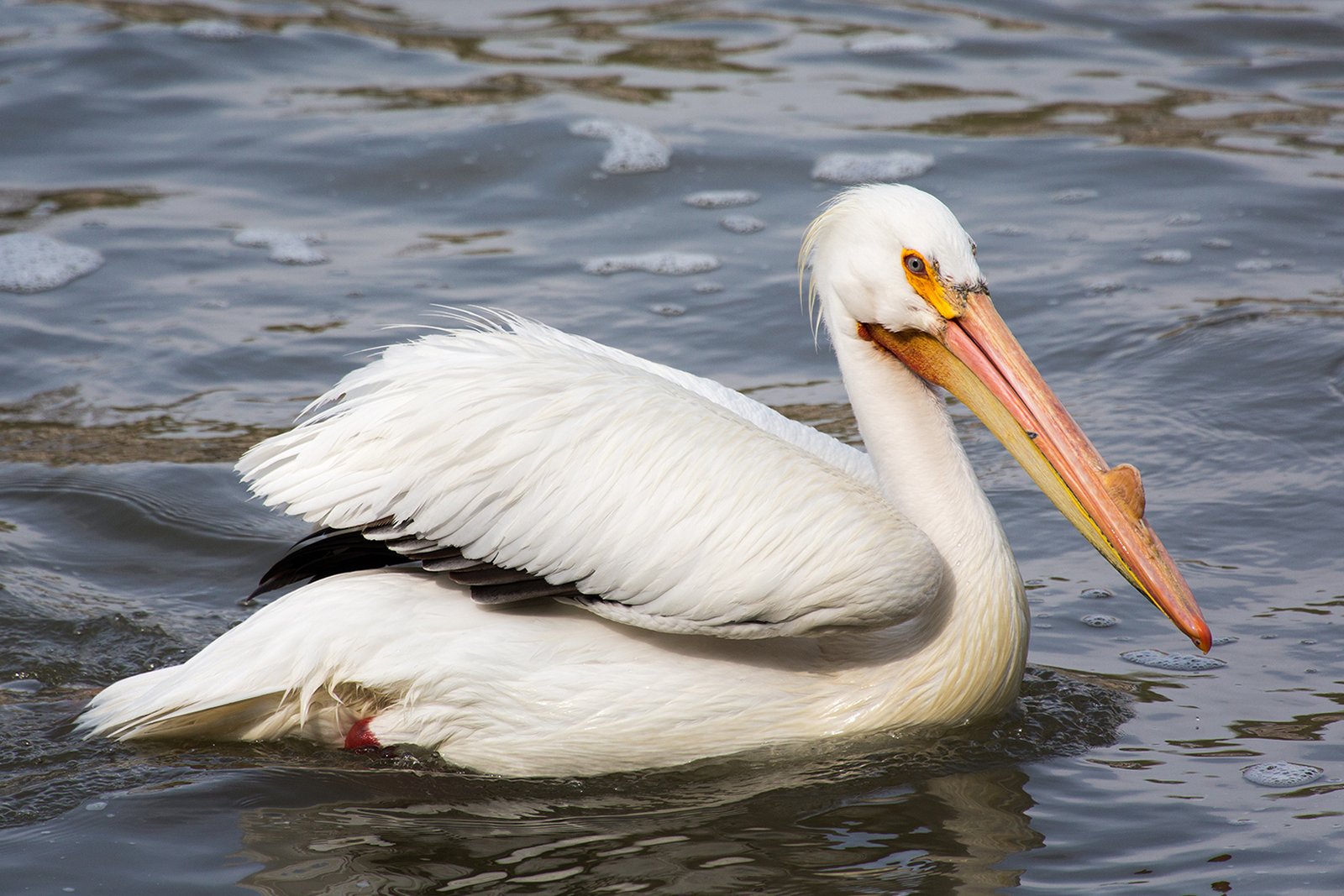
The American White Pelican is a very large, white pelican with black wingtips and an orange-yellow bill. It fishes while swimming, often in groups that herd fish together, and does not dive like the Brown Pelican. In the guide area it is a winter visitor from western and central North America, on inland lakes and coastal lagoons of Mexico.
Voice
Almost silent. Away from the breeding colony at most a low grunt or hiss.
Recording: Bruce Lagerquist — CC BY-NC-SA 4.0 · converted to mono · xeno-canto
Identification
127–165 cm, with a wingspan of almost three metres. Adults are white, with black primaries and outer secondaries that are especially obvious in flight. The long, flat bill and the pouch are orange-yellow, as are the bare skin around the eye and the legs. In the breeding season a flat, vertical horny plate grows on the upper mandible and is shed after egg-laying; outside the breeding season, when the birds are in the guide area, it is usually absent and the bill and legs are duller. Juveniles have a greyish head and upperwing and a greyish bill. It flies with the head drawn back, often in lines or V-formations, and soars on thermals in large flocks high in the sky.
Confusion species
Brown Pelican Pelecanus occidentalis is smaller and dark grey-brown, lives at sea and plunge-dives for fish. Wood Stork Mycteria americana is white with black flight feathers and tail, but has a bare, dark head, a decurved bill and long legs, and flies with the neck outstretched. Jabiru Jabiru mycteria has entirely white wings, a black head and neck and a heavy, black bill.
Habitat
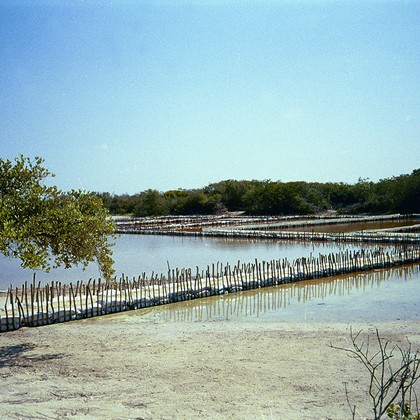
Large shallow lakes, reservoirs, coastal lagoons, estuaries and the edges of saline and alkaline lakes; it rests on sandbars, islets and shores. It fishes in groups that swim in a semicircle or a line and drive fish into shallow water, then dip their bills in unison. It breeds outside the guide area in colonies on islands in inland lakes.
Where the bird is most at home, classified by the vegetation units of Mexico and Central America.



Range and movements
In winter in much of Mexico: on lakes of the central plateau, such as Lake Chapala, and along the Pacific coast from Baja California and Sonora south to Oaxaca and Chiapas, with the largest numbers in the lagoons of Sinaloa and Nayarit. On the Gulf coast from Tamaulipas to the Yucatán Peninsula, especially in the Laguna Madre. Rare in Central America, south to Nicaragua and Costa Rica. Outside the guide area the species breeds in western and central North America, from southern Canada to California and Texas, and also winters in the southern United States.
- Winter visitor (c. Oct–Mar)
- dark = core range, pale = thinly spread
How and when to look
In winter the species is regularly seen at Petatán on Lake Chapala, where hundreds of birds stay around the fishing harbour, and in the coastal lagoons of Sinaloa and Nayarit. On warm days flocks soar high on thermals, the black wingtips flashing as the birds turn.
Conservation status
Not threatened. The population has grown in recent decades. In the guide area a winter visitor without a regular breeding population. Birds die from entanglement in fishing lines and nets, and roosting sites are sensitive to disturbance.
Scientific name
Pelecanus erythrorhynchos | Gmelin, 1789
Gmelin described the species in 1789 and placed it straight away in the genus where it still stands. The genus Pelecanus was introduced in 1758 by Linnaeus. Pelecanus is the Latin form of the Greek pelekan 'pelican', which itself derives from pelekys 'axe'. erythrorhynchos is Greek for 'red-billed', from eruthros 'red' and rhunkhos 'bill', after the orange-red bill. The specimen the first description was based on came from Hudson Bay and New York.