All species › Passerines › Vireos › Yucatan Vireo
Yucatan Vireo | Vireo magister
Yucatánvireo | Vireo yucateco
The Yucatan Vireo lives on the Yucatán Peninsula, in Belize and on islands off Honduras, and otherwise only on Grand Cayman. The Grand Cayman birds, subspecies caymanensis, were recognised in 2026 by the American ornithologists' nomenclature committee as a separate species, Grand Cayman Vireo; this guide keeps them under Yucatan Vireo for now. On the island the bird is known after its song as sweet Bridget.
Voice
The song consists of short, clear whistled phrases, on Grand Cayman often of two or three parts; the local name sweet Bridget derives from it. Also a soft, dry chatter.
Recording: Alfonso Auerbach — CC BY-NC-SA 4.0 · converted to mono · xeno-canto
Identification
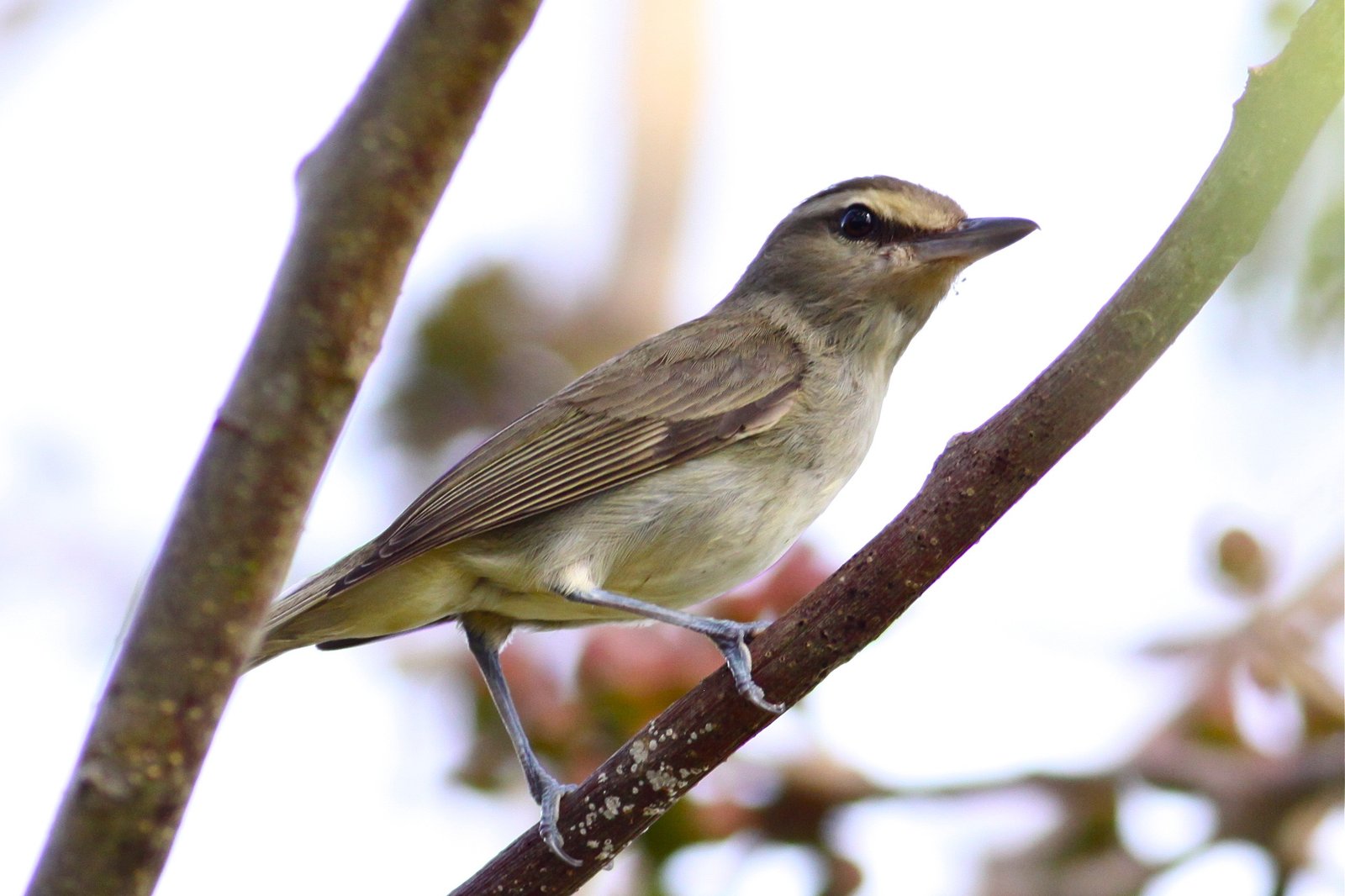
14–15 cm, large for a vireo, with a long, heavy bill and a rather flat head. Grand Cayman birds are the smallest form and more olive above than mainland birds. Crown and upperparts grey-brown to olive-grey, without wingbars. A broad, pale, buffy white eyebrow and a dark eyestripe; no black border to the crown and no malar stripe. Throat pale buff, underparts dirty white with a greyish or yellowish wash on the flanks. Iris dark. The sexes are alike.
Confusion species
Black-whiskered Vireo Vireo altiloquus, a summer visitor on Grand Cayman, has a dark malar stripe, a darker-bordered crown, greener upperparts and a red iris. Red-eyed Vireo Vireo olivaceus, a passage migrant, has a sharply black-bordered grey crown, a white eyebrow and a red iris. Thick-billed Vireo Vireo crassirostris, also in the Cayman Islands, is smaller, with two white wingbars and yellow lores. White-eyed Vireo Vireo griseus, a rare winter visitor, has wingbars and yellow spectacles.
Habitat
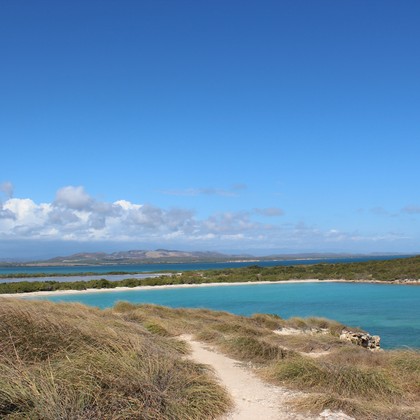
Mangrove edges, dry forest, thickets and dense coastal vegetation, also large gardens with native trees. It forages rather slowly in the middle and upper levels for insects and also eats berries.
Where the bird is most at home, classified by the vegetation types of the Caribbean.




Range and movements
In the region only on Grand Cayman; there is no evidence that it ever lived on Cayman Brac or Little Cayman. Outside the region in the north-east of the Yucatán Peninsula including Cozumel and Isla Mujeres, in Belize and on the Bay Islands of Honduras.
- Resident
- dark = core range, pale = thinly spread
How and when to look
Found in dry forest and thickets in eastern and central Grand Cayman, for example in the Mastic area and the Queen Elizabeth II Botanic Park, and along mangrove edges. The whistled song is the best lead.
Conservation status
Globally not threatened. On Grand Cayman the species is locally fairly common, but the dry forest and thickets it depends on are disappearing fast to development. As a separate species, Grand Cayman Vireo would have a small range limited to a single island.
Scientific name
Vireo magister | (Baird, 1871)
Baird described the species in 1871 as Vireosylvia magister; because it was later moved to another genus, the author and year stand in brackets. The genus Vireo was introduced in 1808 by Vieillot. Vireo was used by Latin authors for a small, green, migratory bird, probably the Eurasian golden oriole, though the European greenfinch has also been suggested. magister is Latin for 'master, chief', probably after its large size among vireos. The specimen the first description was based on came from Belize.