All species › Passerines › Vireos › Red-eyed Vireo
Red-eyed Vireo | Vireo olivaceus
Roodoogvireo | Vireo ojirrojo
In the Caribbean the Red-eyed Vireo appears in two forms. North American breeders migrate in large numbers via Florida, Cuba and the western islands to their wintering grounds in the Amazon Basin. Trinidad and Tobago also have southern resident birds. Most recent checklists treat these as a separate species, Chivi Vireo Vireo chivi; this guide, like the map, keeps them under Red-eyed Vireo.
Voice
The song consists of short whistled phrases repeated endlessly with brief pauses, something like cheewit... cheeweee... cheewit, even in the middle of the day. On migration in the region birds sing little; mostly a nasal, descending myeh is heard.
Recording: Stanislas Wroza — CC BY-NC-SA 4.0 · shortened to the first 60 s, mono · xeno-canto
Identification
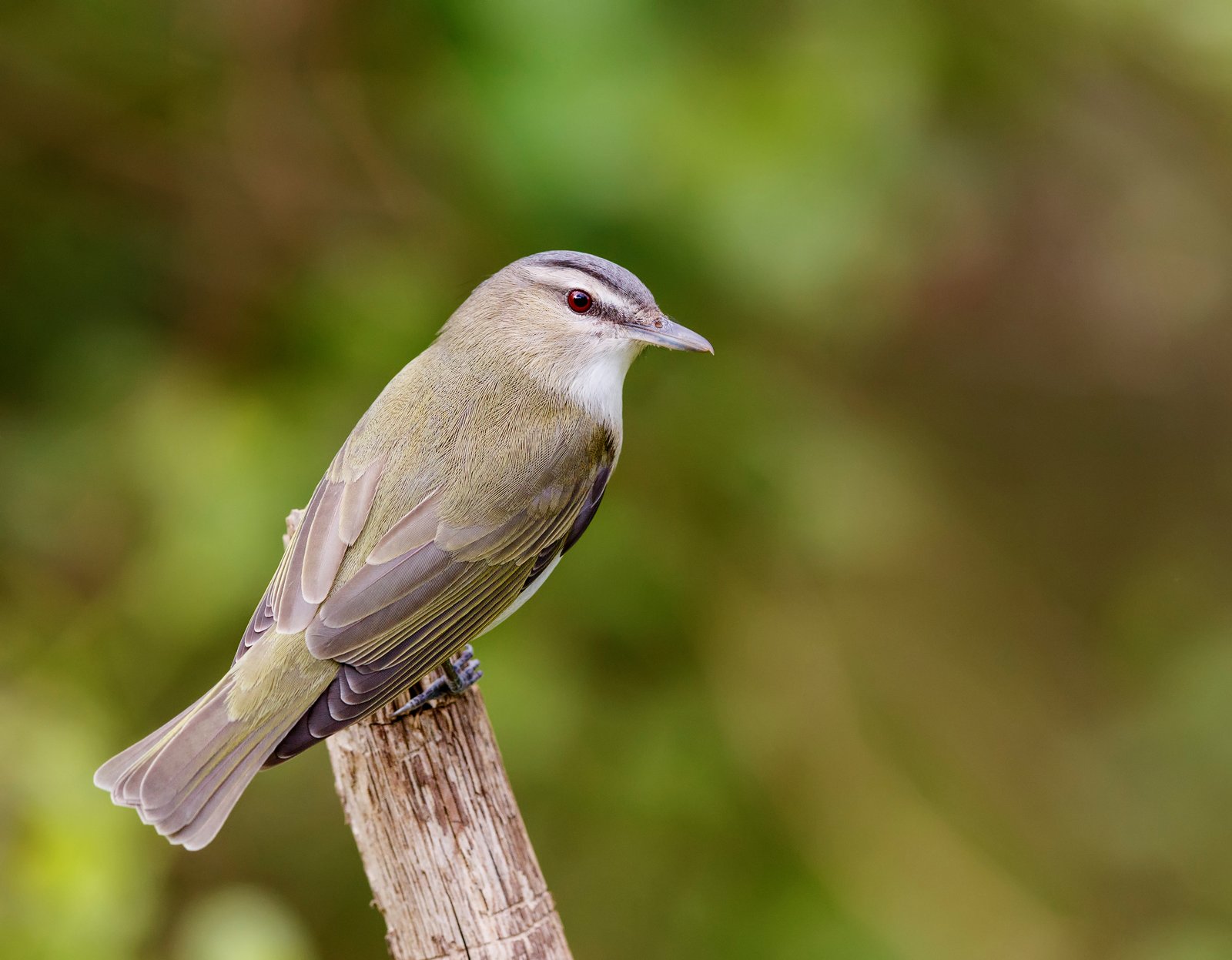
13–15 cm, slim, with a flat head and a fairly long, straight bill. Crown grey, sharply bordered on each side by a black line; below it a long white eyebrow and a black eyestripe. Upperparts olive-green, without wingbars. Underparts white, in autumn often with a yellow wash on the flanks and undertail coverts. Iris red in adults, brown in first-year birds. The southern birds of Trinidad and Tobago have a less sharply bordered crown and more yellow on the flanks; Tobago birds are larger with a heavier bill. The sexes are alike.
Confusion species
Black-whiskered Vireo Vireo altiloquus, a breeding bird over most of the region, has a narrow dark malar stripe and a browner-toned crown with less black edging. Yellow-green Vireo Vireo flavoviridis, a vagrant, is yellower green above, with bright yellow flanks and a weak head pattern. Philadelphia Vireo Vireo philadelphicus is smaller, with a short bill and a yellow throat. Blue-headed Vireo Vireo solitarius has white spectacles and wingbars.
Habitat
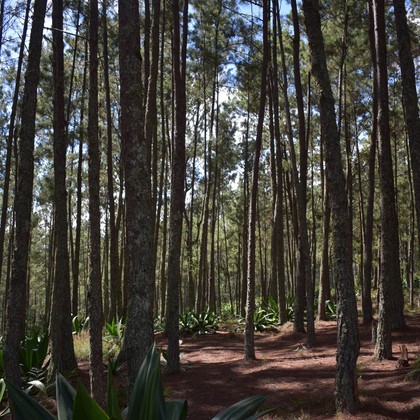
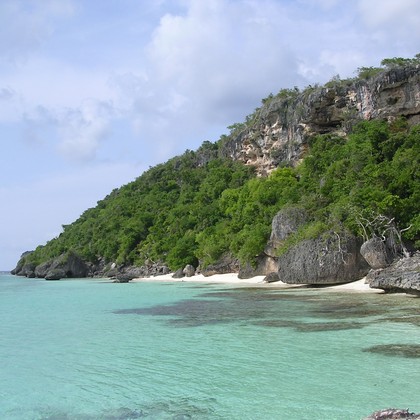
On migration in almost any wooded vegetation: dry and semi-evergreen forest, coastal woodland, pine forest and gardens and parks with trees. The residents of Trinidad and Tobago live in forest edge, secondary growth, cacao plantations and gardens. It forages unhurriedly in the canopy, searching leaves for caterpillars and other insects; in autumn it also eats many small fruits.
Where the bird is most at home, classified by the vegetation types of the Caribbean.





Range and movements
Common passage migrant in Cuba, the Cayman Islands, Jamaica and the Bahamas, mainly from late August to October and less in April and May; scarcer on Hispaniola and rare in Puerto Rico, the Virgin Islands, the Lesser Antilles and the ABC Islands. Southern forms are resident in Trinidad and Tobago. The North American breeding range extends from Canada to the Gulf Coast; the wintering area is in the Amazon Basin.
- Resident
- Summer visitor (c. Oct–Mar)
- Winter visitor (c. Apr–Sep)
- Passage (Mar–Apr, Oct–Nov)
- dark = core range, pale = thinly spread
How and when to look
In Cuba and on Grand Cayman, after a northerly wind in September and October, many migrants can sometimes be seen together at forest edges and in gardens. In Trinidad and Tobago the song of the residents is heard at forest edges throughout the breeding season. The black-bordered grey crown and the lack of a malar stripe separate it from Black-whiskered Vireo.
Conservation status
Not threatened. The North American population is very large and has increased in recent decades. Migrants are killed by collisions with lit buildings and towers.
Scientific name
Vireo olivaceus | (Linnaeus, 1766)
Linnaeus described the species in 1766 as Muscicapa olivacea; because it was later moved to another genus, the author and year stand in brackets. The genus Vireo was introduced in 1808 by Vieillot. Vireo was used by Latin authors for a small, green, migratory bird, probably the Eurasian golden oriole, though the European greenfinch has also been suggested. olivaceus is Latin for 'olive-green', from oliva 'olive', after the greenish upperparts. The specimen the first description was based on came from the Yungas, Bolivia.