All species › Passerines › New World blackbirds › Yellow-hooded Blackbird
Yellow-hooded Blackbird | Chrysomus icterocephalus
Geelkaptroepiaal | Turpial cabeciamarillo
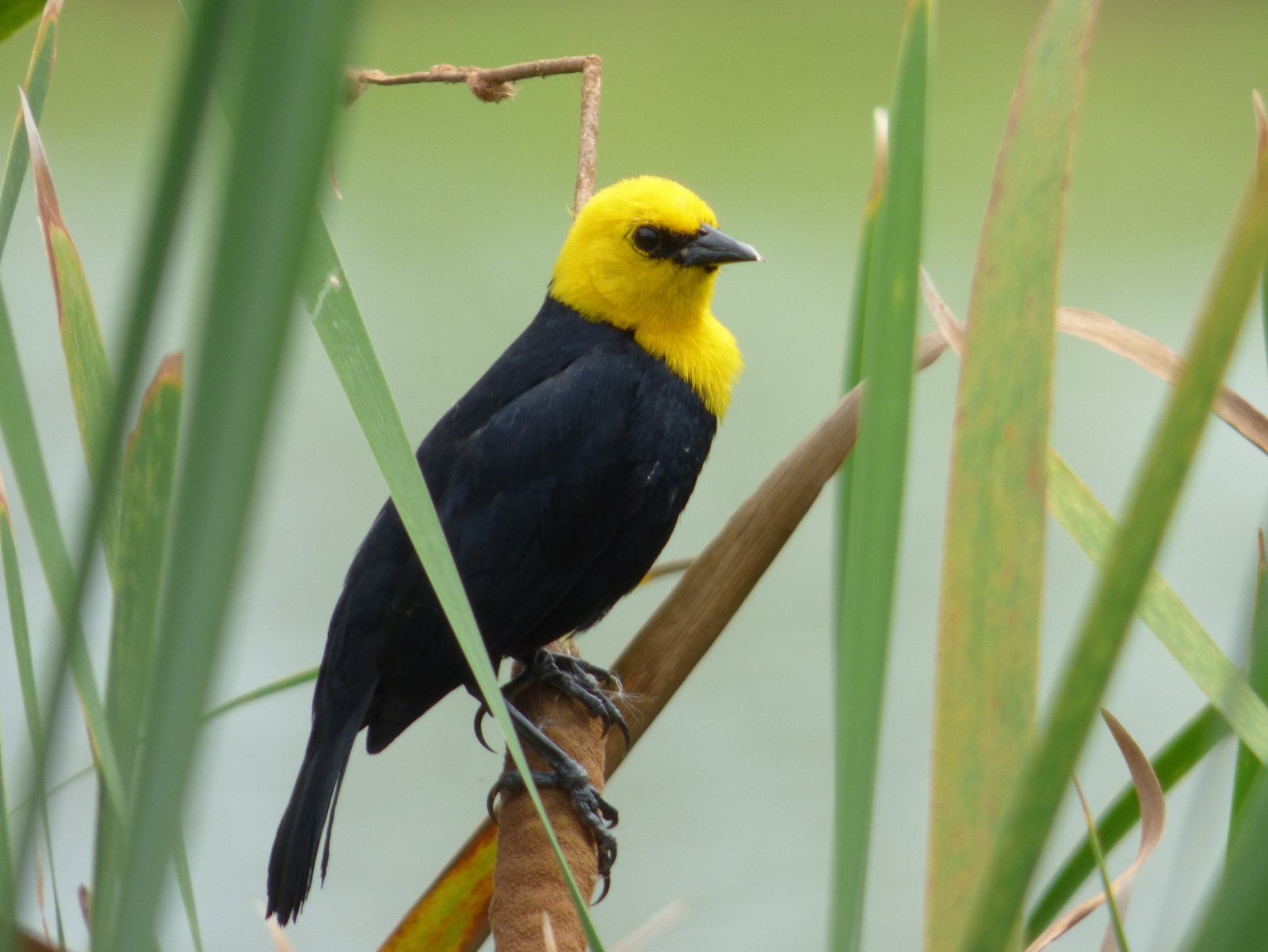
The Yellow-hooded Blackbird is a South American marsh bird that, within the Caribbean, breeds only in Trinidad. Males with their yellow hood stand out in reedbeds, rice fields and marshes, where the species nests in colonies.
Voice
Calls a dry chek and a descending whistle. The song consists of a few short notes or whistles ending in a harsh buzz, and a more varied series of warbling notes.
Recording: David Ricardo Rodríguez-Villamil — CC BY-NC-SA 4.0 · converted to mono · xeno-canto
Identification
17–19 cm, with a pointed, conical black bill. The male is glossy black, with a bright yellow head, throat, neck and upper breast and black lores around the eye. The female is inconspicuous: greyish olive-brown above with dark streaks, an olive-yellow crown and cheek, and a yellow supercilium, throat and upper breast; the rest of the underparts are olive-brown. Young males at first resemble the female and gradually acquire the black and yellow pattern.
Confusion species
Yellow Oriole Icterus nigrogularis is larger and mostly yellow, with a black throat and black wings, not a yellow hood on a black body. The male Red-breasted Meadowlark Leistes militaris has a red throat and breast. Female Shiny Cowbirds Molothrus bonariensis are plain brown without yellow.
Habitat
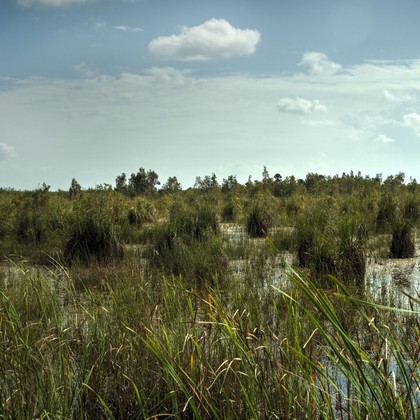
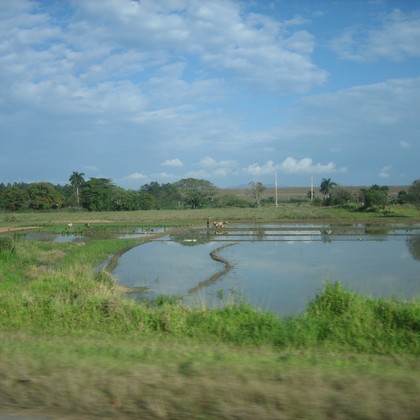
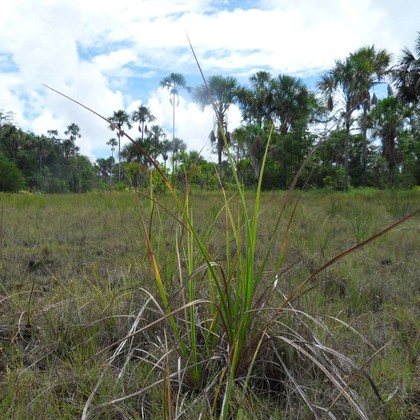
Freshwater marshes with reeds, sedges and cattails, rice fields, flooded grassland, the edges of ponds and sewage ponds, locally also brackish marsh near mangroves. It eats insects and seeds, often in flocks, also outside the breeding season. The male often has several females; the nests are cups of wet sedge and grass in marsh vegetation, in colonies of sometimes dozens of nests.
Where the bird is most at home, classified by the vegetation types of the Caribbean.
Range and movements
Resident in Trinidad, mainly in the west and south: the Caroni rice fields and marshes, the Nariva Swamp and the ponds at Trincity and Waterloo. Absent from Tobago. A vagrant to Aruba (Bubali, 2016–2017) and Curaçao (Klein Hofje, 2015); escaped cage birds cannot be ruled out there. Outside the region in northern South America, from Colombia and Venezuela to the Guianas and along the Amazon to Peru.
- Resident
- Summer visitor (c. Oct–Mar)
- Winter visitor (c. Apr–Sep)
- Passage (Mar–Apr, Oct–Nov)
- dark = core range, pale = thinly spread
How and when to look
Best looked for in the Caroni rice fields and at the Trincity ponds, where males sing from reed stems. Females are identified by the yellow face and throat set in olive-brown.
Conservation status
Not threatened. Common in suitable marshes. Habitat is lost locally through wetland drainage, but the species makes much use of rice fields.
Scientific name
Chrysomus icterocephalus | (Linnaeus, 1766)
Linnaeus described the species in 1766 as O[riolus] icterocephalus; because it was later moved to another genus, the author and year stand in brackets. The genus Chrysomus was introduced in 1837 by Swainson. Chrysomus is Greek, from khrusōma 'wrought gold, something made of gold', after the golden-yellow plumage. icterocephalus is Greek, from ikteros 'jaundice, yellow' and -kephalos '-headed', after the male's yellow head. The specimen the first description was based on came from Cayenne, French Guiana.