All species › Falcons › Falcons › Yellow-headed Caracara
Yellow-headed Caracara | Daptrius chimachima
Geelkopcaracara | Caracara chimachima
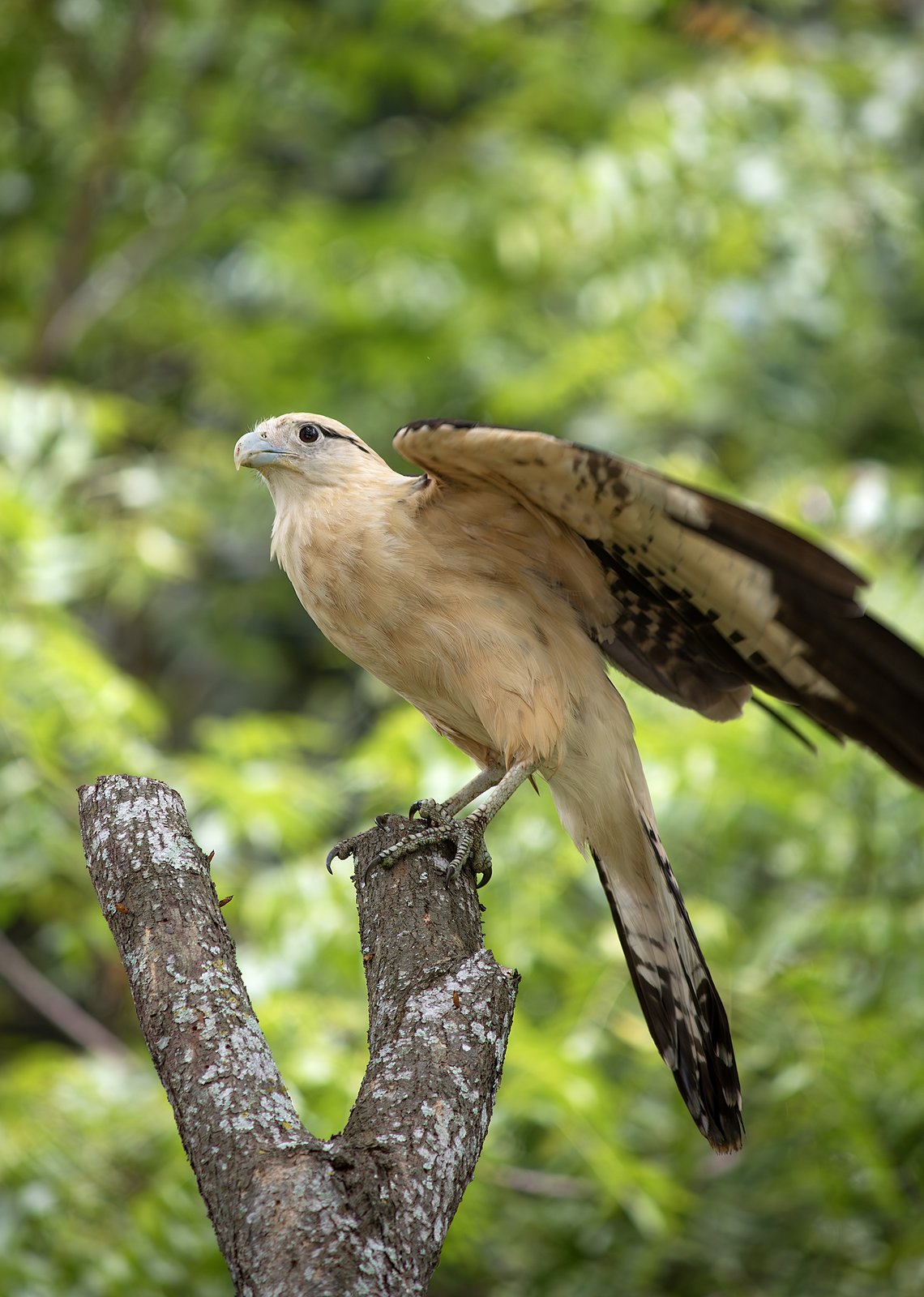
The Yellow-headed Caracara is a small, lightly built caracara of open, lightly wooded country in South America and southern Central America. It colonised Trinidad around the middle of the 20th century and is now a familiar bird of pastures and roadsides there. It feeds on carrion, insects and small animals and picks ticks and other parasites off livestock. It was formerly placed in the genus Milvago; on DNA evidence it is now included in Daptrius.
Voice
Noisy mainly around the nest and in squabbles over food. A harsh, scratchy, descending scream keeeah, often repeated, and a rasping kraa-kraa-kraa.
Recording: JAYRSON ARAUJO DE OLIVEIRA — CC BY-NC-SA 4.0 · converted to mono · xeno-canto
Identification
40–46 cm, slim, with a small head, a fairly long tail and relatively narrow wings. Head, neck and underparts are creamy white to pale buff, with a thin dark line behind the eye. Back and wings are dark blackish brown. In flight a pale patch at the base of the primaries stands out. The tail is pale with dark bars and a broad dark terminal band. The bare skin around the eye is yellow, the bill pale blue and the legs pale green. The sexes are alike; the female is slightly heavier. Juveniles are browner, heavily streaked brown on the head and underparts.
Confusion species
Crested Caracara Caracara plancus is much larger, with a black cap, a red face, a blackish-brown belly and a white tail with a black terminal band. Savanna Hawk Buteogallus meridionalis is rufous, long-legged and has a black tail band. A streaked young Yellow-headed Caracara may suggest a buteo, but it has the slim caracara shape, the pale wing patch and the pale green legs.
Habitat
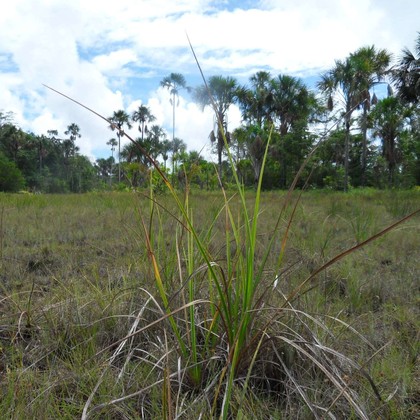
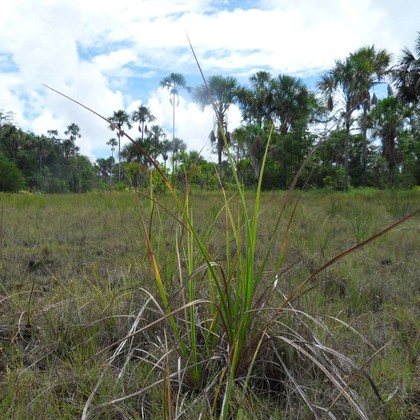
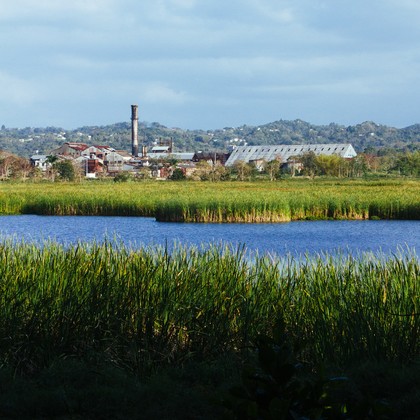
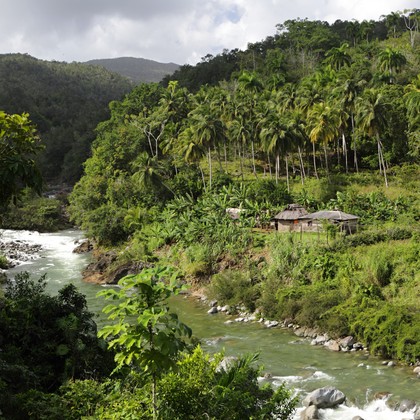
Cattle pasture, savanna, rice fields and farmland, coconut and oil palm plantations, river banks and forest edges in open country, also roadsides and village edges; mainly in the lowlands. It perches on posts, palms or the backs of cattle and searches on foot or in low flight for carrion, road kill, insects and larvae, lizards, snakes, nestlings and fruit. The nest is an open cup of sticks high in a tree or palm.
Where the bird is most at home, classified by the vegetation types of the Caribbean.


Range and movements
Common resident on Trinidad, mainly in the open lowlands of the centre, the north-west and along the east coast; scarce in the forested Northern Range. Rare on Tobago. Recorded as a vagrant on Curaçao and Bonaire. Outside the region from Nicaragua and Costa Rica through Panama and northern South America to Uruguay and northern Argentina.
- Resident
- dark = core range, pale = thinly spread
How and when to look
Best in the open country of Trinidad's central lowlands, such as around the Aripo Savanna and the Caroni rice fields, and along the main highways, where birds sit on fence and lamp posts or forage on the verge. Where cattle or water buffalo graze, they often walk or perch among the animals.
Conservation status
Not threatened. The species benefits from forest clearance and the creation of pasture and is extending its range in Central America. Road traffic takes a toll.
Scientific name
Daptrius chimachima | (Vieillot, 1816)
Vieillot described the species in 1816 as Polyborus chimachima; because it was later moved to another genus, the author and year stand in brackets. The genus Daptrius was introduced in 1816 by Vieillot. Daptrius is Greek, from daptēs 'devourer, eater', from daptō 'to devour'. chimachima is an onomatopoeic local name from Paraguay and Argentina, recorded by Félix de Azara and adopted by Vieillot. The specimen the first description was based on came from Paraguay.