All species › Passerines › Vireos › Yellow-green Vireo
Yellow-green Vireo | Vireo flavoviridis
Geelgroene vireo | Vireo verdiamarillo
The Yellow-green Vireo is the tropical counterpart of the Red-eyed Vireo. It breeds from extreme southern Texas and Mexico to Panama and winters in the western Amazon Basin and along the eastern slope of the Andes. In the Caribbean it is a very rare vagrant; in 2018 it was photographed on Aruba for the first time.
Voice
The song is a repetition of short phrases like that of Red-eyed Vireo, but faster and with shorter pauses, something like veeree veer veeree. The call is a nasal myeh. Vagrants are usually silent.
Recording: Noah Khanti Steinberg — CC BY-NC-SA 4.0 · converted to mono · xeno-canto
Identification
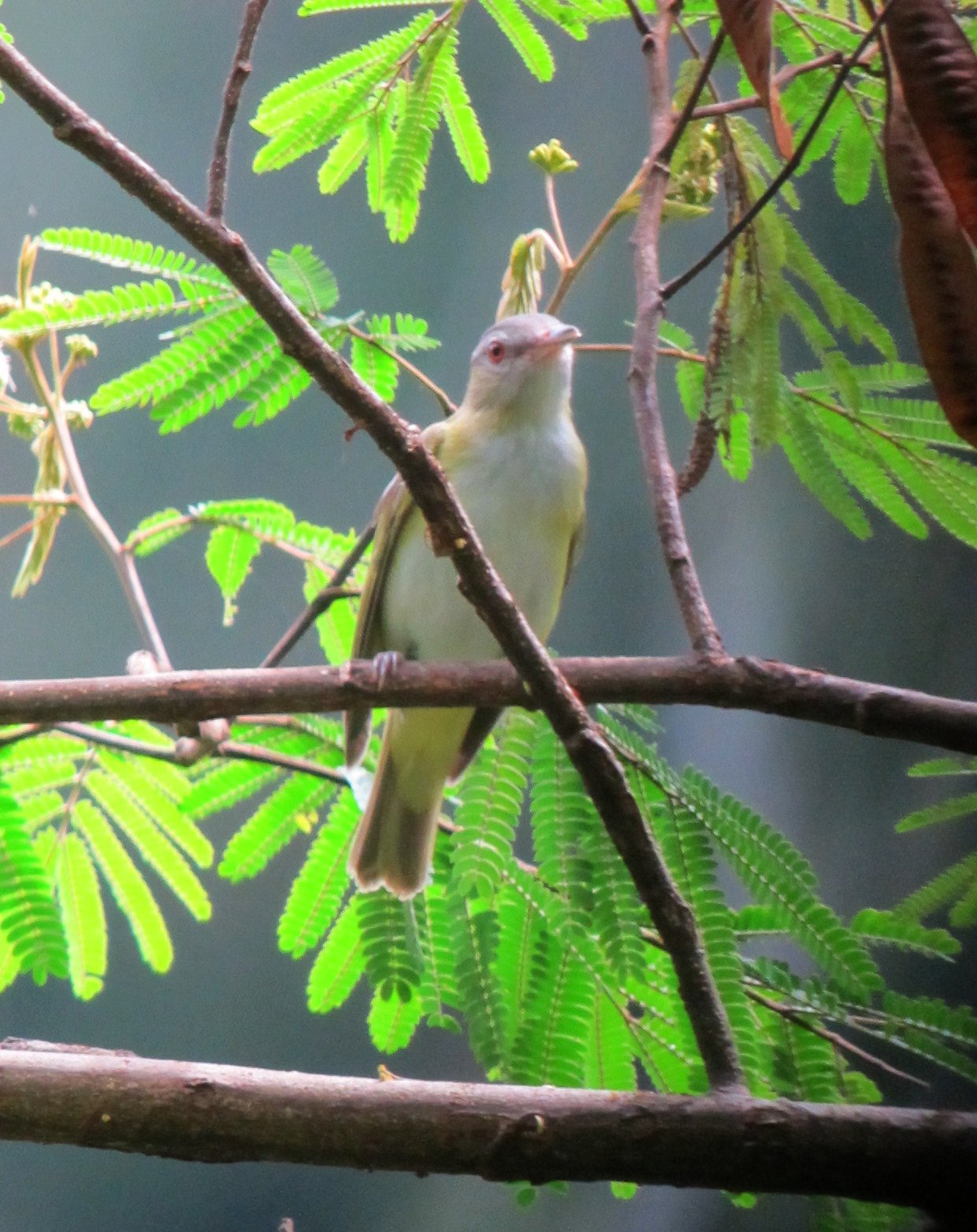
14–15 cm, slim, with a fairly long, heavy bill that is pale below. Upperparts bright yellow-green; the crown is grey with only a faint dark border. A whitish eyebrow and a dark eyestripe give a less crisp head pattern than in Red-eyed Vireo. Underparts white, with bright yellow flanks and undertail coverts; the sides of the head often have a yellow tinge too. Iris reddish brown in adults, brown in young birds. No wingbars. The sexes are alike.
Confusion species
Red-eyed Vireo Vireo olivaceus is the most similar species; some birds cannot be separated with certainty even in the hand. It has duller olive upperparts, a clearly black-bordered grey crown, a sharper eyebrow and less and paler yellow on the flanks and undertail. Black-whiskered Vireo Vireo altiloquus has a dark malar stripe and a browner crown. Philadelphia Vireo Vireo philadelphicus is smaller, with a short bill and a yellow throat.
Habitat
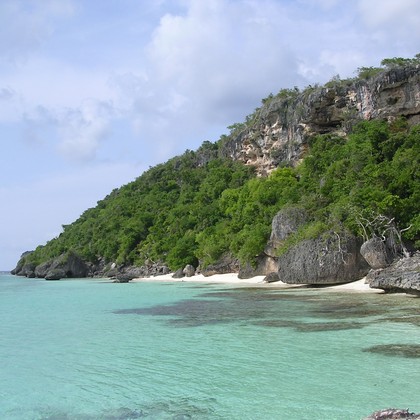
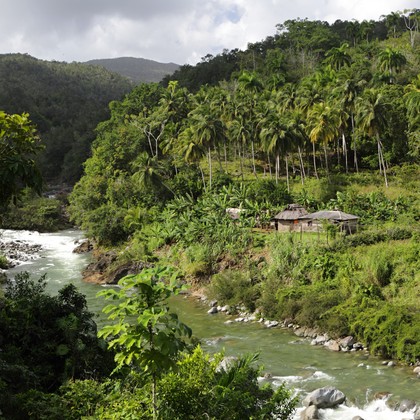
In the breeding range semi-open woodland, forest edge, plantations, villages and gardens with trees in the lowlands. It forages for insects in the canopy and also eats a lot of fruit. Vagrants in the region are to be expected in trees in gardens, parks and coastal woodland.
Where the bird is most at home, classified by the vegetation types of the Caribbean.


Range and movements
Records from Aruba (photographed, published in November 2018) and Guadeloupe. Further records on the islands are possible, but sightings need good documentation because of the resemblance to Red-eyed Vireo. Outside the region it breeds from southern Texas through Mexico and Central America to Panama, and winters in northern South America, mainly in the western Amazon Basin.
How and when to look
The ABC Islands and the western islands close to Central America lie nearest to the migration route. Any vireo with bright yellow flanks and undertail and a weak head pattern deserves a good photograph of the head, flanks and undertail.
Conservation status
Globally not threatened. The species has a large range and is common in its breeding area. In the Caribbean it is a very rare vagrant.
Scientific name
Vireo flavoviridis | (Cassin, 1851)
Cassin described the species in 1851 as Vireosylvia flavoviridis; because it was later moved to another genus, the author and year stand in brackets. The genus Vireo was introduced in 1808 by Vieillot. Vireo was used by Latin authors for a small, green, migratory bird, probably the Eurasian golden oriole, though the European greenfinch has also been suggested. flavoviridis is Latin, from flavus 'yellow' and viridis 'green', after the yellow-green tones. The specimen the first description was based on came from San Juan de Nicaragua, Nicaragua.