All species › Passerines › Crows and jays › Cuban Crow
Cuban Crow | Corvus nasicus
Cubaanse kraai | Cao montero
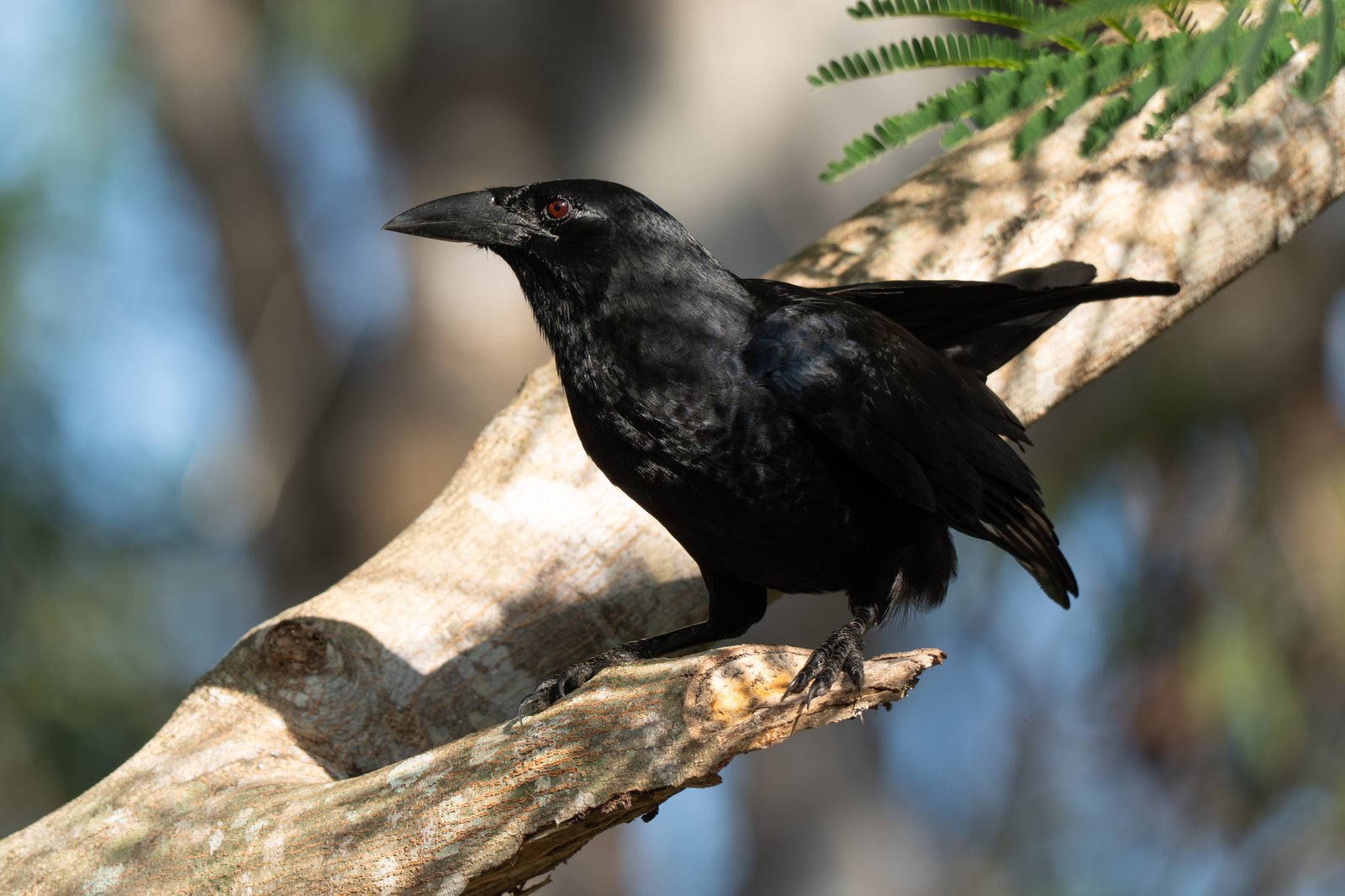
The Cuban Crow is a heavy-set crow of forest and farmland in Cuba, the Isla de la Juventud and the Caicos Islands. It lives in noisy pairs and small groups, often close to farms and villages, and makes sounds more reminiscent of a parrot than a crow. Cuba also holds the much rarer Cuban Palm Crow, which genetic work shows to belong to a different lineage that reached the island separately.
Voice
A varied repertoire of liquid, bubbling notes, high ringing calls and a thin, screeching call rising in pitch, given in all kinds of combinations. Groups are noisy and the calls carry far.
Recording: FREDERIC Lionel — CC BY-NC-SA 4.0 · converted to mono · xeno-canto
Identification
40–42 cm, stocky and large-headed, with a long, deep bill gently curved towards the tip. Entirely black, with a blue-purple gloss in good light. There is a small patch of bare dark grey skin behind the eye and at the base of the lower mandible. The nasal bristles sweep forward and upward, often exposing the nostrils. The gape reaches to about below the middle of the eye; the iris is reddish brown. Bill and legs black. The sexes are alike; juveniles are duller.
Confusion species
Cuban Palm Crow Corvus minutus is smaller, with a shorter bill, a gape ending in front of the eye, a square-ended tail and a crow-like, nasal call; it walks on the ground, whereas Cuban Crow more often hops. Cuban Blackbird Ptiloxena atroviolacea and Greater Antillean Grackle Quiscalus niger are also glossy black but much smaller and slimmer, with a slender bill and, in the grackle, a yellow iris and keeled tail.
Habitat
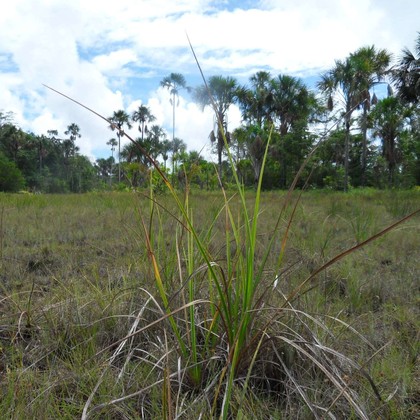
Forest, forest edge, palm savanna and open farmland with scattered trees, including the surroundings of farms and villages; also marsh edges. It forages in trees and on the ground for fruit, seeds, insects, small reptiles and eggs. The nest is built high in a tree or in the crown of a palm.
Where the bird is most at home, classified by the vegetation types of the Caribbean.





Range and movements
Cuba, the Isla de la Juventud and some cays, across the whole island but locally scarce because of persecution. Also in the Caicos Islands, mainly North and Middle Caicos. It does not occur outside this area.
- Resident
- dark = core range, pale = thinly spread
How and when to look
In Cuba found in the farmland and forest edges of the Zapata Peninsula and around the Sierra del Rosario, often first located by voice. In the Caicos Islands in the woodland and farmland of North and Middle Caicos. A long-billed crow with parrot-like calls in Cuba is almost always this species.
Conservation status
Not threatened. Common to locally abundant in Cuba. In the Caicos Islands the population is small and vulnerable to habitat development.
Scientific name
Corvus nasicus | Temminck, 1826
Temminck described the species in 1826 and placed it straight away in the genus where it still stands. The genus Corvus was introduced in 1758 by Linnaeus. Corvus is the Latin word for 'raven'. nasicus is Latin for 'big-nosed' (from nasus 'nose'), probably after the heavy bill and the conspicuously exposed nostrils. The specimen the first description was based on came from Cuba.