All species › Pelicans, herons and ibises › Herons and bitterns › Yellow-crowned Night Heron
Yellow-crowned Night Heron | Nyctanassa violacea
Geelkruinkwak | Martinete coronado
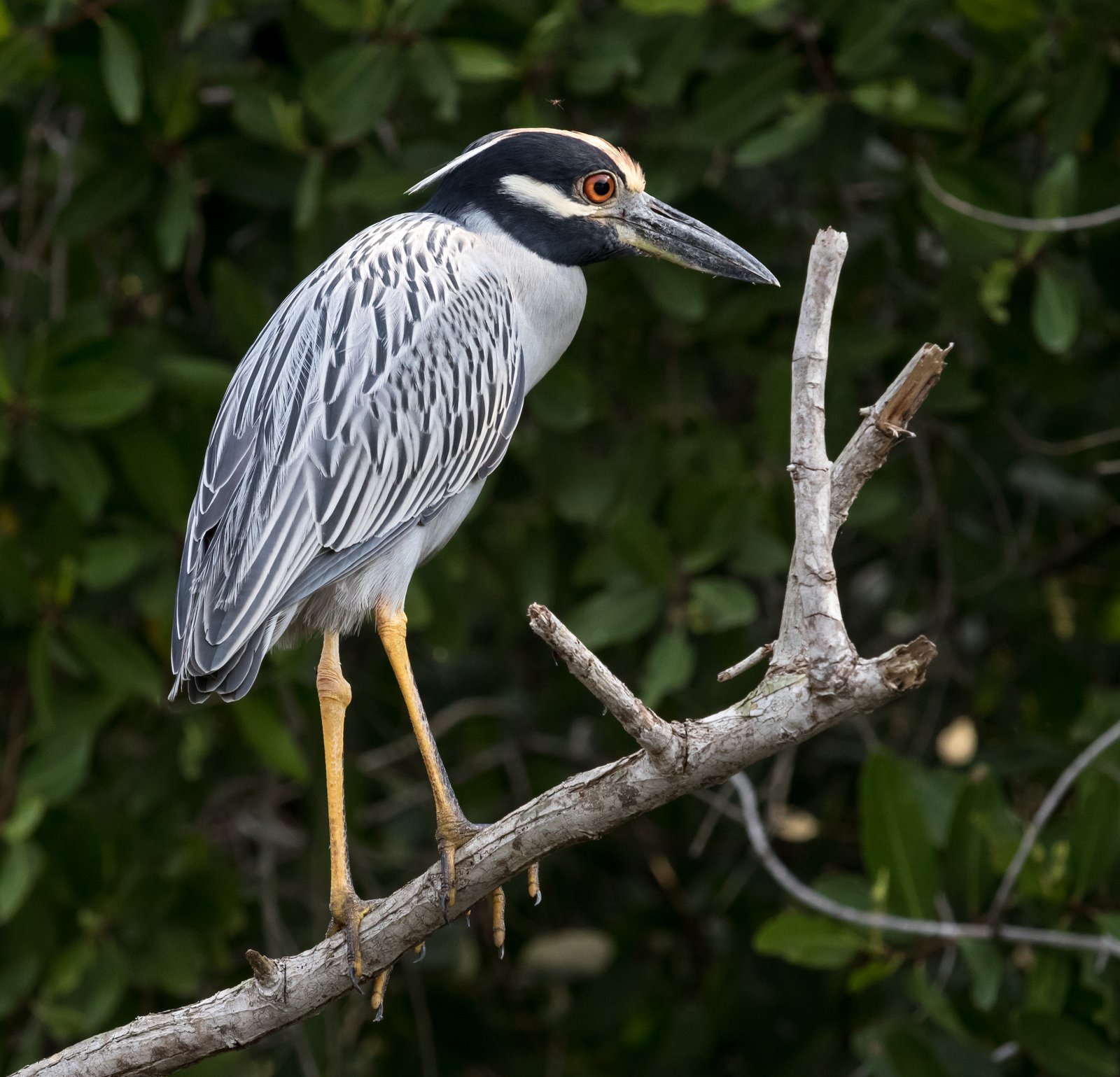
The Yellow-crowned Night Heron is a stocky, medium-sized night heron with a short, thick bill, specialised in crabs. It occurs on almost every island in the Caribbean, in mangroves, along rocky coasts and in coastal towns, and despite its name is also active by day. On some islands, including the Bahamas, young birds are eaten.
Voice
A short, sharp kwak or kok, slightly higher than that of Black-crowned Night Heron; mainly heard on take-off and at night.
Recording: José María Loaiza B. — CC BY-NC-SA 4.0 · converted to mono · xeno-canto
Identification
55–70 cm, with a short, thick neck, a heavy black bill and fairly long legs. Adults are blue-grey, with dark, pale-edged feathers on the back and wings. The head is black with a white cheek patch and a white to pale yellow crown that continues into short nape plumes. The eye is orange-red, the legs yellow, at times orange-red when breeding. Juveniles are grey-brown, with fine white spots on the upperparts and grey-brown streaked underparts; adult plumage is reached only after about three years. In flight the legs project well beyond the tail. The sexes are alike.
Confusion species
Young Black-crowned Night Herons Nycticorax nycticorax closely resemble young Yellow-crowned, but are warmer brown, with larger, teardrop-shaped white spots on the wings, a thinner bill with a yellowish base and shorter legs that barely project beyond the tail in flight. Adult Black-crowned have a black crown and mantle and pale grey wings. American Bittern Botaurus lentiginosus is warmer brown, with dark streaks down the neck and a dark moustachial stripe.
Habitat
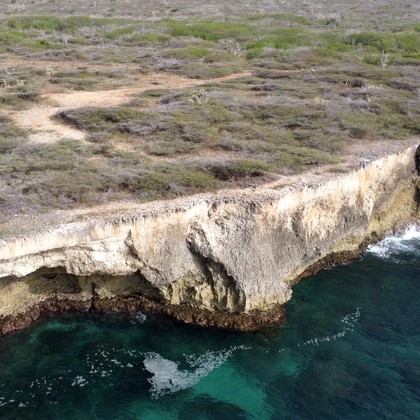
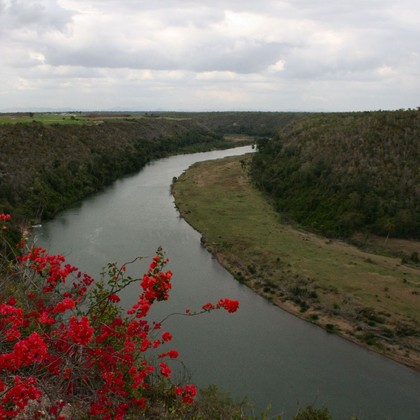
Mangroves, tidal flats, rocky shores, coastal lagoons and river mouths; on some islands also inland streams and gardens and parks in coastal towns. It feeds mainly on crabs, plus crayfish, snails, fish and insects, hunting by day and by night, often in step with the tide. It nests singly or in small groups, in mangroves or other trees.
Where the bird is most at home, classified by the vegetation types of the Caribbean.




Range and movements
Resident on almost all islands: the Bahamas, the Turks and Caicos Islands, Cuba, the Cayman Islands, Jamaica, Hispaniola (Haiti and the Dominican Republic), Puerto Rico, the Virgin Islands, the Lesser Antilles, the ABC islands, San Andrés and Trinidad and Tobago. Scarce on Barbados. Outside the region from the eastern United States along the coasts of Mexico and Central America to Peru and Brazil, and on the Galápagos Islands.
- Resident
- Summer visitor (c. Oct–Mar)
- Winter visitor (c. Apr–Sep)
- Passage (Mar–Apr, Oct–Nov)
- dark = core range, pale = thinly spread
How and when to look
Along mangrove channels and rocky shores at dusk, or roosting in mangroves by day. On many islands also in harbours, along seafronts and at beach hotels, where the birds are used to people and can be seen at close range.
Conservation status
Not threatened. On some islands, including the Bahamas, young birds are illegally taken from nests for food. Mangrove clearance removes habitat locally.
Scientific name
Nyctanassa violacea | (Linnaeus, 1758)
Linnaeus described the species in 1758 as Ardea violacea; because it was later moved to another genus, the author and year stand in brackets. The genus Nyctanassa was introduced in 1887 by Stejneger. Nyctanassa is Greek, from nux, genitive nuktos, 'night' and anassa 'queen': queen of the night. violacea is Latin for 'violet-coloured', from violaceus. The specimen the first description was based on came from Carolina, North America.