All species › Passerines › Thrushes › Wood Thrush
Wood Thrush | Hylocichla mustelina
Amerikaanse boslijster | Zorzal maculado
The Wood Thrush breeds in deciduous forest in eastern North America and winters in Central America, from southern Mexico to Panama. Most birds migrate across or around the Gulf of Mexico, so the Caribbean lies outside the main route. In the north-west it is a rare passage migrant, mainly in Cuba; further east a vagrant.
Voice
Usually silent in the region. The alarm call is a rapid, dry pit-pit-pit or pook-pook; migrating birds give a buzzy heeh at night. The song, on the breeding grounds, is a fluted phrase in several parts such as ee-oh-lay, ending in a trilled note.
Recording: Daniel Parker — CC BY-NC-SA 4.0 · shortened to the first 60 s, mono · xeno-canto
Identification
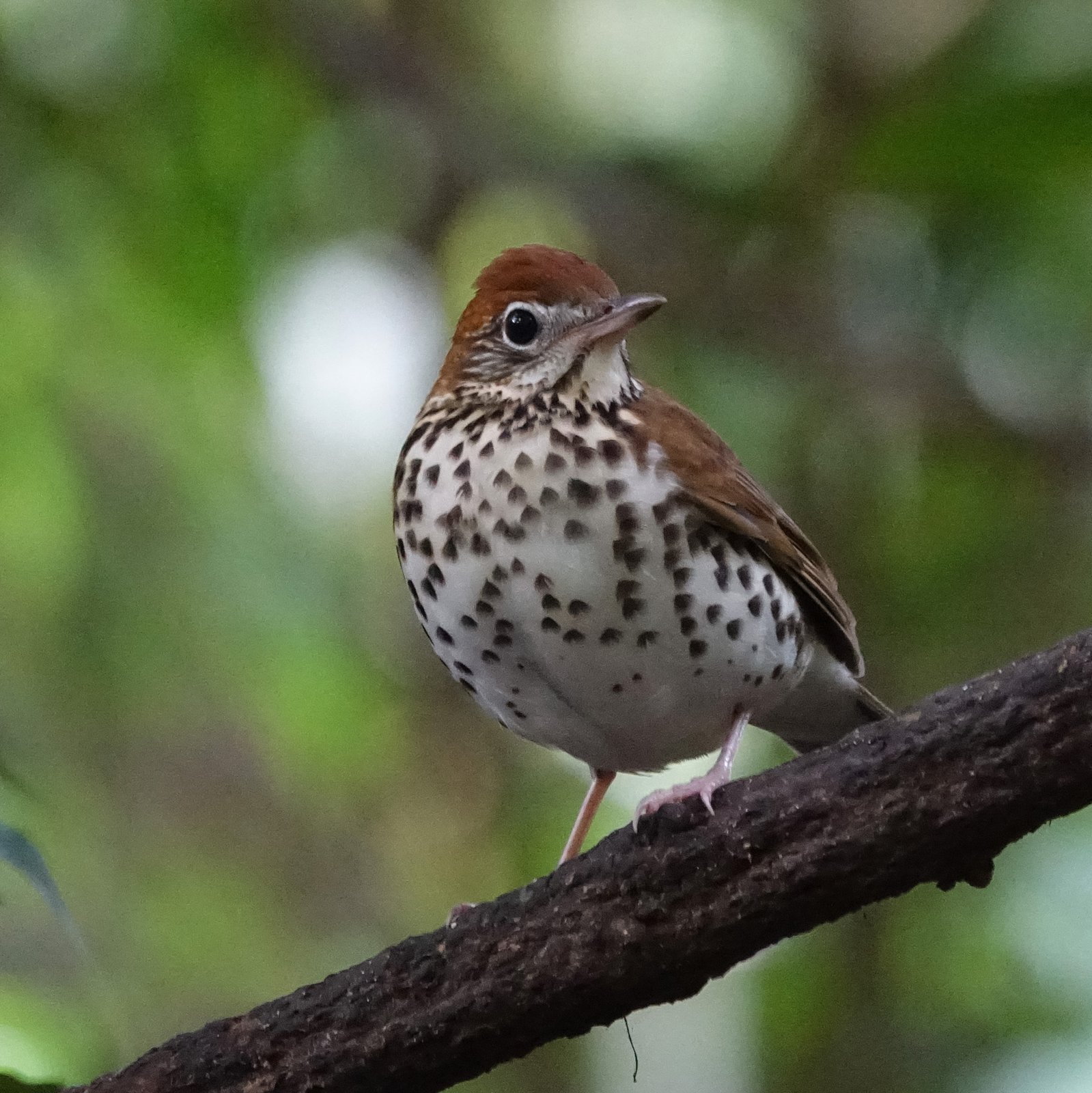
18–21 cm, the largest and heaviest of the brown North American thrushes, with a round belly and a fairly short tail. Crown and nape are warm rusty brown, back and tail a cooler olive-brown. A clear white eye-ring and black-and-white streaked cheeks. The underparts are white with large, round black spots on breast, flanks and belly. The legs are pink. The sexes are alike.
Confusion species
The Catharus thrushes, such as Swainson's Thrush Catharus ustulatus and Veery Catharus fuscescens, are smaller and slimmer, with smaller, fewer spots confined to the breast and an almost unspotted belly. Ovenbird Seiurus aurocapilla can look like a small Wood Thrush at a distance, but it is a warbler with an orange crown stripe edged black and streaked, not spotted, underparts.
Habitat
On migration in moist and semi-evergreen forest, dry forest, coastal woodland and limestone forest with dense undergrowth and leaf litter, also shaded gardens. It searches the leaf litter for insects, snails and other invertebrates and also eats fruit. In the wintering area each bird holds its own forest territory.
Where the bird is most at home, classified by the vegetation types of the Caribbean.




Range and movements
A rare passage migrant in Cuba, the Bahamas and the Cayman Islands; a few birds occasionally winter in Cuba. A vagrant to Jamaica, Puerto Rico, Antigua, Curaçao and Aruba. It breeds from south-eastern Canada to the eastern and southern United States and winters from south-eastern Mexico to Panama, mainly in the lowlands.
- Summer visitor (c. Oct–Mar)
- Winter visitor (c. Apr–Sep)
- Passage (Mar–Apr, Oct–Nov)
- dark = core range, pale = thinly spread
How and when to look
The best chance is in October and April in western Cuba and on Grand Cayman, in places with dense forest and damp leaf litter. A bird standing still on the ground and then making a few hops, with large black spots on a white breast, is this species.
Conservation status
Not globally threatened, but the breeding population has roughly halved since 1966, partly through fragmentation of breeding forest and forest loss on the wintering grounds. In the Caribbean scarce to rare.
Scientific name
Hylocichla mustelina | (Gmelin, 1789)
Gmelin described the species in 1789 as T[urdus] mustelinus; because it was later moved to another genus, the author and year stand in brackets. The genus Hylocichla was introduced in 1864 by Baird. Hylocichla is Greek, from hulē 'woodland' and kikhlē 'thrush': 'wood thrush'. mustelina is Latin for 'weasel-like', from mustela 'weasel', after the warm tawny-brown upperparts. The specimen the first description was based on came from New York, USA.