All species › Tubenoses › Southern storm petrels › Wilson's Storm Petrel
Wilson's Storm Petrel | Oceanites oceanicus
Wilsons stormvogeltje | Paíño de Wilson
Wilson's Storm Petrel breeds around Antarctica and on subantarctic islands and moves north in the austral winter, far into the North Atlantic. It is considered one of the most numerous seabirds in the world. In Caribbean waters it is a scarce passage migrant and summer visitor, seen mainly at sea and from boats.
Voice
Usually silent at sea; a soft peeping chatter is sometimes heard while feeding.
Recording: Fabrice Schmitt — CC BY-NC-SA 4.0 · converted to mono · xeno-canto
Identification
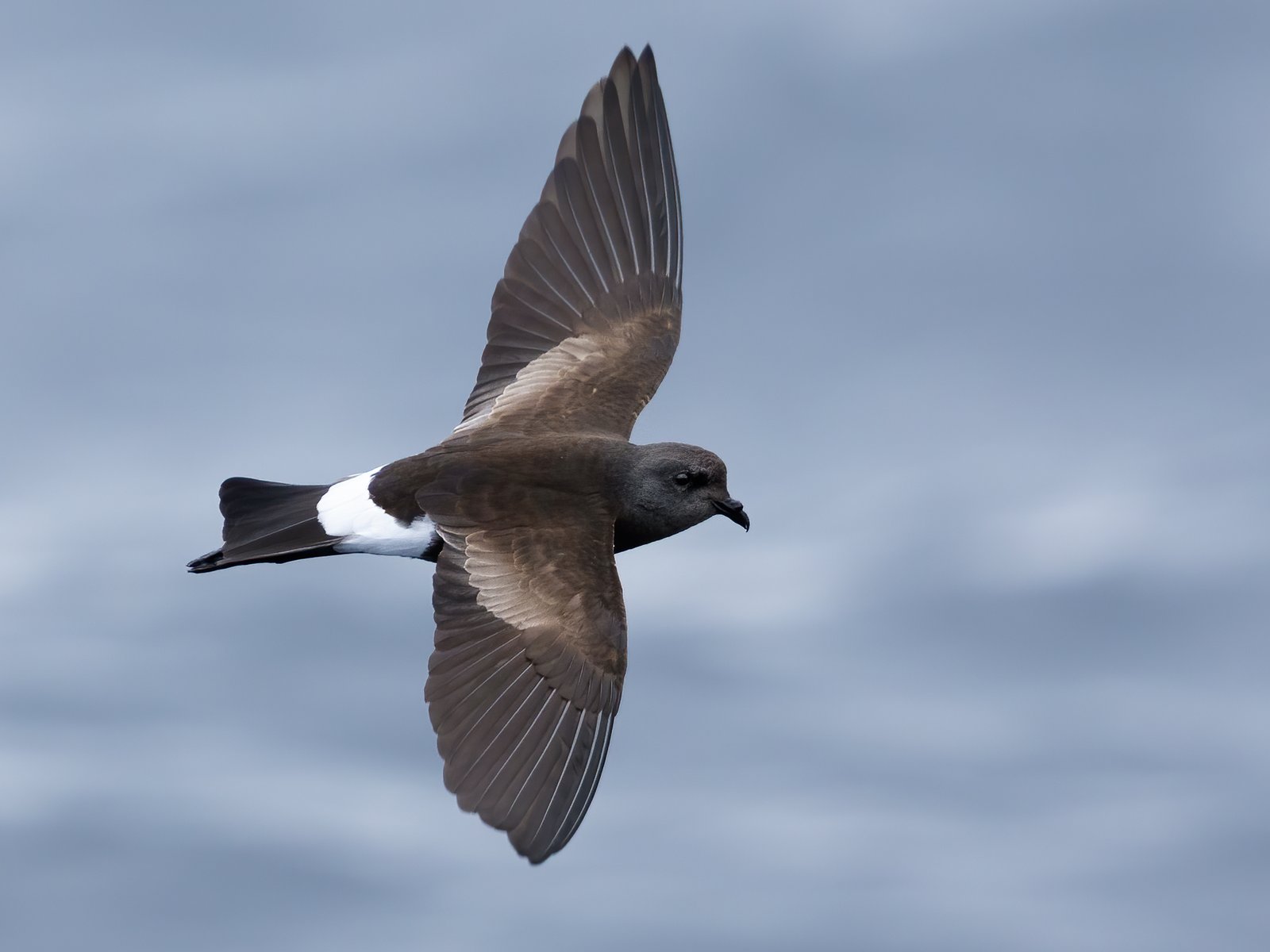
16–19 cm. A small, dark sooty-brown storm petrel with a broad, clean white rump band that wraps around onto the sides of the undertail coverts. On the upperwing a diffuse pale bar across the greater coverts. The wings are short and fairly broad, with a rather straight trailing edge; the tail is square. The long legs project beyond the tail tip in flight; the webs are yellow, though this is rarely visible in the field. The sexes are alike.
Confusion species
Leach's Storm Petrel Hydrobates leucorhous is slightly larger, with longer wings angled at the carpal, a forked tail, a more obvious pale wing bar, a rump often divided by a dark centre and legs not projecting beyond the tail; its flight is more erratic, with abrupt changes of direction. The rare Band-rumped Storm Petrel Hydrobates castro has a narrower rump band, longer wings, shorter legs and a stiffer, shearwater-like flight.
Habitat
Open ocean and waters over the continental shelf, sometimes closer inshore. It feeds by fluttering just above the water with wings raised and feet pattering on the surface, picking up plankton, small crustaceans and fish scraps. It readily follows boats and is attracted to chum.
Where the bird is most at home, classified by the vegetation types of the Caribbean.

Range and movements
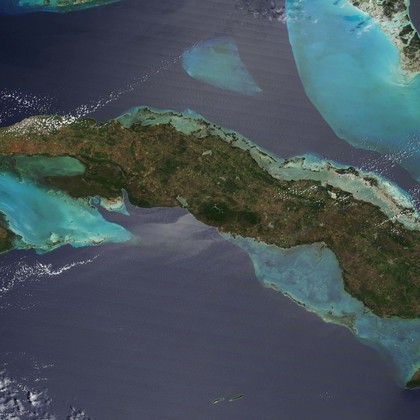
Passage migrant and summer visitor at sea throughout the region, with most records around Puerto Rico, Hispaniola, the Lesser Antilles and Trinidad and Tobago; scarcer around the Bahamas, Cuba and Jamaica. Outside the region it breeds on the coasts of Antarctica and on subantarctic islands, and outside the breeding season ranges over all oceans, in the Atlantic north to the coasts of North America and western Europe.
- Summer visitor (c. Oct–Mar)
- dark = core range, pale = thinly spread
How and when to look
The best chances are on pelagic trips and inter-island ferries in late spring and summer, especially where chum is used. Look for the pattering over the water and the feet projecting beyond the tail; the species is rarely seen from shore.
Conservation status
Not threatened. The world population is estimated at many millions of birds. At sea the birds are vulnerable to oil pollution and the ingestion of plastic.
Scientific name
Oceanites oceanicus | (Kuhl, 1820)
Kuhl described the species in 1820 as Procellaria oceanica; because it was later moved to another genus, the author and year stand in brackets. The genus Oceanites was introduced in 1840 by Keyserling & Blasius. Oceanites is Greek, Ōkeanitēs: an Oceanid, one of the sea nymphs held to be daughters of Oceanus and Tethys. oceanicus is Latin for 'of the ocean', after its life on the open sea. The specimen the first description was based on came from South Georgia.