All species › Tropicbirds › Tropicbirds › White-tailed Tropicbird
White-tailed Tropicbird | Phaethon lepturus
Witstaartkeerkringvogel | Rabijunco coliblanco
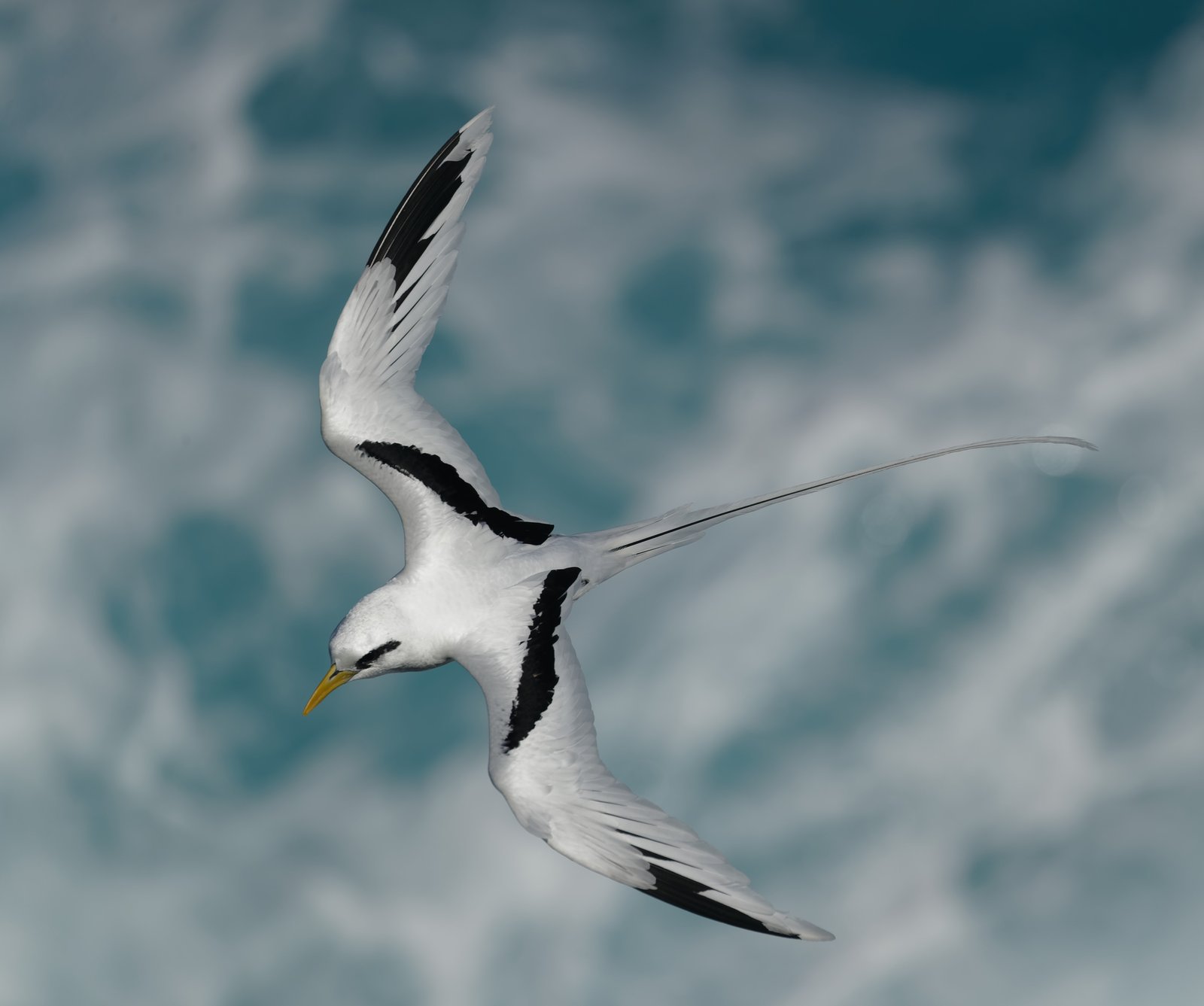
The White-tailed Tropicbird is the smallest tropicbird and the most widespread one in the Caribbean, breeding from the Bahamas to the Lesser Antilles. With its long white tail streamers and its high plunge-dives for fish and squid, it is a characteristic bird of rocky coasts. Caribbean birds, like those of Bermuda, belong to the subspecies catesbyi. On English-speaking islands it is called longtail or boatswain bird.
Voice
High screaming calls during display flights near the colony, such as keee-keee-krrt-krrt-krrt. Usually silent at sea.
Recording: VIBERT Laëtitia — CC BY-NC-SA 4.0 · converted to mono · xeno-canto
Identification
71–80 cm including the long central tail feathers, which make up about half the total length. Adults are white with a black eye-stripe, a broad black diagonal bar across the inner wing and black bases to the outer primaries. The back is unbarred. The bill is yellow to orange. Juveniles lack streamers and have a finely black-barred back, a greenish-yellow bill and no black nuchal collar.
Confusion species
Red-billed Tropicbird Phaethon aethereus is larger, with a red bill, a finely barred back and no diagonal wing bar; juveniles have a black nuchal collar and black tail tips. Terns such as Royal Tern Thalasseus maximus have a forked tail without streamers and a black cap.
Habitat
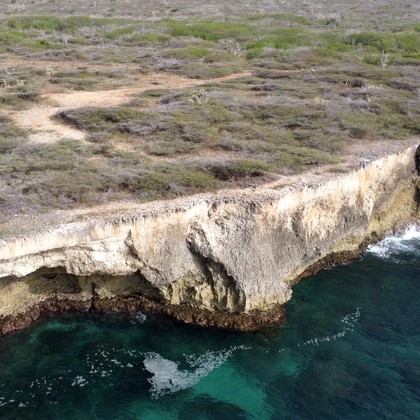
Breeds in crevices and holes in limestone cliffs and rocky coasts, on rocky islets and coral cays, sometimes in hollow trees or under boulders on small islands. Forages over open sea and deep inshore waters, plunge-diving for fish, especially flying fish, and squid.
Where the bird is most at home, classified by the vegetation types of the Caribbean.


Range and movements
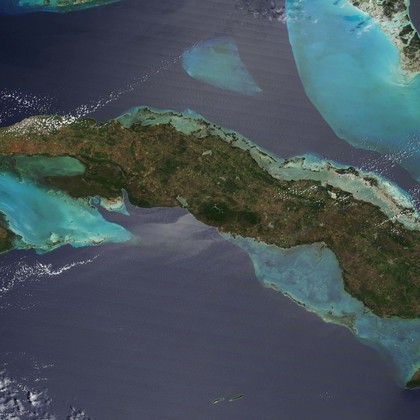
Breeds in the Bahamas, Cuba (locally, mainly on cays), the Cayman Islands, Jamaica, Hispaniola (Haiti and the Dominican Republic), Puerto Rico with Mona and Desecheo, the Virgin Islands and much of the Lesser Antilles; recently also a few pairs on Little Tobago. Rare around the ABC Islands and Trinidad. Outside the region in all tropical oceans, in the Atlantic including Bermuda.
- Resident
- Summer visitor (c. Oct–Mar)
- Winter visitor (c. Apr–Sep)
- Passage (Mar–Apr, Oct–Nov)
- dark = core range, pale = thinly spread
How and when to look
Likely along almost any steep rocky coast within the breeding range, for example in the Bahamas and on the cliffs of Puerto Rico and Cayman Brac. Near the breeding cliffs birds often fly back and forth in pairs with streamers trailing. At a distance the black diagonal wing bar is the best distinction from Red-billed Tropicbird.
Conservation status
Not threatened. On many islands introduced rats and cats, disturbance and the loss of nest sites to coastal development threaten the colonies.
Scientific name
Phaethon lepturus | Daudin, 1802
Daudin described the species in 1802 and placed it straight away in the genus where it still stands. The genus Phaethon was introduced in 1758 by Linnaeus. Phaethon goes back to the Greek phaethon 'sun, the shining one'. lepturus comes from the Greek leptos, 'slender', and oura, 'tail' — for the long, narrow central tail feathers. The specimen the first description was based on came from Mauritius.