All species › Waders, gulls and terns › Sandpipers and snipes › Willet
Willet | Tringa semipalmata
Willet | Playero aliblanco
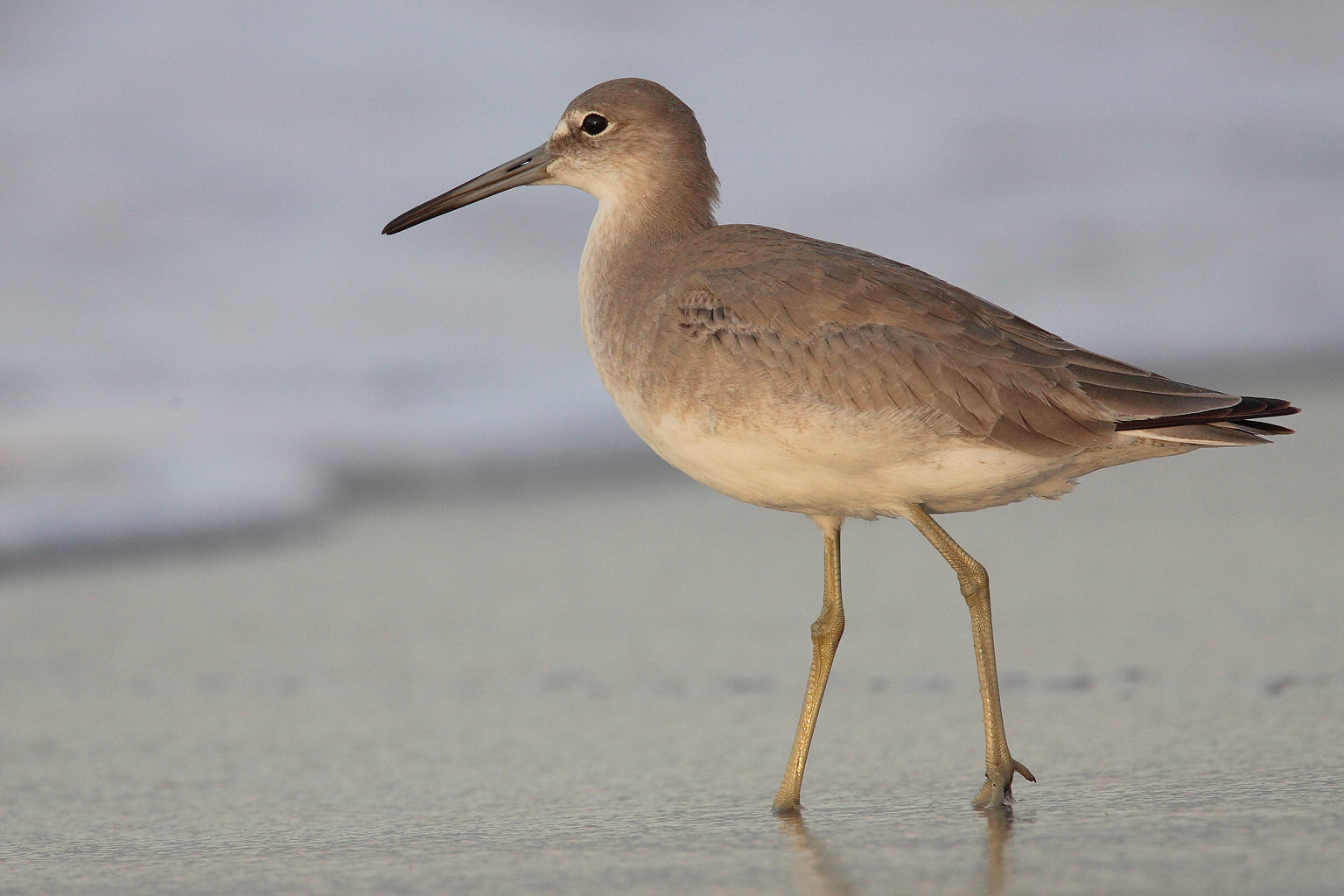
The Willet is a large, grey sandpiper of coasts, mangroves and lagoons, plain at rest but showing a distinctive black-and-white wing pattern in flight. Its name comes from its call. The eastern subspecies Tringa semipalmata semipalmata breeds along the Atlantic coast of North America and on the Caribbean islands; the western T. s. inornata breeds on the prairies. Both are regularly proposed as separate species, as they differ in range, behaviour, structure, voice and genetics.
Voice
In the breeding season a loud, rhythmic pill-will-willet, often in flight or from a post or mangrove branch. Also a clear klee-ee and, when disturbed, a rapid kip-kip-kip.
Recording: Ed Pandolfino — CC BY-NC-SA 4.0 · converted to mono · xeno-canto
Identification
33–41 cm, bulky, with a thick, straight, dark bill with a paler base and stout blue-grey legs. In non-breeding plumage plain pale grey above and white below, with a pale line between bill and eye and a white eye-ring. In breeding plumage brownish grey with dark barring and streaking on the head, neck, breast and flanks. In flight the upperwing shows a broad white band across the dark primaries and the underwing is black and white; the rump is white, the tail grey. Females are slightly larger than males.
Confusion species
Greater Yellowlegs Tringa melanoleuca has bright yellow legs, a thinner, often upturned bill, spotted upperparts and no wing pattern. Marbled Godwit Limosa fedoa is cinnamon-brown, with a long, two-toned, upturned bill. Hudsonian Whimbrel Numenius hudsonicus has a decurved bill and a striped head. In flight the Willet's wing pattern is unique in the region.
Habitat
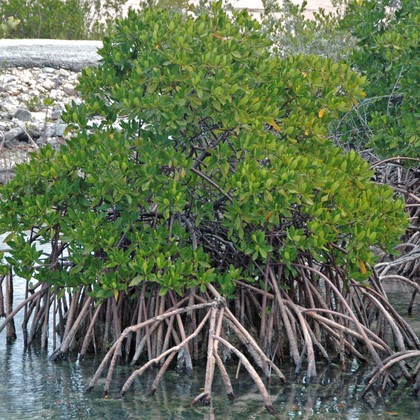
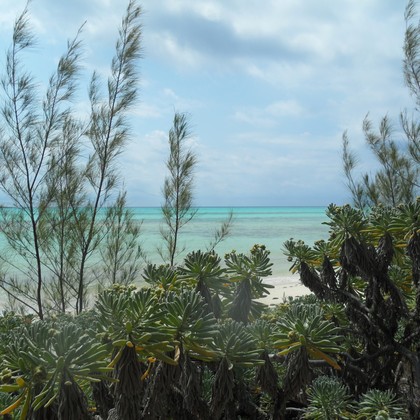
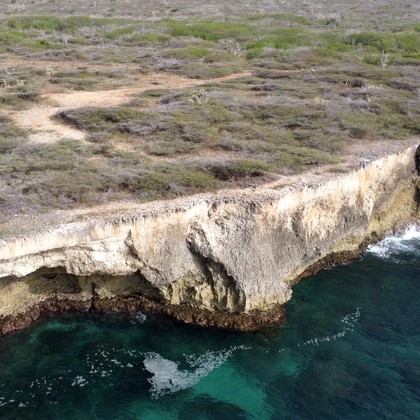
Tidal mudflats, mangrove edges, salt ponds, brackish lagoons, sandy beaches and rocky shores; seldom far from salt or brackish water. It feeds by walking and probing in mud and sand, mainly for crabs, worms and molluscs. The nest is a scrape in short grass or among low vegetation behind the shore, often in loose groups; parents with young are noisy and attack intruders.
Where the bird is most at home, classified by the vegetation types of the Caribbean.


Range and movements
Breeds in the Bahamas, the Turks and Caicos Islands, Cuba, Hispaniola and Puerto Rico, locally on the last; also breeding records in the Virgin Islands and a few other islands. In winter joined by birds from North America. Elsewhere, in the Cayman Islands, Jamaica, the Lesser Antilles, the ABC Islands, San Andrés and Trinidad and Tobago, mainly a winter visitor and passage migrant in varying numbers. Outside the region the eastern subspecies breeds from Newfoundland to the Gulf of Mexico and the western one in the interior of western North America; the species winters from the United States to northern Chile and southern Brazil.
- Resident
- Summer visitor (c. Oct–Mar)
- Winter visitor (c. Apr–Sep)
- Passage (Mar–Apr, Oct–Nov)
- dark = core range, pale = thinly spread
How and when to look
On tidal mudflats and along mangrove edges, where single birds feed spread out. In the breeding season, from April to July, loudly calling birds on posts and in mangroves give away the breeding sites; on take-off the wing pattern is recognisable at once.
Conservation status
Not threatened. Heavily hunted in the nineteenth century and lost from large parts of its breeding range, it has since recovered. Coastal development, disturbance of breeding sites and loss of mangroves and salt ponds are the main threats in the Caribbean.
Scientific name
Tringa semipalmata | (Gmelin, 1789)
Gmelin described the species in 1789 as Scolopax semipalmata; because it was later moved to another genus, the author and year stand in brackets. The genus Tringa was introduced in 1758 by Linnaeus. Tringa is the Neo-Latin name Aldrovandi gave to the green sandpiper, after Ancient Greek trungas, a thrush-sized, white-rumped, tail-bobbing wading bird mentioned by Aristotle. semipalmata is Latin, from semi 'half' and palmatus 'webbed', after the short webs between the toes. The specimen the first description was based on came from New York.