All species › Gamebirds › Pheasants and partridges › Wild Turkey
Wild Turkey | Meleagris gallopavo
Wilde kalkoen | Guajolote norteño
The Wild Turkey is the ancestor of the domestic turkey. It is not native to the Caribbean: the species comes from North America and Mexico, and the turkeys on the islands are domestic birds or their free-living descendants. Turkeys were brought to Hispaniola as early as the sixteenth century.
Voice
The male gives a rolling, gurgling gobble-obble-obble; also soft clucking and putting notes.
Recording: Stanislas Wroza — CC BY-NC-SA 4.0 · shortened to the first 60 s, mono · xeno-canto
Identification
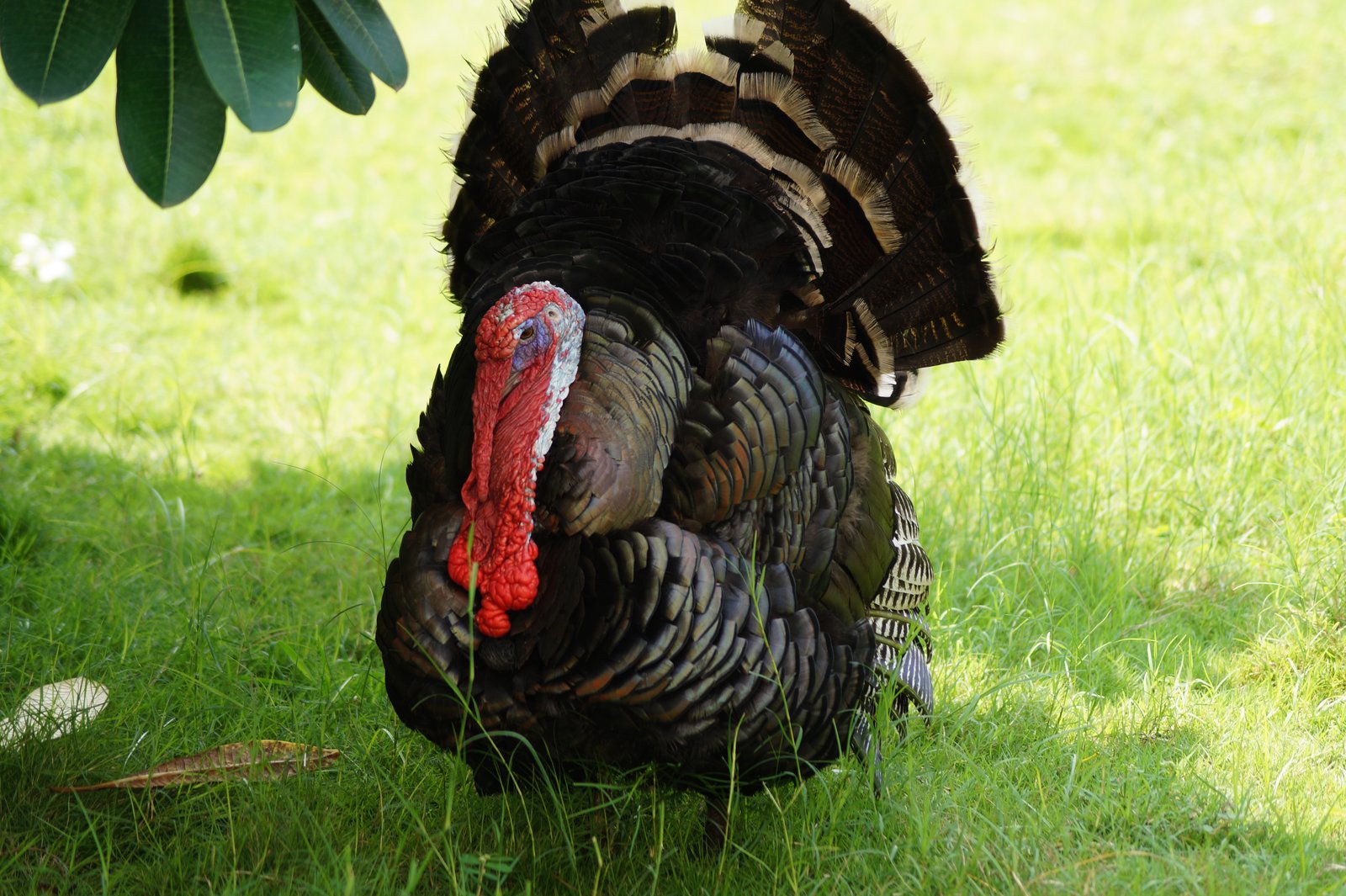
76–125 cm; the male is much larger than the female. Big and heavy, with a bare head and neck, blue and red in colour, a fleshy snood over the bill and wattles on the throat. The wild form is dark brown with a copper and bronze sheen; the male has a beard of hair-like feathers on the breast. Domestic and feral birds are often white, pied or dull dark. In display the male fans its tail.
Confusion species
Not to be confused with any other bird in the region. Indian Peafowl Pavo cristatus has a feathered head with a small crest and is blue, or brown with a green neck.
Habitat
In the region in farmyards, pasture and small-scale farmland near villages; free-ranging birds also visit forest edges. It eats seeds, fruit, insects and other small food and roosts in trees.
Where the bird is most at home, classified by the vegetation types of the Caribbean.


Range and movements
In the region mostly as a kept bird, roaming freely in farmyards, in Cuba, on Hispaniola and in Puerto Rico; most records come from Cuba. Whether self-sustaining feral populations exist anywhere in the region is not well known. Native to the eastern and central United States, southern Canada and Mexico; introduced elsewhere, including Hawaii and New Zealand.
- Resident
- dark = core range, pale = thinly spread
How and when to look
Turkeys in the region are almost always domestic or semi-domestic birds in farmyards and pasture. When one is recorded it is useful to note whether it lives free and breeds.
Conservation status
Not threatened globally. In the Caribbean an alien, occurring almost only as a domestic or feral farm bird.
Scientific name
Meleagris gallopavo | Linnaeus, 1758
Linnaeus described the species in 1758 and placed it straight away in the genus where it still stands. He introduced the genus Meleagris in that same work. Meleagris is the Greek word for 'guineafowl', transferred by Linnaeus to the turkey. gallopavo is Latin, from gallus 'cock' and pavo 'peafowl': 'cock-peacock'. The specimen the first description was based on came from Mexico.