All species › Gamebirds › Pheasants and partridges › Indian Peafowl
Indian Peafowl | Pavo cristatus
Blauwe pauw | Pavo real común
The Indian Peafowl is a large fowl from South Asia, the male of which carries a long train of covert feathers with eyespots. It is not native to the Caribbean: peafowl are kept as ornamental birds on many islands, and in some places they live semi-wild or feral, in parks, hotel grounds and estates.
Voice
A loud, plaintive, trumpeting may-awe, mainly at dusk and carrying far; also short, harsh alarm calls.
Recording: Uku Paal — CC BY-NC-SA 4.0 · converted to mono · xeno-canto
Identification
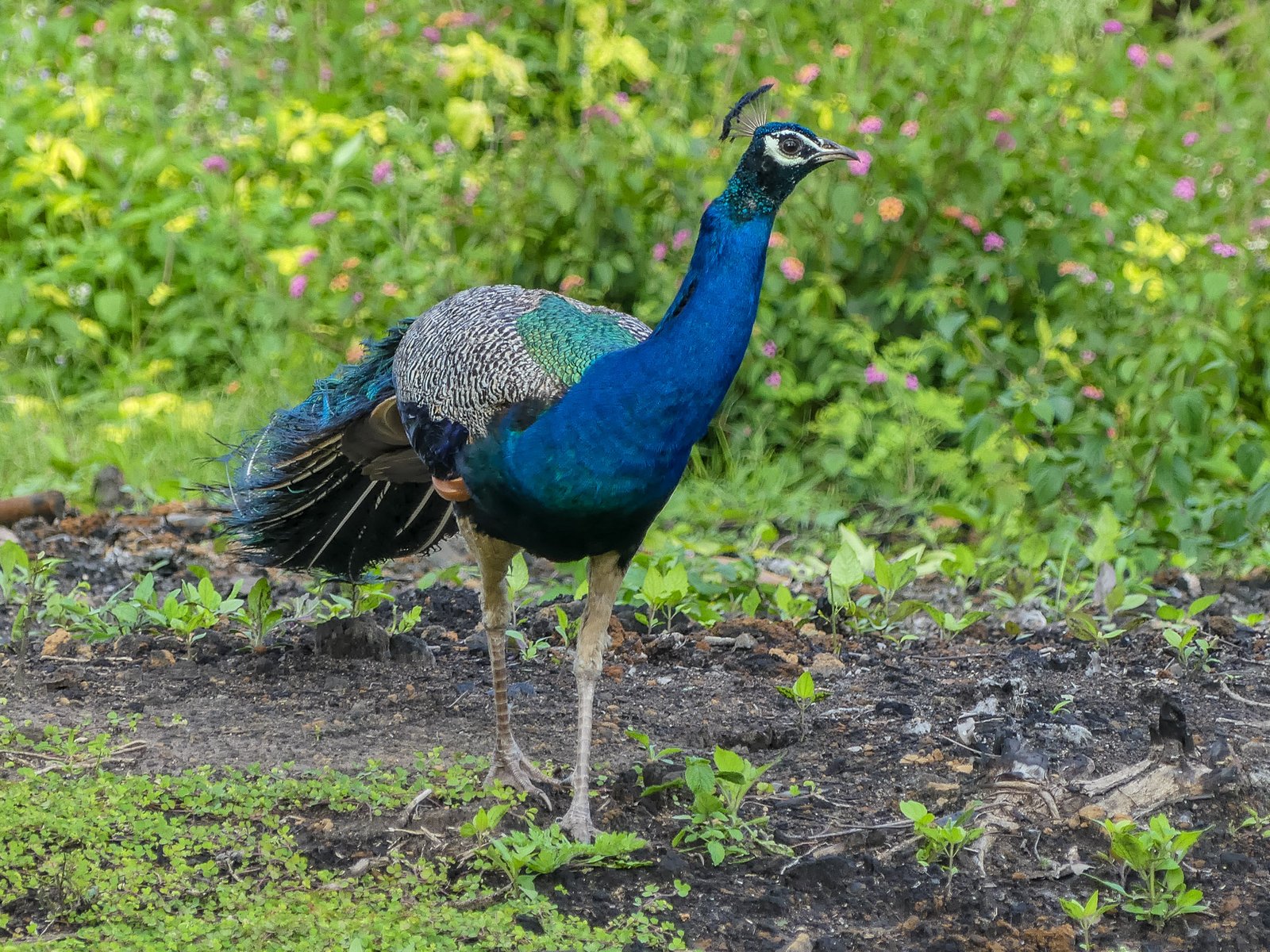
90–230 cm; the great length of the male is largely due to the train. The male is glossy blue on head, neck and breast, with a fan-shaped crest of spatula-tipped feathers; the back is scaled green and the primaries rufous. The train consists of greatly elongated uppertail coverts with green-and-bronze eyespots and is raised in a fan in display. The female is smaller and brown, with a green neck, a white belly and the same crest, without a train. White and pied domestic forms exist.
Confusion species
Not to be confused with any other bird in the region. At a distance females may recall a Wild Turkey Meleagris gallopavo or a chicken, but the crest and green neck are distinctive.
Habitat
Parks, gardens, hotel grounds and estates, farmyards and small-scale farmland with trees. It forages on the ground for seeds, fruit, insects and small animals and roosts high in trees.
Where the bird is most at home, classified by the vegetation types of the Caribbean.



Range and movements
Kept on many islands and locally semi-wild or feral, including Puerto Rico, St John and St Croix (US Virgin Islands), Cuba, the east of the Dominican Republic, the Bahamas and the Cayman Islands. Whether these are self-sustaining populations is mostly unclear place by place. Native to the Indian subcontinent and Sri Lanka.
- Resident
- dark = core range, pale = thinly spread
How and when to look
Peafowl give themselves away by their loud call, especially at sunrise and sunset. On some islands semi-wild groups can be seen in parks and hotel grounds.
Conservation status
Not threatened globally. In the Caribbean an alien, occurring mainly as a kept or semi-wild ornamental bird.
Scientific name
Pavo cristatus | Linnaeus, 1758
Linnaeus described the species in 1758 and placed it straight away in the genus where it still stands. He introduced the genus Pavo in that same work. Pavo is the Latin word for 'peafowl'. cristatus is Latin for 'crested', from crista 'crest', for the fan-shaped crest. The specimen the first description was based on came from India.