All species › Passerines › Hispaniolan tanagers › White-winged Warbler
White-winged Warbler | Xenoligea montana
Witvleugelzanger | Cigüita aliblanca
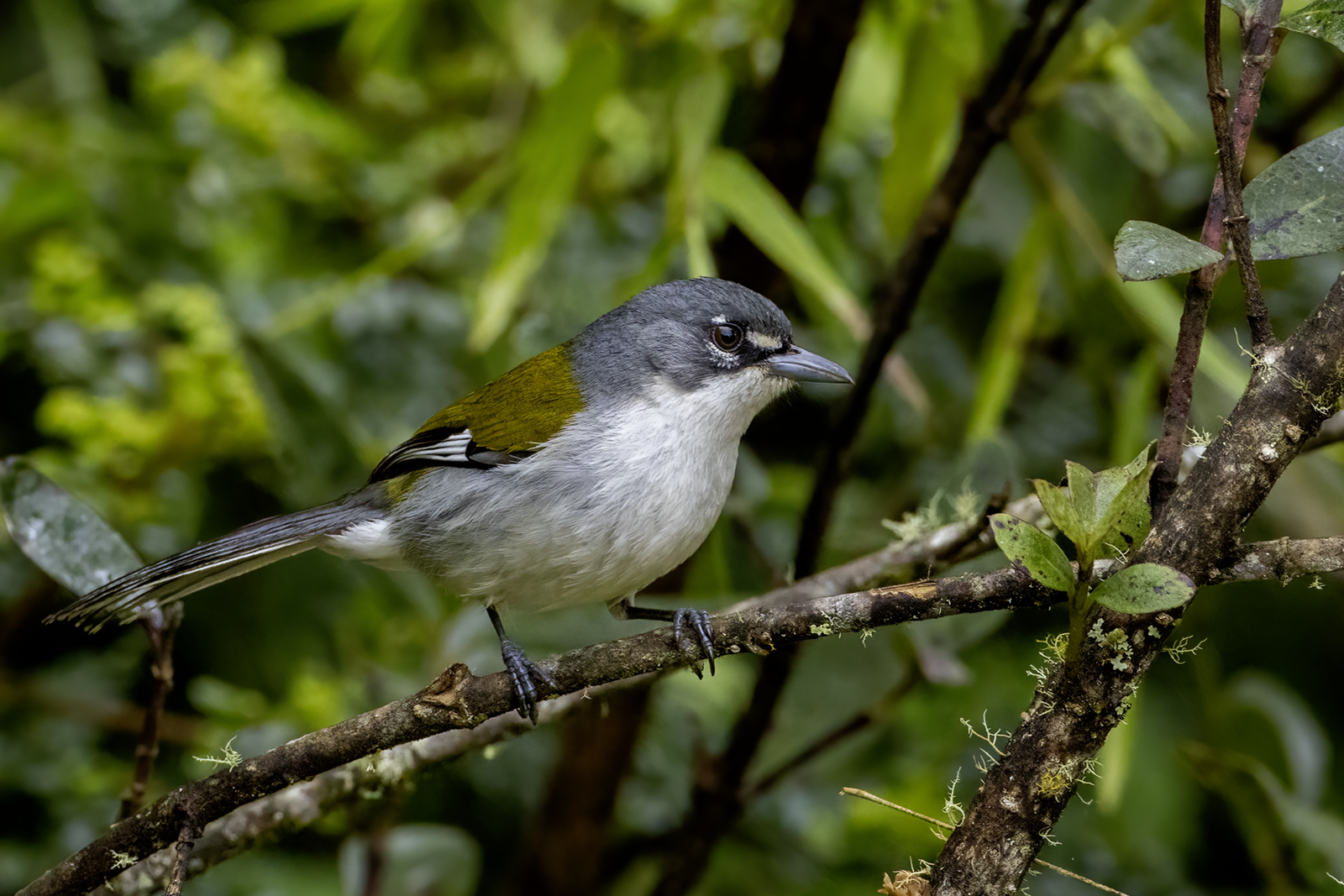
The White-winged Warbler is a small grey and olive-green mountain bird of Hispaniola. Despite its name it is not a wood-warbler: DNA studies place it with Green-tailed Warbler and the two palm-tanagers in the family Phaenicophilidae, a small group found only in Hispaniola. In the Dominican Republic it is called cigüita aliblanca.
Voice
The song is a series of high, squeaky notes that accelerate at the end. There are also low call notes and a chattering, mainly in mixed flocks.
Recording: Ross Gallardy — CC BY-NC-SA 4.0 · converted to mono · xeno-canto
Identification
13–14 cm, slim, with a fairly long tail and a fine bill. Head and neck are grey, with a short white supercilium above black lores and white arcs above and below the eye. Back and rump are olive-green, the wings dark grey with a white patch at the base of the primaries that is also obvious at rest. The tail is dark grey with white tips to the outer feathers. The underparts are white, washed grey on the breast and flanks. The sexes are alike; juveniles are browner in tone.
Confusion species
Green-tailed Warbler Microligea palustris shares the montane forest and is very similar, but lacks the white wing patch and white supercilium, has a red iris and a longer tail, and usually forages lower in the understorey. Pine Warbler Setophaga pinus of the pine forest has two white wing bars and a yellowish breast. Black-crowned Palm-tanager Phaenicophilus palmarum is much larger, with a black crown and no wing patch.
Habitat
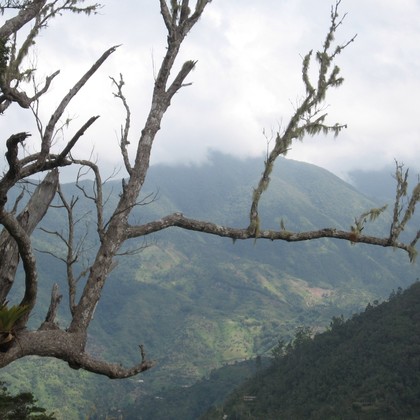
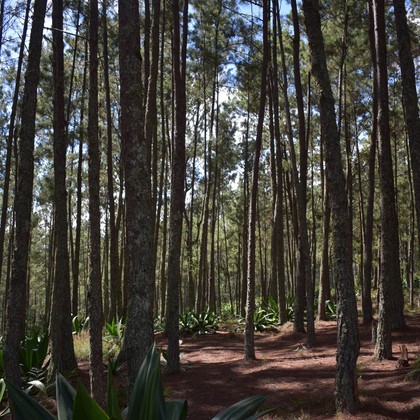
Montane forest with dense understorey: humid broadleaf forest, mixed pine and broadleaf forest, limestone forest and older secondary forest, especially along edges, clearings and in thickets. Mostly above 1,200 m, with the highest densities between 1,300 and 1,800 m; occasionally lower. It gleans insects in the middle level of the vegetation, higher than Green-tailed Warbler, and often joins mixed flocks.
Where the bird is most at home, classified by the vegetation types of the Caribbean.



Range and movements
Only in Hispaniola. In the Dominican Republic in the Cordillera Central, Sierra de Neiba and Sierra de Bahoruco. In Haiti in the Massif de la Hotte; in the Massif de la Selle it is rare and possibly gone from La Visite National Park. The species does not occur outside Hispaniola.
- Resident
- dark = core range, pale = thinly spread
How and when to look
The higher parts of the Sierra de Bahoruco and the Cordillera Central, early in the morning. Mixed flocks with Green-tailed Warblers are the best lead; the white wing patch and supercilium pick out the White-winged Warbler among them, although it is usually far less numerous.
Conservation status
Vulnerable. The world population is estimated at 1,500 to 7,000 mature birds, split between separate mountain ranges, and is declining. The main threat is forest clearance for farming, logging and charcoal, especially in Haiti; predation by the introduced mongoose may also play a part.
Scientific name
Xenoligea montana | (Chapman, 1917)
Chapman described the species in 1917 as Microligea montana; because it was later moved to another genus, the author and year stand in brackets. The genus Xenoligea was introduced in 1967 by Bond. Xenoligea combines the Greek xenos 'strange' with Ligea, the old name of the related genus Microligea: 'strange Ligea'. montana is Latin for 'of the mountains', after the montane forests of Hispaniola where the species lives. The specimen the first description was based on came from Loma Tina (Azua), Dominican Republic.