All species › Passerines › Typical antbirds › White-flanked Antwren
White-flanked Antwren | Myrmotherula axillaris
Witflankmiersluiper | Hormiguerito flanquiblanco
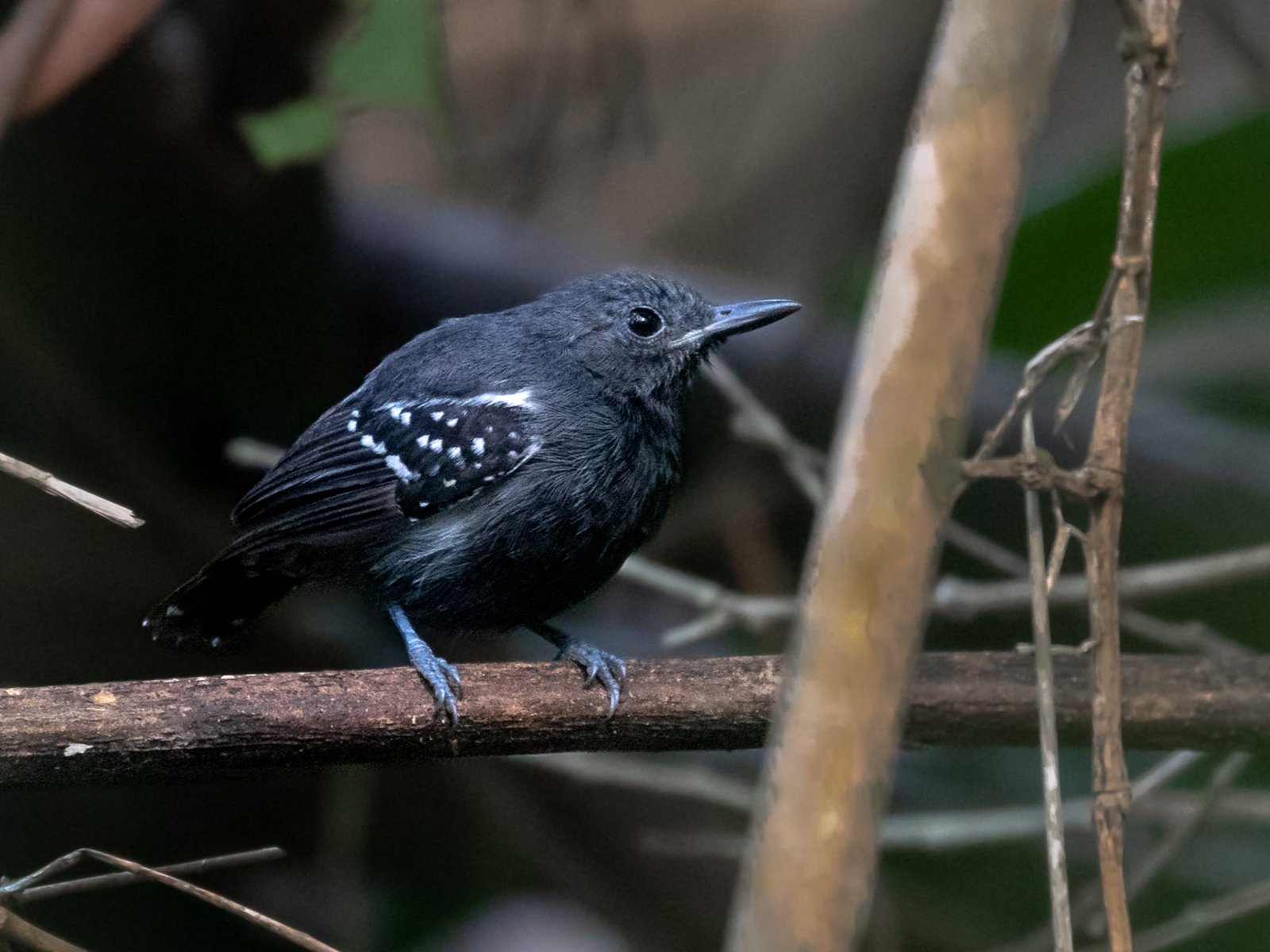
The White-flanked Antwren is one of the smallest antbirds (Thamnophilidae), a family represented in the region only in Trinidad and Tobago. It moves restlessly through the lower and middle storeys of the forest, constantly flicking its wings and so exposing its white flank plumes. It often travels with mixed flocks of small insectivores.
Voice
The song is a series of clear, evenly spaced whistled notes; calls are short sharp notes and a dry rattle. In mixed flocks the species is often heard before it is seen.
Recording: Juan Freile — CC BY-NC-SA 4.0 · shortened to the first 60 s, mono · xeno-canto
Identification
9–10 cm, small and short-tailed, with a thin black bill. The male is dark slate grey with a black throat and breast; long, silky white flank feathers contrast with the black. The wing-coverts are tipped white, forming two or three rows of spots, and the short black tail is tipped white. A white patch between the shoulders is usually hidden. The female is olive-brown above, washed rufous on the rump, with buff edges to the wing feathers and buff underparts; she also has white flanks.
Confusion species
Plain Antvireo Dysithamnus mentalis is larger and bigger-headed, with a heavier bill and no white flanks. Northern White-fringed Antwren Formicivora intermedia lives in Tobago, not Trinidad, and has a white stripe from the eyebrow to the flanks. The female suggests a small buffy warbler, but the white flanks and wing spots are distinctive.
Habitat
The lower and middle storeys of humid evergreen forest and older secondary forest, also shaded cacao at the forest edge, from sea level into the hills. It forages 2 to 12 metres up for small insects and spiders picked from leaves and thin twigs, often among dead curled leaves.
Where the bird is most at home, classified by the vegetation types of the Caribbean.




Range and movements
In Trinidad a resident of the forested parts of the island, especially the Northern Range; absent from Tobago and unknown elsewhere in the region. Outside the region from Honduras through Central America to Amazonia and the Atlantic coast of Brazil.
- Resident
- dark = core range, pale = thinly spread
How and when to look
Best looked for along forest trails in the Northern Range, for example at the Asa Wright Nature Centre, by following a mixed flock. The constant wing-flicking and flashes of white on the flanks attract attention.
Conservation status
Not threatened. The species has a very large range and tolerates older secondary forest, but in Trinidad it depends on the survival of forest.
Scientific name
Myrmotherula axillaris | (Vieillot, 1817)
Vieillot described the species in 1817 as Myrmothera axillaris; because it was later moved to another genus, the author and year stand in brackets. The genus Myrmotherula was introduced in 1858 by Sclater. Myrmotherula is a diminutive of Myrmothera, Greek for 'ant-hunter' (murmos 'ant', -thēras 'hunter'): 'little ant-hunter'. axillaris is Latin, from axilla 'armpit', after the white flank feathers under the wing. The specimen the first description was based on came from Cayenne, French Guiana.