All species › Passerines › Typical antbirds › Northern White-fringed Antwren
Northern White-fringed Antwren | Formicivora intermedia
Noordelijke witbandmiersluiper | Hormiguerito coicorita norteño
The Northern White-fringed Antwren is a small antbird of dry forest and scrub, found in the region in Tobago and not on mainland Trinidad. It was formerly lumped with Southern White-fringed Antwren Formicivora grisea and split on the basis of song differences; not all classifications follow the split. Tobago has its own subspecies.
Voice
A soft chup, repeated up to about 25 times, and a mellow overslurred whistle followed by a fast, flat trill. Both sexes sing, usually hidden in foliage, from before dawn through the morning.
Recording: Brian Cox — CC BY-NC-SA 4.0 · converted to mono · xeno-canto
Identification
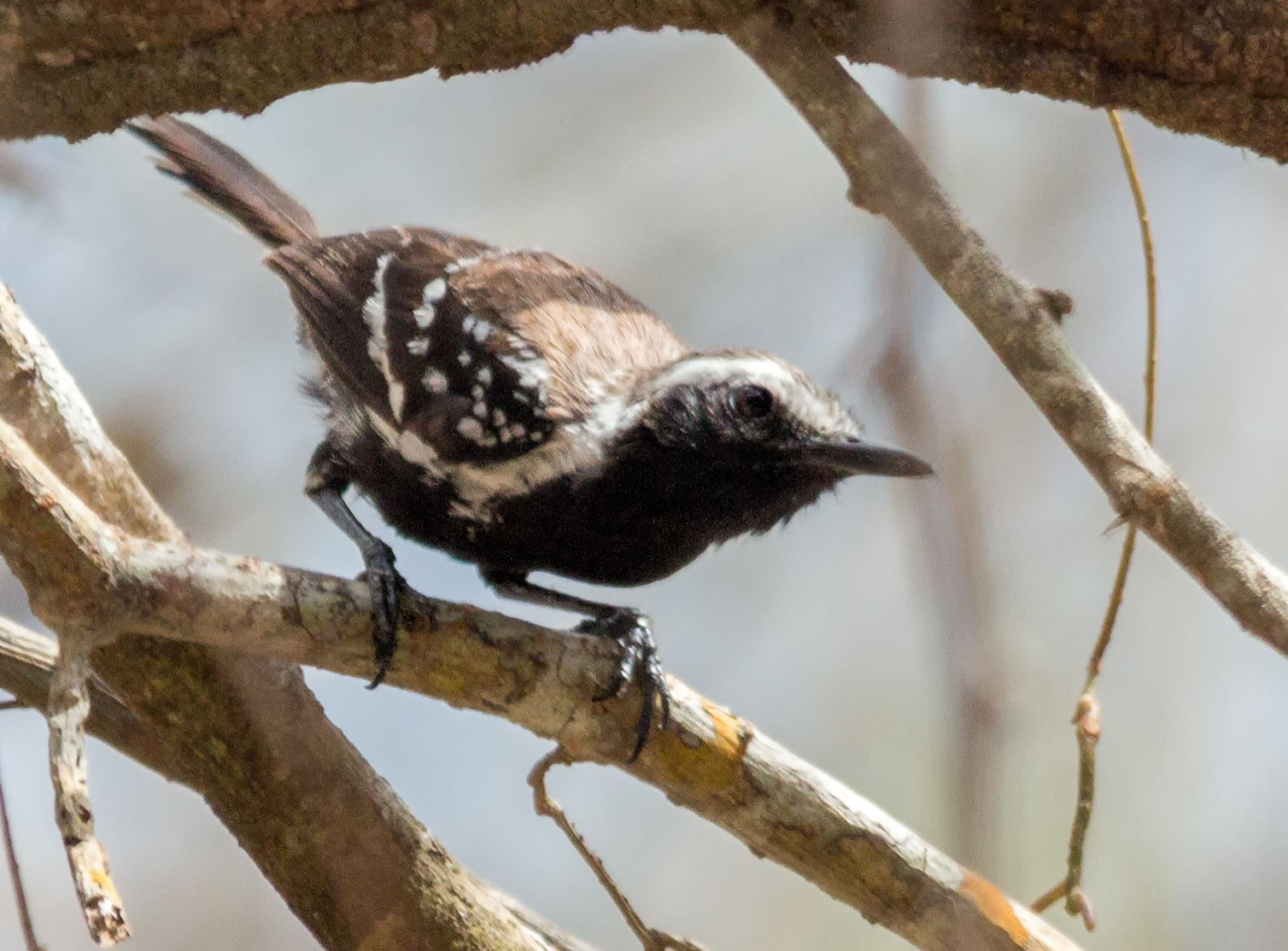
12–13 cm, slender, with a fairly long tail. The male is smoky brown above; face, throat and underparts are black. A white stripe runs from above the eye down the side of the neck and breast to the flanks, where it widens. The wings are black with a bold white wing bar and white spots on the coverts, and the black tail is tipped white. The female shares the brown upperparts and wing pattern, but has a greyish face and dull white to buff underparts with variable dusky streaks on the breast.
Confusion species
No other antwren occurs in Tobago. Barred Antshrike Thamnophilus doliatus is larger, crested and heavy-billed, and either barred all over (male) or rufous (female). Plain Antvireo Dysithamnus mentalis is stockier, with a grey or rufous crown and no white flank stripe.
Habitat
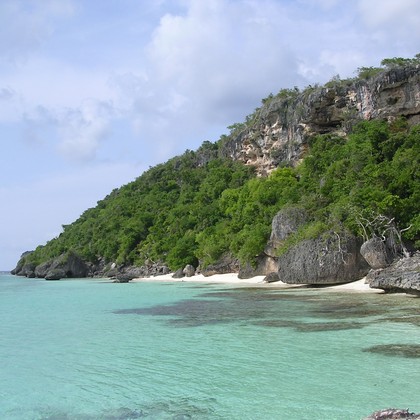
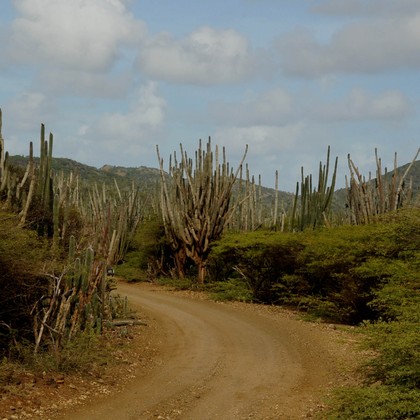
The lower and middle storeys at the edges of dry deciduous forest, coastal woodland, thorn scrub and mangrove. It forages in pairs in dense growth and vine tangles for insects and spiders, often moving its tail.
Where the bird is most at home, classified by the vegetation types of the Caribbean.



Range and movements
In Tobago a resident of the lowlands. Also reported from Chacachacare, an islet off the north-western tip of Trinidad; absent from Trinidad itself. Outside the region in northern Colombia and Venezuela, on Isla Margarita and on the Pearl Islands of Panama.
- Resident
- dark = core range, pale = thinly spread
How and when to look
In Tobago in dry woodland and scrub along forest edges in the lowlands, where pairs call from dense growth. The repeated chup is the best lead.
Conservation status
Not threatened. The species has a fairly large range and tolerates secondary growth. The Tobago population is small in extent, but no acute threats are known.
Scientific name
Formicivora intermedia | Cabanis, 1847
Cabanis described the species in 1847 and placed it straight away in the genus where it still stands. The genus Formicivora was introduced in 1824 by Swainson. Formicivora is Latin, from formica 'ant' and -vorus '-eating': 'ant-eating'. intermedia is Latin for 'intermediate', after features between those of related forms. The specimen the first description was based on came from Aragua, Venezuela.