All species › Parrots › Parrots › White-eyed Parakeet
White-eyed Parakeet | Psittacara leucophthalmus
Witoogparkiet | Aratinga ojiblanca
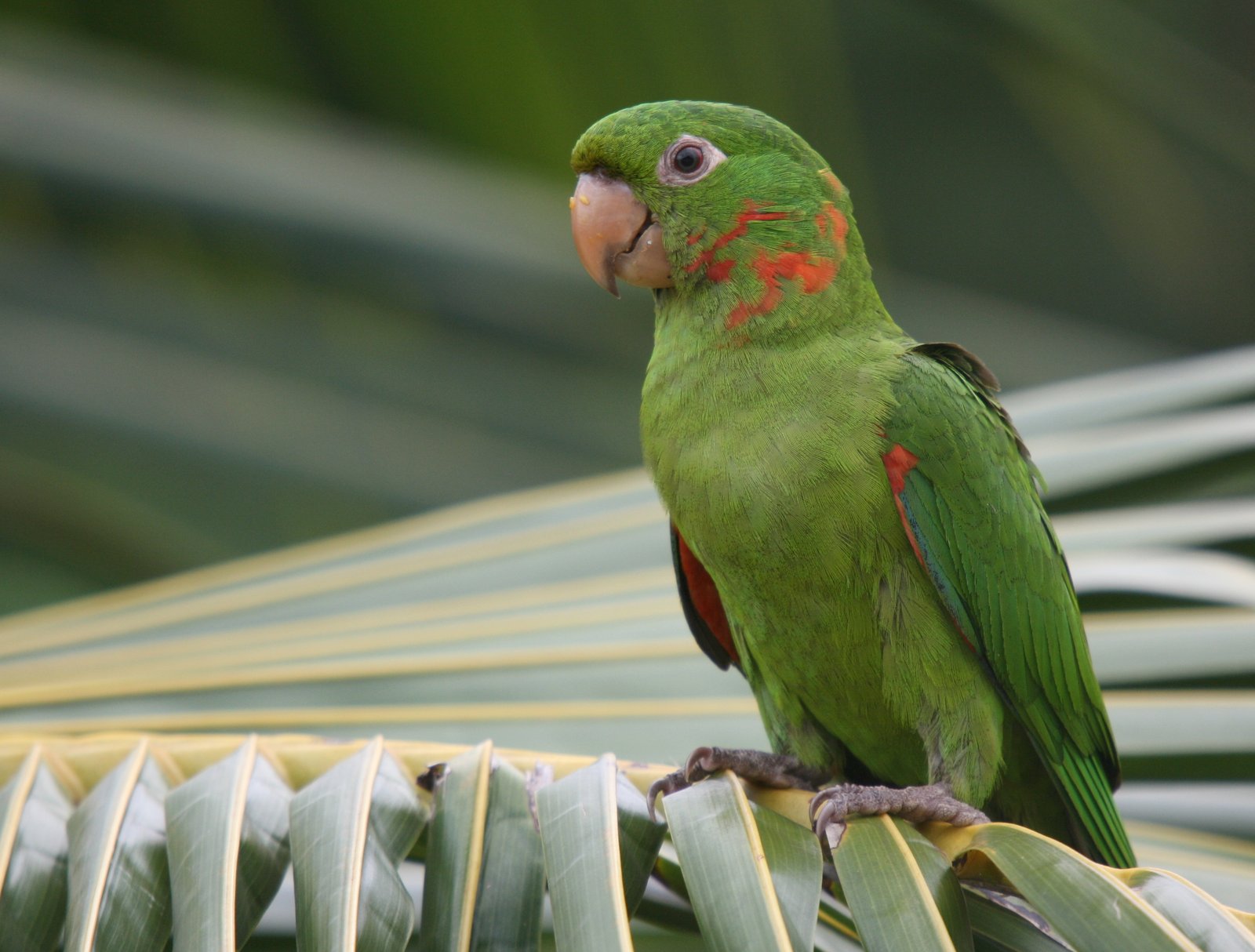
The White-eyed Parakeet is a large green conure of the South American lowlands, with a long pointed tail, a ring of bare white skin around the eye and red and yellow patches under the wing. It is widely kept in captivity. In the Caribbean it is known only in small numbers from Trinidad and Curaçao; the Trinidad birds may be escapes, but could also be wanderers from the nearby Venezuelan mainland.
Voice
Noisy in flight: a grating chatter mixed with higher, rasping cries such as kreek-kreek. Perched flocks give sharp, squeaky notes.
Recording: Jacob Wijpkema — CC BY-NC-SA 4.0 · converted to mono · xeno-canto
Identification
32–35 cm, with a long pointed tail. Green, slightly yellower below. Scattered red feathers mark the head and neck, barely visible in some birds and extensive in others. The bend and leading edge of the wing are red. In flight the red outer lesser coverts and yellow outer greater coverts stand out on the underwing; flight feathers and the underside of the tail are olive-yellow. The bare eye-ring is white to yellowish white, the iris orange and the bill horn-coloured. The sexes are alike. Juveniles show little or no red on head and wing.
Confusion species
On Curaçao Blue-crowned Parakeet Thectocercus acuticaudatus is the same size but has a dull blue head and no red and yellow under the wing; Scarlet-fronted Parakeet Psittacara wagleri has a solid red forehead and a green underwing. Brown-throated Parakeet Eupsittula pertinax is much smaller, with a yellowish-brown face and olive-brown breast. On Trinidad Orange-winged Amazon Amazona amazonica and other amazons are stockier, with a short tail; Green-rumped Parrotlet Forpus passerinus is far smaller.
Habitat
On Trinidad town parks, gardens and suburbs with tall trees, mainly in Port of Spain and San Fernando, and a few forested areas inland. On Curaçao golf courses, hotel grounds, the area around the Klein Hofje sewage works and the mangroves at Piscadera Bay, often together with Blue-crowned Parakeets. In its native range forest edge, gallery and secondary forest, palm groves, savanna and mangroves, mostly in the lowlands. It eats seeds, fruit and flowers. It nests in tree holes.
Where the bird is most at home, classified by the vegetation types of the Caribbean.



Range and movements
Trinidad: small numbers since the 2010s, mainly in Port of Spain (including the Royal Botanic Gardens) and around San Fernando, with scattered records elsewhere on the island; the birds are regarded as rare and their origin is uncertain. Curaçao: a small group since about 2017, mainly at Blue Bay, Klein Hofje and Piscadera Bay, probably derived from escapes. No records known from other islands. Native across much of tropical South America east of the Andes, from Venezuela and the Guianas to northern Argentina and Uruguay.
- Resident
- dark = core range, pale = thinly spread
How and when to look
On Trinidad in the Royal Botanic Gardens and along Belmont Circular Road in Port of Spain, on Curaçao in the grounds of Blue Bay. A flock passing overhead is identified by the red and yellow underwing patches; perched birds show the white eye-ring and the scattered red feathers on the head.
Conservation status
Not threatened globally, although it is declining locally through trapping for the trade and habitat loss. In the Caribbean a rare alien or possible vagrant; whether the birds on Trinidad and Curaçao breed on their own is unknown.
Scientific name
Psittacara leucophthalmus | (Müller, 1776) (GBIF: Aratinga leucophthalma)
Müller described the species in 1776 as Psittacus leucophthalmus; because it was later moved to another genus, the author and year stand in brackets. The genus Psittacara was introduced in 1825 by Vigors. Psittacara joins Greek psittakos 'parrot', Latin psittacus, with the genus name Ara, the macaws. leucophthalmus is Greek for 'white-eyed', from leukos 'white' and ophthalmos 'eye', after the bare white eye-ring. The specimen the first description was based on came from the Guianas.